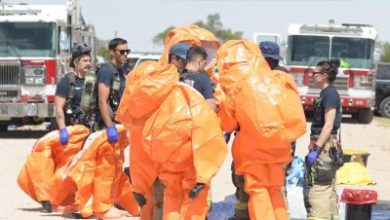
Reserve helicopters for emergencies, asks Nepal’s disaster agencypublished at 08:48 BST
 Image source, Reuters
Nepal’s disaster agency is requesting that helicopters only be used for search and rescue materials, amid the country’s widescale rescue effort.
“Helicopters should be used only for transportation of urgent search, rescue and relief materials,” the National Disaster Risk Reduction and Management Authority writes in an update on social media.
Large parts of the affected disaster zone have only been reachable by helicopter, with access roads wiped out by the flash floods.
However, the agency says that “alternative roadways” are now opening up and should be used where possible.
This village was thriving before the flood – now barren land surrounds a lone buildingpublished at 08:21 BST
 Azadeh Moshiri
Reporting from Nepal

I’m standing next to a group of villagers in Sanu Bharkhu, staring over the Bhote Koshi river, which flows from Tibet to Nepal. The roads to this area have only recently been cleared, and it’s the first chance we’ve had to witness first-hand the devastation.
The sight beneath us is shocking to the people here. A lone building is surrounded by barren land. Yet they tell me that was a thriving village before the flood.
A small entrance to the Chilime Hydropower tunnel can also be seen. Eight of their workers are unaccounted for and they believe six are still trapped inside the tunnel.
One man whose home looks over the river tells me his parents live in Kathmandu and are safe, but that several of his family members are missing. He doesn’t believe they’ve survived.
The chances of reaching anybody else alive in Tibet are getting smallerpublished at 08:02 BST
 Stephen McDonell
China correspondent
On the Tibetan side of the border, we’re in day six of this emergency.
Rescue teams haven’t found any survivors since the end of last week so the chances of reaching anybody else alive are getting smaller and smaller.
And yet the teams are still trying.
We’re seeing footage of emergency teams using ropes, repelling down the sides of collapsed mountains, crawling through mud, calling out people’s names, even though they’re not finding anyone according to officials up there.
Police, though, say that what they are now doing is targeting social media accounts here which they deem have exaggerated the extent of the emergency, especially people who are speaking about a much higher death toll.
And yet, with nearly 550 people listed as missing, you’d have to think that the real death toll in Tibet is much much higher than the official numbers would suggest.
Aid flowing into Nuwakotpublished at 07:42 BST
Ashok Dahal and Kamal Pariya
BBC Nepali, reporting from Nuwakot district
We’re at a military training school in Nuwakot that has been transformed into a search and rescue and relief hub.
On the journey here, we passed ambulances and aid trucks heading towards Nuwakot, while at the site, helicopters continue to bring in emergency supplies and medicines.
These images show aid being unloaded and sorted for distribution, alongside a temporary medical facility where injured people are still receiving treatment.
The fact that relief operations remain this intensive nearly a week on underlines the scale of the challenge facing communities here, and the difficult conditions responders are continuing to confront on the ground.


In pictures: Army personnel organise relief while families mourn loved onespublished at 07:19 BST
Families are mourning the deaths of their loved ones, while rescue and relief efforts for those affected by Wednesday’s deadly flash floods are continuing.
Here are some of the latest pictures:
 Image source, reuters
Armed Police Force (APF) and army personnel organise relief material at Maithili Barrack army training centre in Trishuli, Nepal
 Image source, Reuters
Army rangers wait to load relief materials onto a helicopter
 Image source, Reuters
Muna Khadka, mother of a 21-year-old, Aayush Khadka, who died during the flash floods, mourns near a cremation ground
Total number missing in Nepal jumps to 4,247published at 06:58 BST
 Image source, Reuters
Members of the Nepali army search for bodies in the Narayani river
As we just reported, the number of people missing in Nepal has risen sharply as rescue efforts enter a sixth day.
It now stands at 4,247, according to the country’s National Disaster Risk Reduction and Management Authority – up from Sunday’s figure of 2,502.
Here’s a breakdown of who’s included:
- 3,655 Nepali citizens
- 592 foreigners
Among those missing figures are:
- 933 hydropower workers
- 102 Nepali soldiers, police and customs officers
Scores of bodies are being found each day, and Nepal’s confirmed death toll has now risen to 903 people, up from 781 on Sunday.
In Tibet, the death toll currently stands at 16, according to Chinese state media, with 546 missing.
At least 275 Indians remain missing in Nepalpublished at 06:05 BST
Nikita Yadav
BBC News, Delhi
At least 275 Indian nationals still remain missing in Nepal, India’s foreign ministry has said. Another 128 people of Indian origin are also missing.
The ministry said 403 Indian nationals had crossed into Nepal from China, while another 500 were safe in China. A total of 149 people have been rescued till now.
India has also stepped up support for rescue operations in Nepal. A 19-member specialised forensic team has begun work in Kathmandu, helping analyse DNA samples and identify victims.
Meanwhile, an Indian tunnel rescue team is working with the Nepali Army at hydropower sites in Chilime and Langtang.
Death toll rises to 903published at 05:52 BST Breaking
The death toll in Nepal has now risen to 903, according to Nepal’s national disaster authority, while the number missing is now more than 4,200.
New barrier lake ‘basically cleared’ but China warns of continual rainpublished at 05:34 BST
 Image source, Getty Images
In an update on Monday, Chinese state media say the barrier lake which formed on Saturday evening has “naturally drained and is basically cleared”, but that Gyirong will continue to experience “continuous rainfall” through Tuesday.
A thick layer of silt, exceeding 1m in depth, has blanketed some of the worst-hit areas in Gyirong, which makes it very easy for people to get trapped, according to China Central Television.
Search and rescue operations have continued at the border crossing, with 117 firefighters and 13 rescue dogs deployed to help with the search. Two rounds of search have concluded so far, the state broadcaster reported.

Rescuers and residents rely on generators in one of the worst-hit townspublished at 05:24 BST
Azadeh Moshiri
Reporting from Dhunche
Rasuwa is one of the worst-hit areas, and here in the town of Dhunche, residents are living with only pockets of electricity, and relying on generators.
The roads from the capital Kathmandu to Rasuwa have only recently opened up, but they’re narrow, winding roads up the mountains of northern Nepal, and caked in mud, making it difficult for aid to arrive.
Every few minutes we can still hear helicopters pass from up above, as rescue efforts continue.
Nearby villages were swallowed by flood water, leaving many people displaced and living in camps. One man told us, anyone you speak to here will know dozens of people who have died.
Burials continue in Chitwan for hundreds of unidentified victimspublished at 05:07 BST
 Image source, Getty
Authorities in Chitwan, a district downstream from where the floods first hit last Wednesday, have resumed the burials of unidentified victims whose bodies have washed ashore.
Officials are collecting DNA samples from these remains, to be matched with the DNA of the family members later on, to identify those deceased.
Nearly 200 of the 272 bodies were buried on Sunday and officials say they hope to complete the burial of the remaining bodies today.
Chitwan authorities earlier said that many of the bodies have washed up in a condition that makes identifying them extremely challenging. Each burial would be properly documented, Nepali police say, with serial numbers marked at the burial spot, along with DNA samples, post-mortem and autopsy reports, and any available identification detail.
At least 43 Australians missingpublished at 04:21 BST
 Simon Atkinson
Australia reporter
Each
day the official number of Australians unaccounted for in the disaster has
risen slightly. Today the government said it now understood that 43 Australians
were missing.
“We haven’t given up hope that we can rescue those Australians safe and
well,” Assistant Foreign Minister Matt Thistlewaite told the
ABC.
“We’re doing everything we can, working around the clock to try and locate
those missing Australians.”
One of those who was initially listed as missing, Cara Severino, hiked to
safety and was picked up by consular officials over the weekend.
In a statement yesterday, her parents said: “We are so grateful to her
Nepalese hiking partners who saw her through a harrowing several days of hiking
in very difficult terrain, so thankful that they have all made it to safety.”
Loved ones distressed with ‘frustratingly low’ rescue operationspublished at 03:55 BST
 Image source, Reuters
A woman whose husband is believed to be trapped inside a hydropower tunnel in Nepal’s Trishuli-3A site when the catastrophic flood broke out last Wednesday is stil holding out hope that he is alive.
“I still have a 50% hope that he is alive because there is an oxygen system inside,” Sita Pandey told Nepali newspaper Kantipur.
“But with every hour that passes, that hope becomes thinner.”
At least 897 people associated with hydropower projects, including Pandey’s husband Jiblal Adhikari, are still unaccounted for, according to the Nepal Electricity Authority and the Independent Power Producers’ Association.
Delays with the rescue operations have frustrated their loved ones – rescuers began pumping air into the tunnel over the weekend, but some families say that should have been done earlier.
“The longer it takes, the more our hope dies. This operation must move much faster because every second is meaningful to us,” Jiban Khadka, whose relative is also trapped inside the plant told the paper. “It’s a frustratingly slow operation.”
Too early to confirm climate change linkpublished at 03:33 BST
Climate change is known to be driving faster glacier melt in the Hindu Kush Himalaya region.
Geologist Daniel Shugar – one of the first experts to suggest Wednesday’s flash flooding could have been caused by glacial activity – said glacial thinning caused by global warming could increase the risk of landslides.
But it is still too early to link the event to climate change definitively, Shugar, who is based at the University of Calgary in Canada, has told the BBC.
Simon Cook, a geoscientist at the University of Dundee, said however that climate change “could have an impact”.
“Permafrost is partially holding some mountainsides together, this permafrost is warming and thawing and degrading so you are going to get more landslides,” he has said.
‘The flood took everything’: Survivors recount devastating ordealpublished at 02:52 BST
Survivors of massive flash floods in Nepal have recounted how they saw their loved ones disappear into torrents of mud.
“My family members were swept away by the flood in front of my eyes,” Nuwakot distric resident Kalpana Malla told the BBC.
Malla says her father, mother, sister and sister’s children were all claimed by the disaster.
“They could not escape the flood. There was no chance at all,” she says. “This flood took everything but my son and I climbed the rooftop of a house and survived but couldn’t explain how.”
Another survivor, Goma Pandit, has said she’s lost her buffaloes and all her other cattle.
“My farmland is also swept away. Ten sacks of mustard seed, tons of corn and rice paddy are all gone, nothing left.”
Nepal flood relief vehicles trapped as heavy rain turns roads to mudpublished at 01:36 BST
Thousands in Nepal are still waiting to be rescued, but unpredictable weather is making rescue operations increasingly difficult.
South Asia correspondent Azadeh Moshiri reports from the scene.
Rescuers search for father of girl saved from floodspublished at 23:52 BST 30 August
Nepalese media have reported that rescuers are searching for the father of a young girl who was rescued from the floodwaters in Khalte, Rasuwa earlier this week.
Local media reports that Ishara, 5, became trapped in a net after she lost hold of her mother’s hand and watched as she was swept away by the floodwaters. She was reportedly rescued and taken to a paediatric hospital.
Staff there tell Nepal’s Online Khabar news site that Ishara arrived to hospital unconscious but was able to provide her name and recount her story after she awoke.
“No one from her family has been in contact. We don’t know whether someone will come looking for her. So, for now, we are doing our best to care for her like our own child,” healthcare worker Pavitra Magar told Online Khabar.
Ishara reportedly told staff that her father was in Kathmandu. The news site says that attempts are being made to find her father via social media.
Rescue efforts enter sixth day in Nepal and Tibetpublished at 22:46 BST 30 August
 Image source, Reuters
Rescue operations have entered their sixth day after flash floods devastated the Nepal-Tibet border region, with the death toll reaching nearly 800.
In Kathmandu, BBC Nepali has spoken to people leaving pictures of missing loved ones on the wall of a hospital in the hope of finding them.
Meanwhile, at the Trishuli-3A hydroelectric facility, rescuers have managed to create a hole wide enough to enter and begin the search for survivors, but have so far received no response.
Of the more than 2,500 missing people, hundreds are believed to be workers in Nepal’s hydropower sites.
Also among the missing are foreign nationals from all over the world – we’ve got a breakdown here.
Amid the loss and devastation, there have also been stories of hope and rescue – we’ve looked at some of those in an earlier post.
In Tibet, which is controlled by China, the official death toll is 16, with 546 reported to be missing – around half are thought to be foreign nationals.
Officials in Shigatse say rescue teams are not finding anyone alive, the BBC’s China correspondent writes.
‘We’re just hoping to hear good news’: South London Hindu temple holds prayers for missing memberspublished at 22:21 BST 30 August
 Image source, Reuters
Earlier today special prayers were held at the south London Sanatan Mandir temple, where the community holds out hope for 16 of its members who remain missing since Wednesday’s floods.
Prajval Haldia, 22, whose parents are among the missing, says he is “trying to stay positive”.
“I was really close to my parents. I’m an only child, so, like, losing that support system, the people you speak to every day, it’s really hard, but we’re just hoping to hear good news very soon,” he tells news agency AFP.
“Everyone’s here for the same thing, to try and hope for, and be positive, and pray for everyone coming back home safely.”
 Image source, AFP
Prajval Haldia, 22, says he and others are hoping for good news
At this wall of missing people in people in Kathmandu, loved ones hold out hopepublished at 21:28 BST 30 August
Shreejana Shrestha
BBC Nepali, reporting from Kathmandu
 Image source, BBC Nepali
I’ve been speaking to people appealing for information to find loved ones at the Tribhuvan University Teaching Hospital in Kathmandu, where the images of missing people cover a wall.
“This is my brother.” Nani Maya BK tells me. “This too, this too.”
She continues: “This is my son. This one too.”
She says she has heard of many people stuck in forests, waiting to be rescued. “I hope they could be found among them,” she says.
“I am posting their photos, asking them to contact us once they see them.”