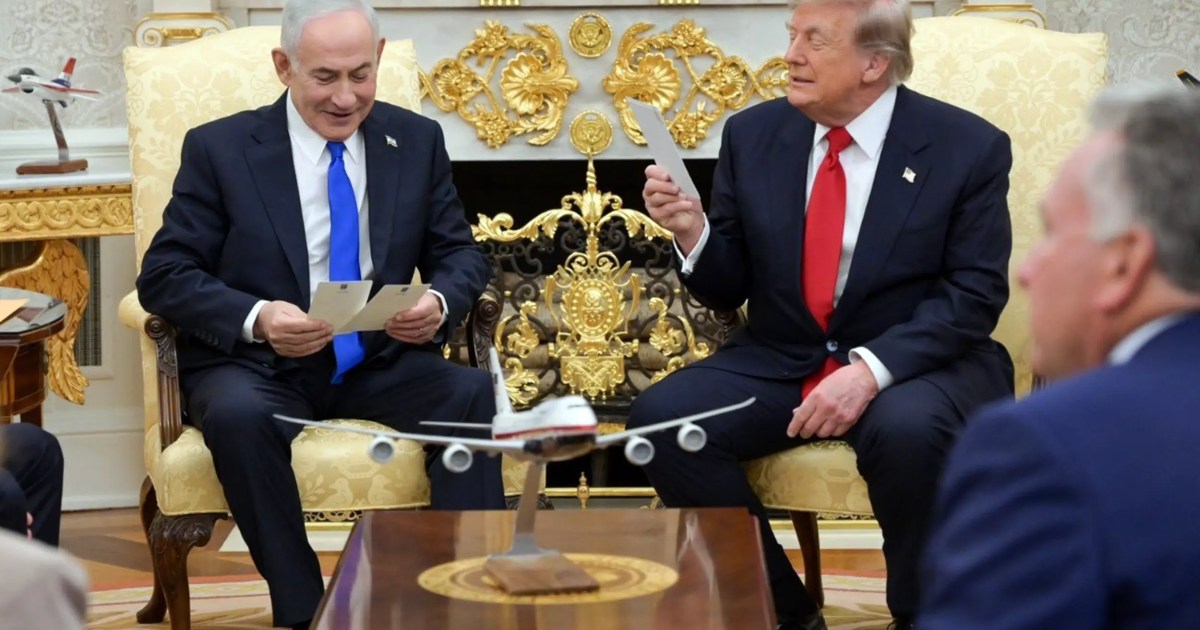
When Israeli Prime Minister Benjamin Netanyahu arrived this week for his tour of Washington, he may have had a mission in mind.
Netanyahu needed to overcome his newly diminished stature and waning influence over his once close friend President Donald Trump as both leaders grapple with the unpopularity of a war they started together and is escaping their control.
His meeting at the White House with Trump on Tuesday, which was closed to the press, was the first face-to-face encounter between the two allies since the U.S. and Israel launched a joint attack against Iran on Feb. 28.
Trump gave him a muted welcome and afterwards simply described the meeting as “very good.” “Obviously, many important subjects were discussed,” the president wrote on Truth Social.
Rather than an intimate one-on-one setting, the Oval Office was full of top U.S. officials — Vice President JD Vance, Secretary of State Marco Rubio, Treasury Secretary Scott Bessent, Secretary of Defense Pete Hegseth, Chairman of the Joint Chiefs of Staff Gen. Dan Caine, and special envoy Steve Witkoff.
But Netanyahu continued the full court press on the Trump administration.
Over the course of two days, in addition to seeing Trump and attending Sen. Lindsey Graham’s funeral at the Capitol, Netanyahu also met separately with Vance, Hegseth, and Rubio, White House and Israeli officials confirmed to MS NOW.
The Israeli prime minister’s slate of meetings with key U.S. national security officials comes at a pivotal moment in the Iran conflict as tensions escalate in the region and Americans increasingly sour on the war. A recent Quinnipiac poll shows 60% of American voters opposing U.S. military action against Iran and 74% against sending U.S. ground troops into Iran.
Not only does Trump face pressure as Republicans face an uphill battle to retain congressional control in this fall’s midterms, Netanyahu’s fate as prime minister is at stake in Israel’s upcoming September elections – and he can’t afford to lose Trump’s favor.
The talks largely focused on what to do next as Iran continues to menace shipping in the Strait of Hormuz and retaliate against American bases in the region and launch attacks on Gulf allies.
According to a senior Israeli official who was granted anonymity to describe the closed-door meeting, President Trump and Israeli Prime Minister Netanyahu did not come to a final decision after discussing three paths forward: get a “good deal” focused on Iran’s nuclear program and enriched material, have no deal and instead continue the blockade and economic pressure, or take escalated military action.
But Netanyahu did not tell Trump what he should do – nor did he express a preference.
The senior Israeli official noted Netanyahu has not ruled out diplomacy – as long as it is coupled with “very strong pressures,” calling the push to dismantle Iran’s nuclear program “a contest of will and a contest of force.”
“There are ways of squeezing them and squeezing them and squeezing them and negotiating at the same time,” the official said.
Netanyahu did not present President Trump with new intelligence regarding the underground Iranian nuclear facility Pickaxe Mountain, per the senior Israeli official, noting the U.S. and Israel already are constantly sharing intelligence – and know where Iran’s highly enriched material is. “We don’t think it’s moved, and I think we have a pretty good grasp on that,” the official said.
During their meeting on Tuesday, Trump and Netanyahu discussed ways Israel and the U.S. can work together to stop Iran’s nuclear program and get the Strait of Hormuz open to maritime trade, the senior Israeli official said.
The two leaders also discussed a third goal: to continue to undermine the Iranian regime and “possibly create future conditions for a change in that area.” U.S. officials have backed away from pursuing paths that would overthrow the current leadership, but Netanyahu still believes that could happen.
“The chasm that has been created between the people and the regime is not about to be closed,” the senior Israeli official said of Netanyahu’s thinking.
Netanyahu advised Trump in February that Israeli intelligence indicated launching strikes against Iran would lead to the toppling of the Islamic Republic’s regime – and five months later, the slain ayatollah’s son retains power with a close circle of hardliners, calling into question the accuracy of Israel’s intelligence apparatus.
But the senior Israeli official said at the time, Netanyahu did not promise the Iranian people would take fate into their own hands following a coordinated attack. Rather, he chose his words carefully and said that an attack could create conditions to “advance the probability or the possibility that that would happen.”
The conditions needed for the Iranian regime to fall, “did not materialize,” the official told MS NOW, adding, “not for lack of insight, but for either operational failure or decisions that were made.”
Despite Netanyahu insisting Israel and the U.S. are on the same page, differences still remain: the sale of F-35 fighter jets to Turkey and the Saudi nuclear arrangement did not come up during Wednesday’s White House meeting, according to a second Israeli official granted anonymity to describe sensitive discussions.
Meanwhile, the conflict continues to spread, with an Iranian drone attacking a U.S. gas storage tanker off the coast of Egypt on Wednesday.
Trump indicated he would not let Iran’s latest action slide, telling reporters on Wednesday that the U.S. would retaliate against Iran even as he leaves room for diplomatic talks to resume.
“It’s our turn, and we’ll see if we get there with an agreement at some point,” Trump said. “But we’re going to hit them very hard.”
As for what it would take for Israel to join the U.S. strikes, the senior Israeli official said that if Israel is attacked by Iran, “We will respond very, very forcefully and very quickly. And I think Iran would make a great mistake.”
Julia Jester covers politics for MS NOW and is based in Washington, D.C.