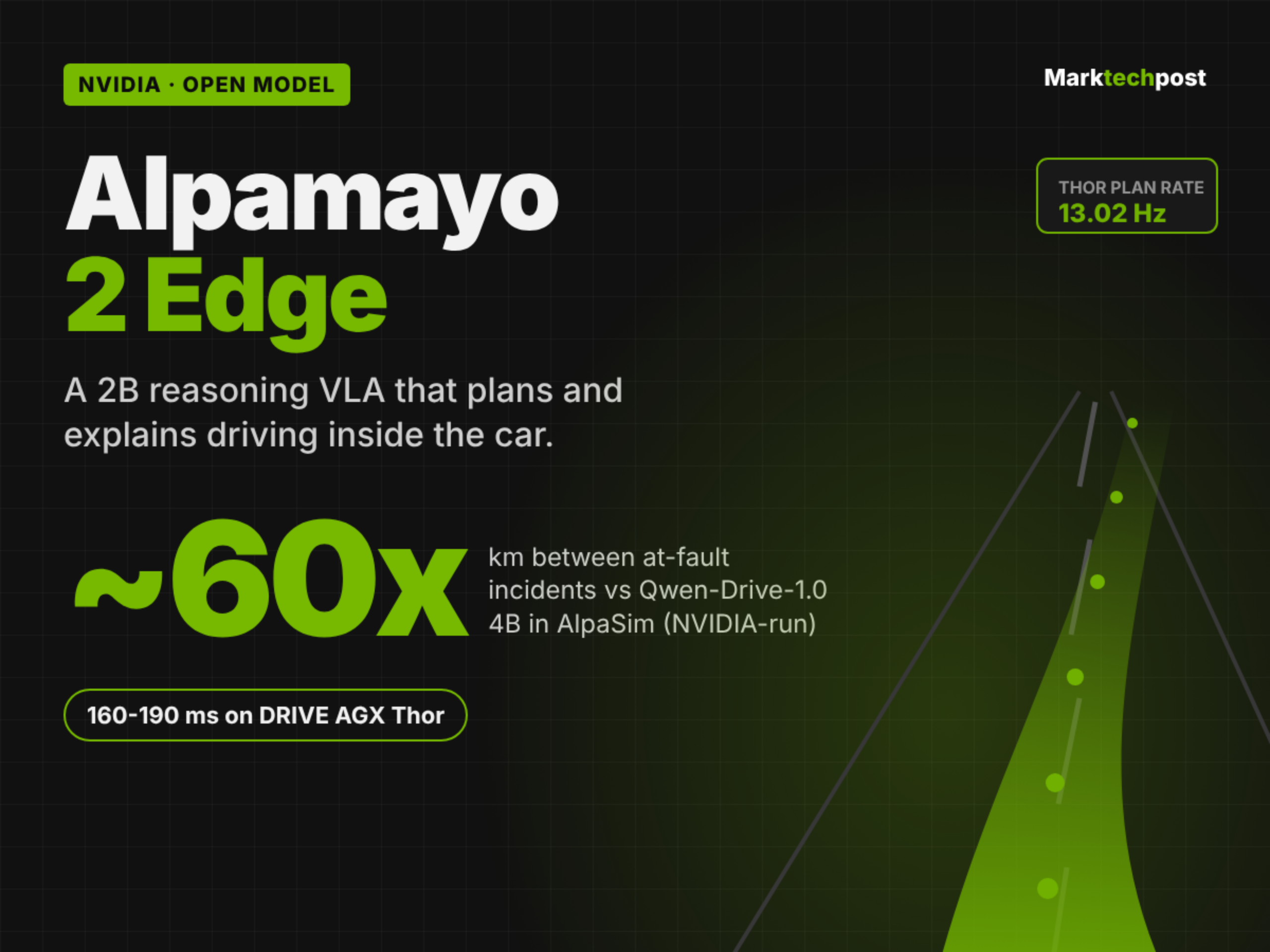
NVIDIA has released Alpamayo 2 Edge, a 2B-parameter reasoning vision-language-action (VLA) model designed specifically for autonomous driving systems.
What Is Alpamayo 2 Edge?
Alpamayo 2 Edge is a compact, on-device AI model built for real-time operation inside vehicles. It is part of NVIDIA’s Alpamayo family, which includes a larger 34B-parameter cloud model, Alpamayo 2 Super.
The model runs on the NVIDIA DRIVE AGX Thor platform, not on datacenter GPUs. It processes video from six surround cameras to generate driving plans and explain them in real time.
According to the model card, the backbone consists of a 2.45B parameter structure combining a 1.96B language model and a 0.41B SigLIP2 encoder. A 0.2B diffusion action expert sits atop this foundation. The model is marketed as a 2B-parameter system, though Hugging Face metadata lists it at 3B parameters.
How It Works: Input and Output
The model takes inputs from six cameras and 22 frames per observation. The two front cameras provide five frames each, while the remaining four provide three each. It also receives a navigation instruction and 20 historical ego poses.
From this, it generates 64 waypoints spanning from 0.1 to 6.4 seconds into the future. The action expert predicts acceleration and curvature, which are then integrated using a unicycle model to produce a physical trajectory.
The model produces a Chain-of-Causation (CoC) reasoning trace, explaining how decisions are made. It can also answer free-form questions about the driving scene.
Adaptive Reasoning
During normal driving, the model emits only special tokens instead of a full reasoning trace. It only generates a complete CoC trace when a scene requires it—such as when a complex decision is needed.
This adaptive behavior reduces computational load during routine driving, improving efficiency without sacrificing safety during critical moments.
Training and Development
NVIDIA trained Alpamayo 2 Edge using several methods:
- Offline distillation from CoC autolabels generated by Alpamayo 2 Super.
- Closed-loop reinforcement learning (RL) in AlpaGym, where the model learns from its own actions in simulation.
- Multi-resolution inputs to reduce the computational cost of encoding surround-view images.
The training process emphasizes real-world driving scenarios and ensures the model can generalize across diverse environments.
Performance and Benchmarks
NVIDIA tested Alpamayo 2 Edge in simulation using AlpaSim, a closed-loop driving environment. In that test, it covered 15.15 kilometers between at-fault incidents.
These results are from NVIDIA’s own runs and are measured across 875 NuRec scenarios and 1,392 PhysicalAI-AV samples.
On benchmark tests, the model scores:
- LingoQA: 75.2 (behind Alpamayo 2 Super, which scores 79.2).
- nuReasoning numeric: 48.67.
- SURDS: 86.50.
- KITScenes scene: 89.46.
These scores reflect performance in reasoning and scene understanding, but do not represent full real-world safety or reliability.
Real-Time Operation on DRIVE AGX Thor
Alpamayo 2 Edge runs on the DRIVE AGX Thor with a specific optimized pipeline. The model uses the FP8 precision and TensorRT Edge-LLM recipe to achieve real-time performance.
NVIDIA reports pixel-to-trajectory latency between 160 and 190 milliseconds, depending on whether full reasoning is triggered. The reference setup includes DRIVE AGX Thor-X, DRIVE OS 7.2.7.0, CUDA 13.4, and TensorRT 11.3.1.9.
In a demo, PyTorch BF16 runs at 0.76 Hz. The optimized FP8 pipeline reaches 13.02 Hz in AlpaSim. Partner Embedl achieved 10 Hz on AGX Thor in under 48 hours.
On a workstation, the model requires at least 16 GB of GPU memory. NVIDIA tested this on a single H100 with 80GB, where peak process memory reached 12.06 GiB with six trajectory candidates. Performance on other GPU architectures has not been validated.
Limitations and Open Questions
While Alpamayo 2 Edge performs well in simulation, its real-world performance remains unverified. The model’s LingoQA score of 75.2 is lower than Alpamayo 2 Super and Qwen-Drive-1.0, indicating a gap in reasoning quality.
Performance is currently only validated on H100 and AGX Thor. No data exists on how it performs on other hardware or in actual road conditions.
Its reliance on simulation for training and evaluation raises questions about how well it generalizes to unpredictable real-world driving situations.
What Else Is Shipped?
NVIDIA also released AlpaJudge, a human-calibrated judge for reasoning traces. It evaluates traces, filters training data, and provides rewards for reinforcement learning. It improved reasoning quality by 10.2% (judge) and 11.4% (human).
Availability and Licensing
The model weights are licensed under OpenMDW-1.1, and the code under Apache 2.0. Inference code is available on GitHub. The model supports fine-tuning for custom applications.
Users can access the model card, technical blog, and GitHub repository directly. Deployment options are available via the GPULeaderboard.com Chrome extension.
Alpamayo 2 Edge is designed to enable reasoning-based planning within the constraints of in-car hardware and latency budgets. It represents a step toward more autonomous, explainable driving systems.
For deeper technical details, see the original source at MarkTechPost. The model is also available on Hugging Face at huggingface.co.
For more on AI infrastructure, see Baseten’s recent release.
Sources & further reading
Featured image: NVIDIA Releases Alpamayo 2 Edge: A 2B Reasoning VLA for DRIVE Thor. Via original publisher. Image source