
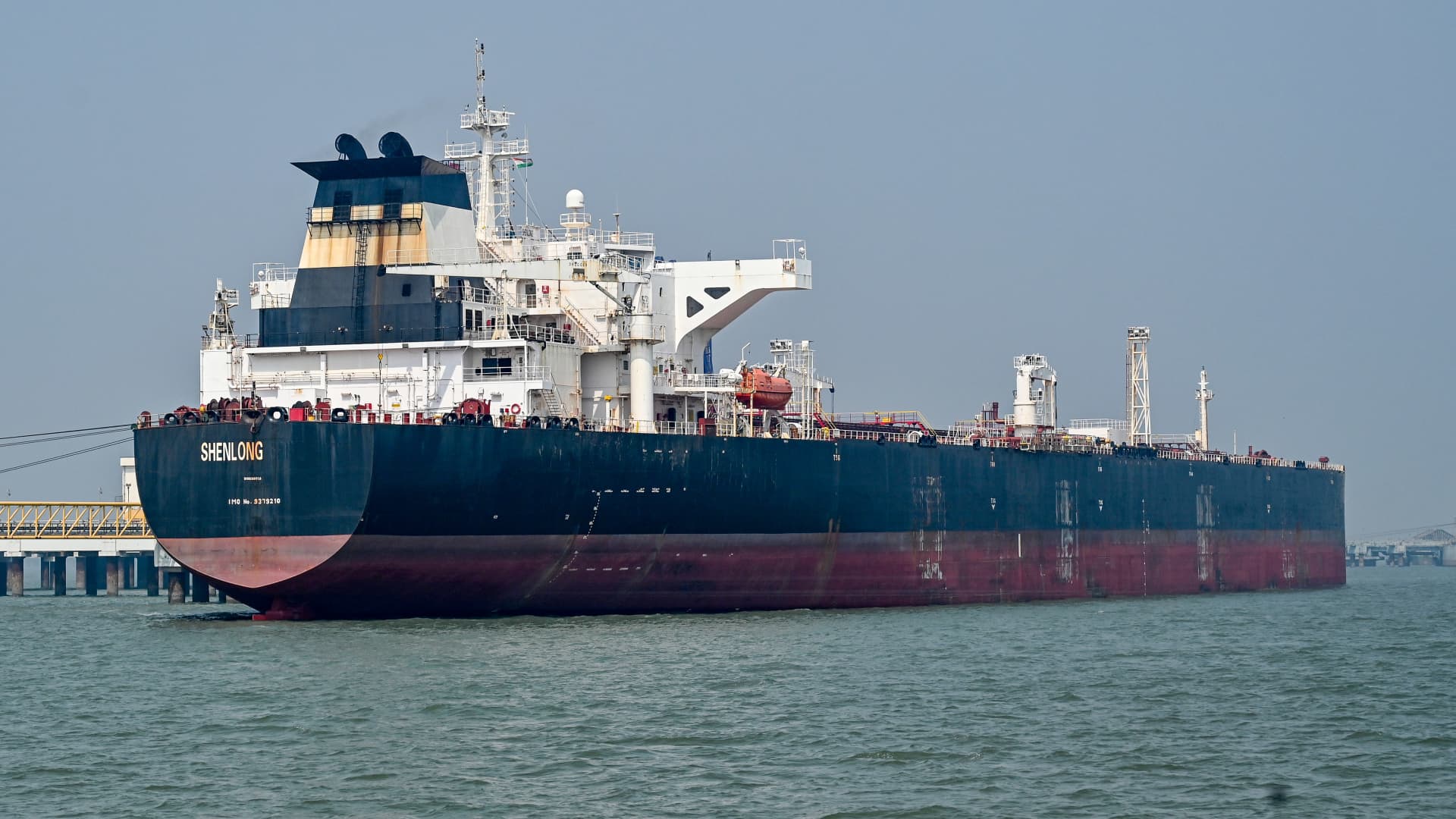
The Liberia-flagged crude oil tanker Shenlong Suezmax successfully docked at Mumbai Port after navigating the high-risk Strait of Hormuz amid the intensifying West Asia conflict on March 11, 2026 in Mumbai, India.
Hindustan Times | Getty Images
Oil prices jumped Monday after Israeli Prime Minister Benjamin Netanyahu warned that the conflict with Iran was “not over,” raising fears that tensions in the Middle East could escalate again and further threatening energy supplies.
U.S. President Donald Trump, meanwhile, rejected Iran’s counteroffer to end the war with the U.S. and Israel. “I have just read the response from Iran’s so-called “Representatives.” I don’t like it — TOTALLY UNACCEPTABLE!”
U.S. West Texas Intermediate futures with June delivery advanced 3.08% to $95.42 per barrel, while the international benchmark Brent crude futures with July delivery rose 3.16% to $104.49 per barrel.

Brent crude prices this year
“There’s still nuclear material, enriched uranium that has to be taken out of Iran,” Netanyahu said on Sunday in an interview on CBS’s “60 Minutes” that is set to air Sunday night. “There is still enrichment sites that have to be dismantled, there’s still proxies that Iran supports, there are ballistic missiles that they still want to produce … there’s work to be done.”
Asked how the U.S. and Israel would remove the nuclear material, Netanyahu replied: “You go in, and you take it out.”
Citi analysts wrote in their latest oil report that prices could rise further if Iran and U.S. do not agree a deal, adding that crude markets have been cushioned by high inventories, strategic petroleum reserve releases, weaker demand in developing economies and intermittent signs of possible de-escalation in the Middle East.
Citi maintained that risks to oil prices remain tilted to the upside, as Iran retains significant control over the timing and terms of any potential agreement to reopen the critical Strait of Hormuz energy route.
“We assume that the regime will make a deal that reopens the Strait around end-May … but we continue to see the risks skewed towards this timeline being pushed out and/or a partial reopening, which means disruptions for longer.”
— CNBC’s Garrett Downs contributed to this report.
