
Latin America
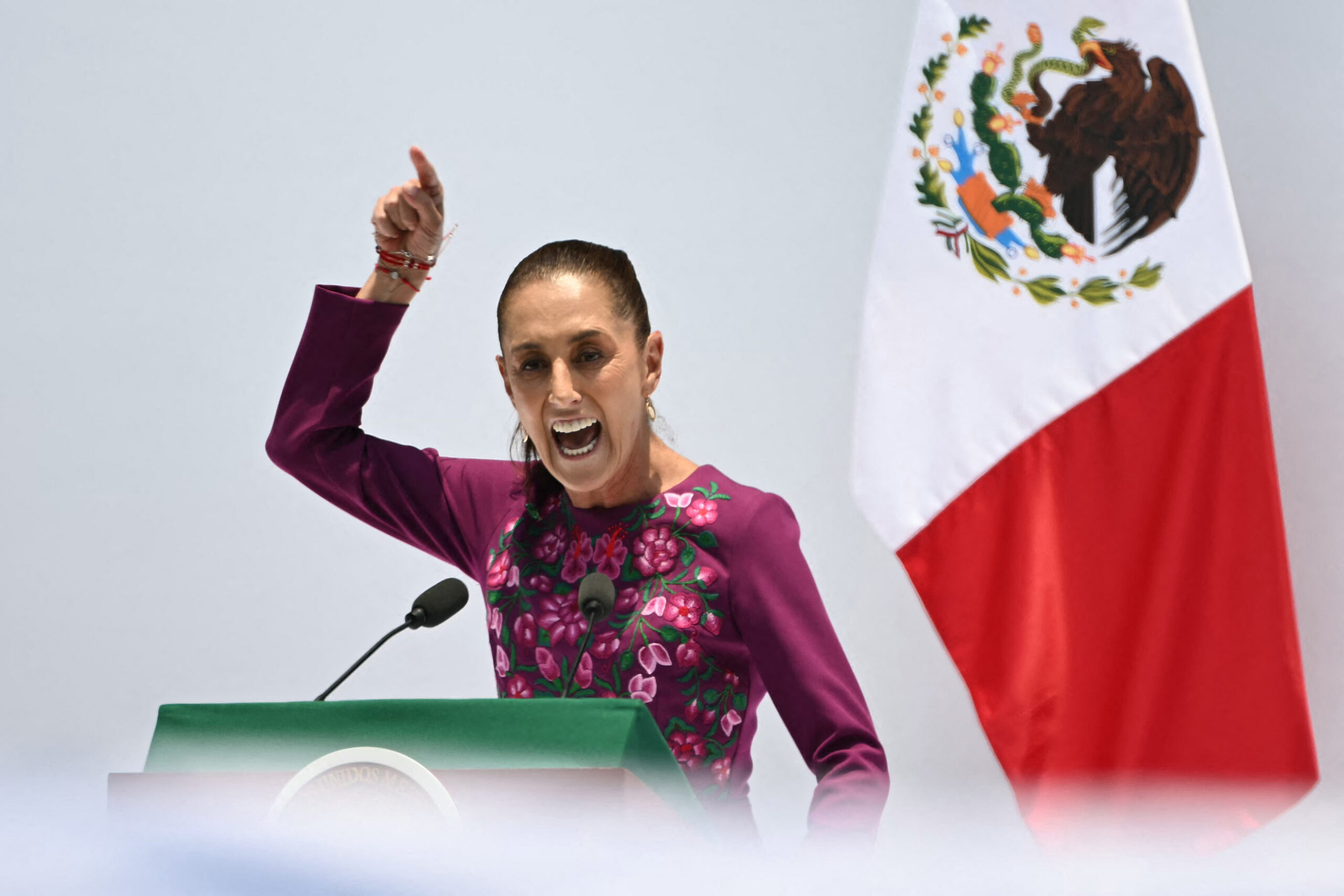
The Mexican president is cutting off threats to her power from within and without.

In an announcement marking the end of an era, Andrés “Andy” López Beltrán, the son of the former Mexican president Andrés Manuel López Obrador, declared that he would resign his position as secretary of organization for the Morena party to stand as a candidate for Mexico’s legislature in the state of Tabasco. The departure of López Beltrán, once considered a surrogate and potential political heir for his father, leaves Mexican President Claudia Sheinbaum in unquestioned control of the party that once seemed identical with the persona and politics of its founder López Obrador.
At one time there were serious doubts about the independence of Sheinbaum, who was López Obrador’s protege and handpicked to be his successor to the presidency in 2024. His popularity among the Mexican public was unmatched, he commanded the loyalty of Morena’s rank-and-file, and its political leadership relied on his endorsement for their authority. It was widely suspected that despite his promise to retire from politics to his ranch in Mexico’s rural south, he would continue to lead the party from afar, with Sheinbaum as a compliant cutout.
But Sheinbaum has proven anything but a puppet for her old boss, who, to the surprise of most, has largely avoided politics after his six years of presidency and settled comfortably into the background. She has consolidated control of the party around her and her allies, frozen out internal dissent, and built her own brand and personal popularity. She has adopted many of López Obrador’s political tools, like the daily morning briefing and the rhetoric of the “Fourth Transformation.” But she has also added her own cool, technocratic style, which contrasts with López Obrador’s brash, chummy populism, and has broken with many of his policies, like the “hugs, not bullets” campaign against organized crime.
The departure of “Andy” López Beltrán ended the last hope of those still hoping that López Obrador might step in and lead Morena from afar. It’s Sheinbaum’s party now, inside and out.
And she’s used that authority to great effect, placing Morena in an essentially unassailable position, spearheading a massive constitutional reform to the Mexican judiciary that passed under the most dubious of circumstances. Mexico now has a unique institution, the popularly elected judicial branch—a great convenience to the party which marshals a supermajority of votes in the country and has a well-developed party machine to turn them out in elections.
Morena’s position within Mexico was augmented still further last week by another constitutional amendment, backed by Sheinbaum and championed by Ricardo Monreal, the head of the party’s delegation in the House of Deputies. The “Monreal Law,” which was ushered through both houses of the legislature Thursday, will allow the government to overturn elections which feature “intervention from individuals, organizations, or foreign governments with the intention of influencing public preferences or the results of the election.”
This amendment is very clearly aimed directly at the United States, which, under the Trump administration, has placed Mexico under significant political pressure. Sheinbaum has largely cooperated with the U.S. and maintained a good working relationship with President Donald Trump himself, but two major scandals earlier this year seem to have crossed the line for what she is willing to tolerate.
In April, a fatal car crash in the state of Chihuahua exposed two CIA agents who died while participating in a clandestine operation with local officials there. The affair created a political firestorm: the Mexican public is fiercely protective of the country’s national sovereignty and is adamantly opposed to American operations, military or intelligence, on Mexican soil. Sheinbaum has castigated the U.S. for its violation of Mexico’s prerogatives, but the incident probably would have blown over if the U.S. had not decided to escalate further. Last month, the Justice Department indicted several sitting Morena officials, including the governor of the state of Sinaloa, for conspiring with drug cartels.
This was a blow aimed directly at the most sensitive spot in all of Mexican politics. To the Trump administration, it might just be an attempt to coerce Mexico into cleaning up its act, but Morena is violently allergic to allegations that it is a “narcoparty” or that its members work with cartels (even when that is undoubtedly the case). The U.S. publicly insinuating that Sheinbaum leads a government and party that is a partner with organized crime required a substantive response, which this new amendment to the constitution provides.
Being able to overturn election results at will when “foreign intervention” is allegedly involved gives Sheinbaum the trump card in any public showdown with the U.S. over corruption within the Mexican state. If the Trump administration wants to deal with Mexican officials they believe are cooperating with the cartels, the most sensible route is now to go through her. That doesn’t mean the U.S. will comply, of course.
Beyond giving Sheinbaum another weapon in an ongoing duel with the Trump administration, the amendment gives Morena yet another lever it can pull to ensure that it remains on top. The definition of “foreign intervention” is vague and all-encompassing enough that, especially in the age of social media, almost any election could qualify as having been the target of an influence operation. This tactic has already been used to great effect by governments in Europe. To name one example, a Romanian court annulled the country’s presidential election over allegations of Russian influence online.
Subscribe Today
Get daily emails in your inbox
The National Action Party (PAN) appears especially vulnerable to this new mechanism. It has campaigned on increased cooperation with the U.S. on matters of security and anti-cartel operations. More damning still, PAN controls the government of the state of Chihuahua, and the CIA agents that caused a political crisis earlier this year were working with local officials from the PAN there. Chihuahua’s governor, Maria Eugenia Campos, is already the subject of federal investigations over the affair and has accused Sheinbaum of persecuting her; it would not be surprising if the government goes the next step and intervenes in the next state election directly.
While the Monreal law is in many ways a continuation of Morena’s political strategy going back to the presidency of López Obrador, it is also clearly part of a broader pushback against the U.S. by Sheinbaum, who has become more willing to confront the Trump administration in 2026, at least partly out of the domestic political necessity to be seen as fighting to preserve the country’s national sovereignty.
Still, Sheinbaum will need to play her cards carefully. The U.S. has a massive piece of leverage over Mexico it can deploy in the coming months: the renegotiation of the U.S.–Mexico–Canada trade agreement (USMCA), the new terms of which are due to be signed in July. The Trump administration is looking to press Mexico for significant concessions in the updated USMCA, and Sheinbaum will need to marshal all her tact and skill to come out with a deal she can sell as a win to the Mexican public—an undertaking that will probably require her to make some political concessions elsewhere.

