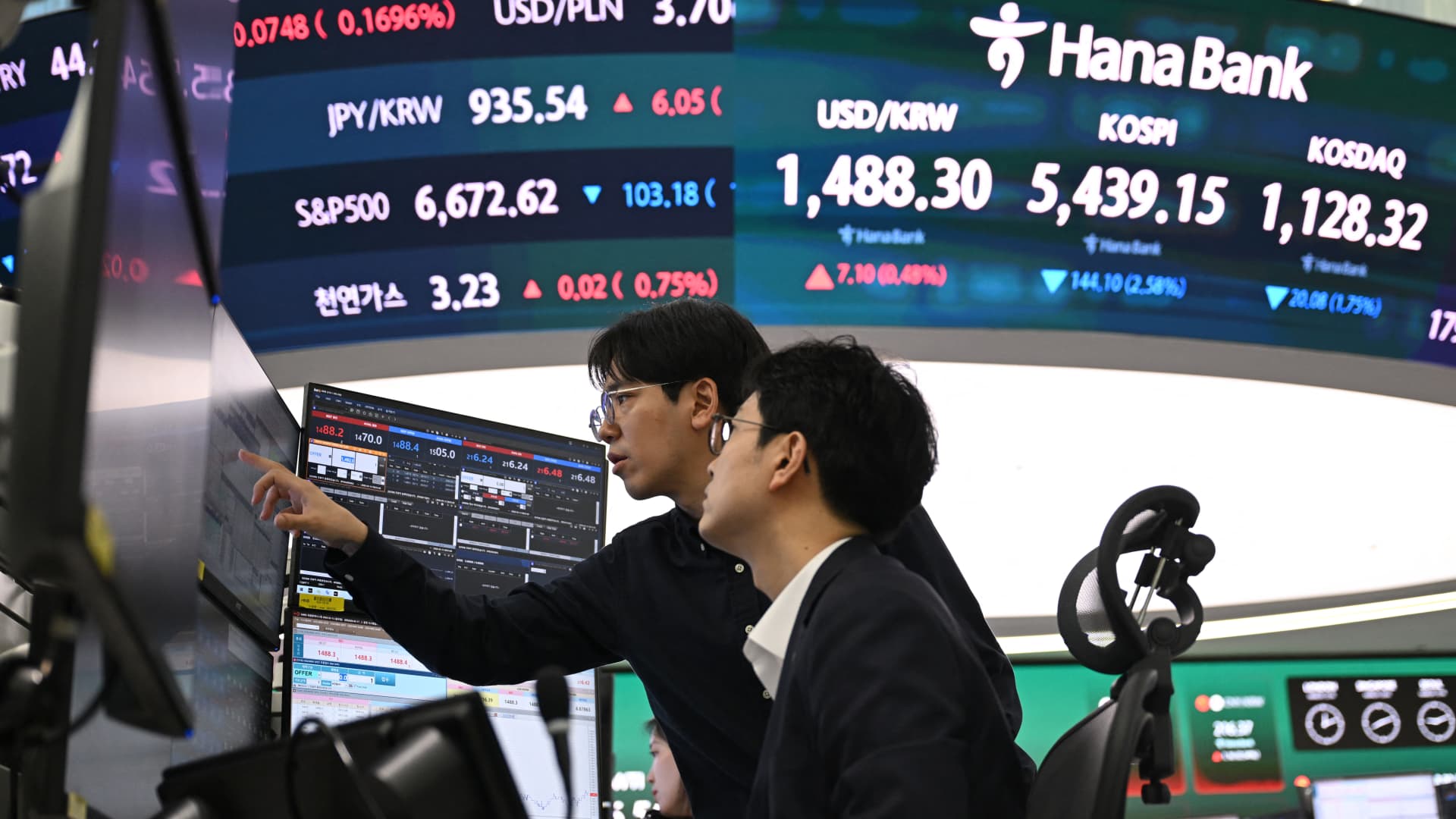
Currency dealers monitor exchange rates as an electronic screen (top) shows South Korea’s benchmark stock index (KOSPI) in a foreign exchange dealing room at the Hana Bank headquarters in Seoul on March 13, 2026.
Jung Yeon-je | Afp | Getty Images
South Korea’s stock market volatility surged to near record highs on Monday after foreign investors dumped $13.2 billion worth of local equities last week, triggering sharp swings in the Kospi and a brief trading curb on the exchange.
The Kospi fell as much as 4% in early trade, extending Friday’s 6% tumble that Goldman Sachs described as having “erased weekly gains amid Trump-Xi Summit and strong foreign outflows.”
The Kospi Volatility Index surged 2.56% on Monday to near peaks seen in early March.
Overseas investors pulled about $17 billion from emerging Asian markets excluding China last week, marking the second-largest weekly outflow on record, according to data from Goldman Sachs. South Korea accounted for the bulk of the selling with $13.2 billion in outflows, followed by Taiwan at $2.5 billion.
South Korea’s exchange briefly halted some program trading on Monday after sharp losses in stock-index futures triggered a so-called “sidecar” mechanism aimed at calming market volatility. The curb was activated after Kospi 200 futures plunged 5%, pausing automated trading activity for five minutes.


South Korea stocks performance year-to-date
The reversal came after the Kospi index surged past the 8,000 mark for the first time last week, fueled by enthusiasm around artificial intelligence-linked stocks, chipmakers and retail momentum.
Strategists at Citigroup said the Korean market now appeared “much more overbought than in the U.S.,” prompting the bank to cut exposure to its bullish Korea trade.
“While we think we are too early in the tightening of financial conditions to get a severe pull back or end of the bull market thanks to rates, Kospi appears much more overbought than in the U.S. and prudence suggests we take profits on half our position,” Citi strategists wrote.
The bank said Korea was showing more warning signs of “exuberance” by local retail investors. That group has emerged as key buyers of South Korean equities this year, frequently piling in through margin trading and leveraged exchange-traded funds.
While it doesn’t mean the Kospi trade is over, “it does mean that risks have risen,” Citi said.


The remarks underscore growing concern that soaring global bond yields and geopolitical tensions are beginning to pressure some of Asia’s best-performing equity markets. Citi pointed to a “break-out in backend yields” globally, with both Japanese government bond yields and UK gilt yields climbing sharply amid concerns over persistent inflation and higher oil prices linked to the Iran conflict.
Still, both Citi and Goldman see potential for South Korea’s rally to continue. Goldman estimated Korean retail traders bought $14.1 billion worth of equities last week. And Citi said it was taking profit on half of its Korea trade — not exiting entirely — as it also expects the market to be among the largest beneficiaries of passive inflows linked to index provider MSCI’s coming rebalance.