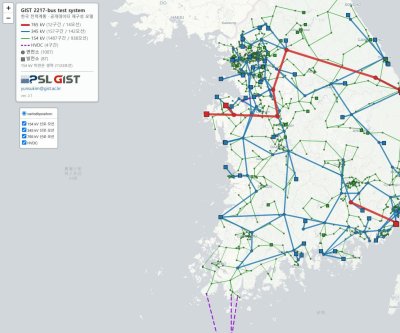
A single-line diagram shows the GIST 2217-Bus Test System, an open simulation model of South Korea’s national power grid. Courtesy of Gwangju Institute of Science and Technology
June 19 (Asia Today) — South Korean researchers have developed an open simulation model that digitally reproduces the structure of the country’s power grid, allowing researchers to study the domestic electricity system without using classified infrastructure data.
The Gwangju Institute of Science and Technology said Friday that its Power Grid Research Center developed the GIST 2217-Bus Test System using only publicly available maps and electricity statistics.
A bus is a connection point within a power system where electricity is generated, transmitted or distributed.
The institute said the model could improve South Korea’s power grid research environment, which has largely depended on foreign test systems developed around electricity networks with different geographical and operational characteristics.
The project is part of an effort by the research center, which opened in September, to establish the foundation for a next-generation South Korean power grid research platform.
Computer simulations are needed to analyze how electricity moves through transmission networks and to ensure that power generated at plants can be delivered reliably to homes and industrial facilities.
Detailed information about South Korea’s actual power grid is not publicly available because it is considered sensitive national infrastructure data. Domestic researchers have therefore relied on foreign test systems, including models provided by the Institute of Electrical and Electronics Engineers.
Researchers said those models have limitations when applied to South Korea.
Many of the country’s power plants are concentrated along coastal areas, while a large share of electricity demand is centered in the Seoul metropolitan area. That structure differs significantly from the foreign grids represented in existing research models.
The GIST team constructed its model without using confidential grid data. Researchers instead combined publicly available geographical information with national electricity statistics.
The completed system contains 2,217 buses and about 3,700 transmission circuits. It represents connections among major power plants and substations across South Korea, including links between the mainland and Jeju Island.
GIST said the model produced stable calculations under conditions simulating peak electricity demand during the summer, demonstrating sufficient reliability for power system research.
The institute released the grid dataset, map and construction and analysis tools for public use. Researchers and companies can download and use the materials without obtaining separate permission.
The model could be used to study how much additional solar and wind power can be connected to the grid, responses to blackouts, grid operations during the transition to carbon neutrality and artificial intelligence-based electricity management systems.
Kim Yoon-soo, director of the Power Grid Research Center, said he hopes the model will serve as both a starting point and a shared platform for research on South Korea’s electricity system.
“We will continue updating the model as the power grid changes and incorporate the actual operating characteristics of generators and renewable energy facilities,” Kim said.
He said the center intends to develop it into a South Korean power grid platform that can be used jointly by domestic researchers and companies.
— Reported by Asia Today; translated by UPI
© Asia Today. Unauthorized reproduction or redistribution prohibited.
Original Korean report: https://www.asiatoday.co.kr/kn/view.php?key=20260619010006836