At least 69 killed in Spain high-speed train crash near Toledo Source: independent.co.uk.
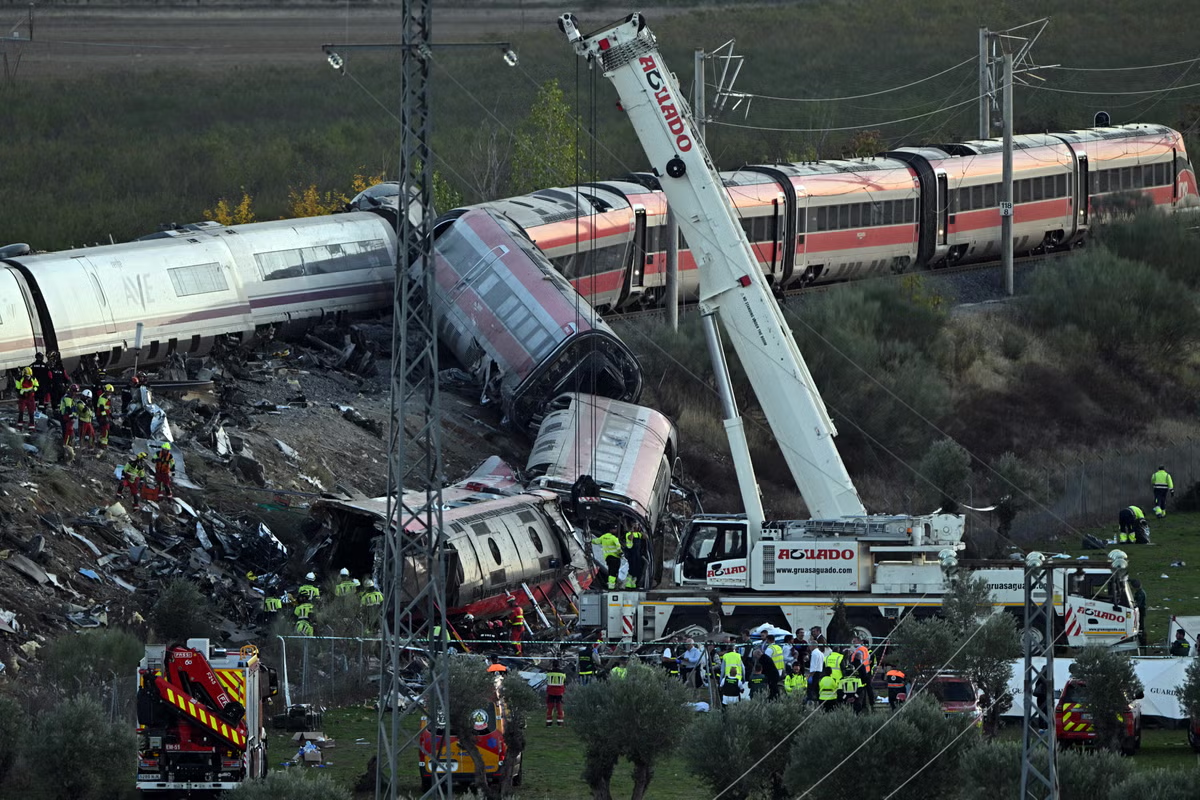
A deadly high-speed train crash in Spain has left at least 69 people dead, with over 100 injured. The incident occurred near the town of Urda in the Toledo province on Wednesday morning.
What happened
Two trains collided in a rural area of Toledo province. One train, operated by Iryo, had been stationary due to a signal fault. The other, operated by Renfe, resumed its journey and struck the stationary train.
There were 544 people on board the two trains traveling between Madrid and Seville. The crash is the fourth fatal rail incident in Spain this year.
Key facts
- on Wednesday.
- Rescue operations began immediately, with cranes working through the night to lift wreckage.
- One of the worst-affected carriages remained overturned, with officials saying no further fatalities are likely beneath it.
- Human remains were found during overnight efforts. Authorities have not yet named any victims.
- Emergency teams deployed a canine unit to search for possible survivors.
Who was on board
Fátima Báñez, former minister for employment and social security, was traveling on the Iryo train. She is chairwoman of the Spanish Confederation of Employers’ Organizations (CEOE).
Spanish sources confirm she was on board. Close sources to her say she was in one of the most severely damaged carriages. She is feared dead.
Her former political party, the People’s Party (PP), and the CEOE have both confirmed her presence on the train.
Official response
Esther Padilla, a spokesperson for the regional government of Castilla-La Mancha, said rescue teams are still working carefully. She added that a canine unit would return to search for any remaining survivors.
Emiliano Garcia-Page, the regional leader, confirmed the death toll had risen to 69. He said human remains were found during overnight operations.
Spain’s transport minister, Óscar Puente, suggested the accident may have been caused by human error. He said the control centre made a decision to resume traffic under ‘inexplicable’ circumstances.
He stated: ‘It was the control centre, through its operators, that made the decision to resume traffic, under circumstances that, from our point of view, are inexplicable. Clearly, it was a wrong decision.’
Background: Spain’s rail network
Spain has operated Europe’s largest high-speed rail network for decades. The dedicated high-speed lines have not had a fatal incident since the network opened in 1992.
Why it matters
This is one of Spain’s deadliest rail disasters. It is the worst since 78 people died in a derailment near Santiago de Compostela in 2013.
The incident raises urgent questions about rail safety in Spain.
Train drivers in Spain proceeded with a planned strike the day after the crash, demanding more investment in railway safety.
What to watch next
Authorities will continue to search for survivors. The full death toll may rise as recovery efforts progress.
Investigations into the control centre’s decision to resume traffic are expected to begin soon. The transport ministry may issue a formal report on the incident.
Spanish families are awaiting news about loved ones. No official list of victims has been released.
For more on recent rail incidents in Europe, see a similar incident in Paris or a shooting in Jordan.
Sources & further reading
Featured image: original publisher image. Via original publisher. Image source