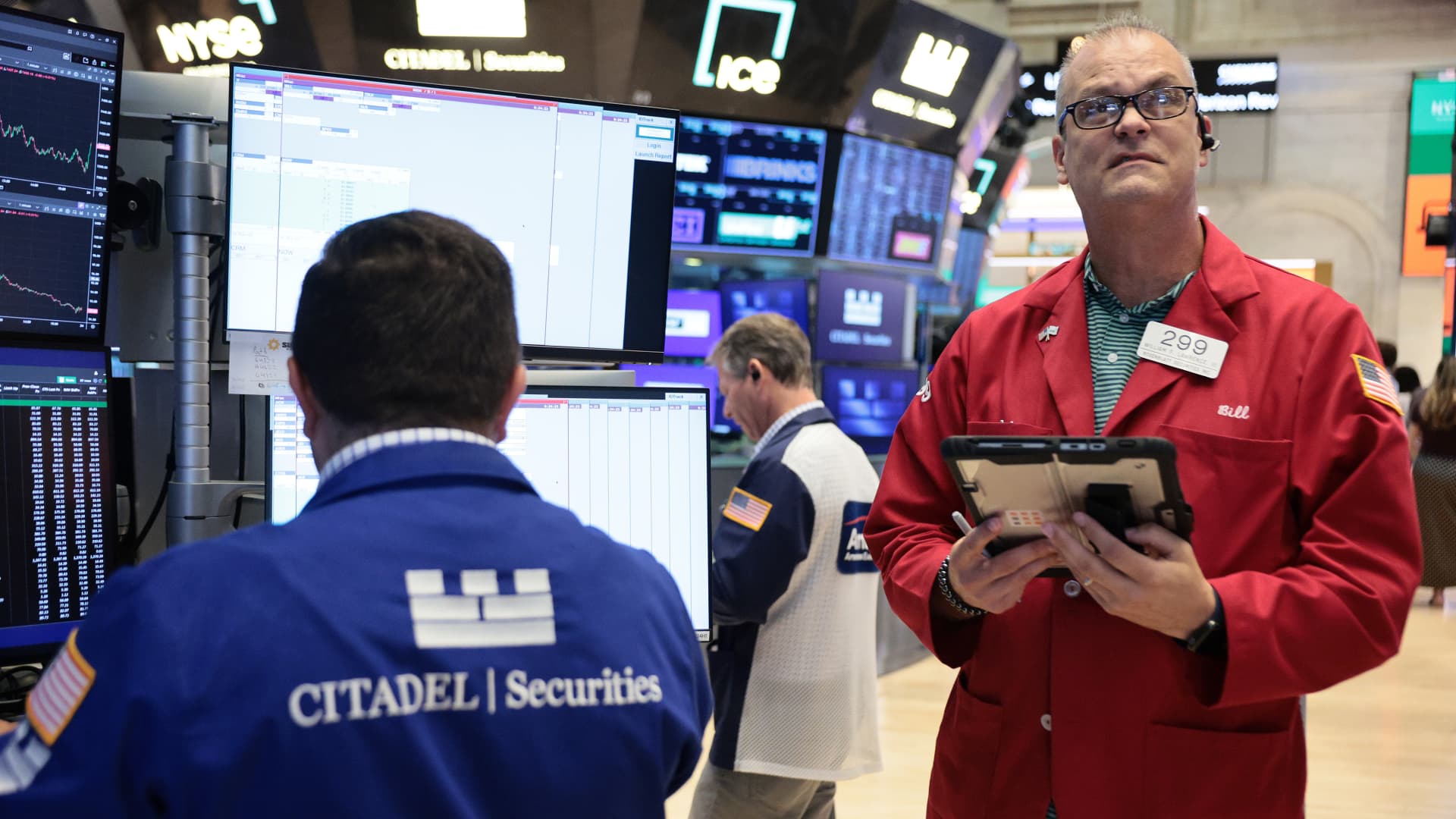
Dow Jones Industrial Average closes up
The Dow Jones Industrial Average closed higher on Monday, although stocks were little changed on a broader basis.
The 30-stock average gained 0.51%, or 262.83 points, to end at 52,210.08. The S&P 500 added just 0.02%, settling at 7,413.18. The Nasdaq Composite lost 0.18% and closing at 24,932.08.
— Liz Napolitano
Digital cyclospora conversation focuses on Taco Bell, Wolfe Research says
The Taco Bell logo sign is seen on a restaurant location in Chicago, Illinois, United States, on July 25, 2026.
Marcin Golba | Nurphoto | Getty Images
Taco Bell is taking the brunt of online concern around the cyclospora outbreak, according to Wolfe Research.
Wolfe’s Margaret-May Binshtok said the firm’s artificial intelligence-driven social listening showed the conversation centers on the Yum Brands-owned chain. At the peak, Taco Bell accounted for about 20% of overall chatter, she said.
“Taco Bell is the headliner,” Binshtok wrote in a Monday note to clients.
On the other hand, she said other chains such as Cava, Sweetgreen and Chipotle have largely flown under the radar in comparison.
— Alex Harring
Crypto stocks rally thanks to rotation from AI infrastructure; bitcoin miners lag
Feature China | Future Publishing | Getty Images
Crypto stocks were some of the top gainers Monday as the broader market sold off and capital rotated away from chip and AI infrastructure names.
The ether accumulator Bitmine Immersion surged 11%, bitcoin treasury pioneer Strategy jumped 7% and Coinbase gained 4.5%.
Meanwhile, AI-exposed bitcoin miners slid as chip and AI infrastructure stocks faced pressure from concerns over circular financing and intensifying competition from Chinese semiconductor companies.
Cipher Mining led the group with an 8% decline. Hut 8 and Terawulf fell 6% and 4%, respectively. The weakness even extended to pure play bitcoin miners. Riot Platforms lost 5%, Mara Holdings sank 3% and CleanSpark was lower by 4%. Core Scientific, which has mostly pivoted away from bitcoin mining, was down 9%.
“Today’s weakness partly reflects concern around capex requirements and whether companies across the miner-to-AI group may need to raise incremental capital at higher costs to fund their development pipelines,” Michael Donovan, senior research analyst at Compass Point, told CNBC. “Some investors are questioning whether credit appetite for these projects is approaching its limits and which developers can fund their pipelines without meaningful dilution, expensive debt or additional support from customers and strategic partners.”
For more, read our full story here.
— Tanaya Macheel
Analysts come out bullish on Lime parent
Wall Street firms are bullish on Lime parent Neutron Holdings after the scooter company’s public market debut earlier this month.
Goldman Sachs analyst Eric Sheridan came out with buy rating in a Sunday note to clients. He said Lime is “positively exposed to several secular tailwinds with the micromobility industry”
JPMorgan’s Doug Anmuth unveiled an overweight rating on Monday, citing “multiple levers of growth” and “attractive unit economics.” Anmuth said shares trade at a roughly 32% discount to peers by one measure and have an attractive risk-to-reward ratio.
Jefferies analyst John Colantuoni pointed out the company’s “juicy” valuation when announcing his buy rating on Monday. Colantuoni said to expect a 16% compound annual growth rate on revenue over three years.
— Alex Harring
Software breaks away from chip trade
Software and semiconductor stocks are breaking apart after years of generally moving together. The iShares Expanded Tech-Software ETF is higher today while the iShares Semiconductor ETF is lower, extending a divergence between the two that has become increasingly pronounced. The two ETFs have moved in opposite directions 32 of the past 60 trading sessions, the highest count on a rolling basis since the ETFs’ inception in 2001.
Their 60-day rolling correlation too has fallen to around zero, from a long-term average around 0.75. At the same time, both ETFs are up around 7% or better over the past three months, outperforming the broader S&P 500.
The software leadership has been concentrated in cybersecurity and data protection: Datadog, Fortinet, Palo Alto Networks and CrowdStrike are among the best performing from the group. On the chip side, Micron, United Microelectronics, Advanced Micro Devices and Astera Labs lead the way over three months.
—Nick Wells
JPMorgan initiates Rhythm Pharmaceuticals with a buy rating
Sheldon Cooper | Lightrocket | Getty Images
Rhythm Pharmaceuticals is a buying opportunity thanks to expanding use cases for its obesity drug, according to JPMorgan.
Analyst Priyanka Grover initiated coverage of the pharmaceutical stock with an overweight rating, as well as a Dec. 27 price target of $145 that represent more than 40% upside from Friday’s close. On Monday, the stock was last higher by more than 3%.
“Our OW thesis centers on Rhythm’s opportunity to grow Imcivree (setmelanotide) from a rare genetic obesity franchise into a more durable MC4R-pathway rare disease platform, driven by the newly launched acquired hypothalamic obesity (HO) indication (WW peak sales ~ $2.1B), where there is a significant unmet need,” Grover wrote on Monday.
“Imcivree’s recent expansion into acquired HO is an important inflection point that we expect to be a key near-term driver for the next chapter of growth for Rhythm,” he added.


Rhythm Pharmaceuticals, 1-day
— Sarah Min
Apollo’s Slok calls AI spending ‘engine’ for economy ahead of tech earnings
The artificial intelligence boom could account for around half of GDP growth amid the data center buildout and wealth effect, according to Torsten Slok, chief economist at Apollo.
Slok said Monday on CNBC’s “Squawk on the Street” that around one percentage point of the overall GDP increase should stem from AI. That would be roughly half of the 2% expansion seen in a normal year, he said.
“The economy is certainly driving on a very important engine that is called AI spending,” Slok said.
Slok said company values can depend on how fast they can get a return on their AI-related investments. His comments come ahead of megacap tech earnings this week from companies such as Apple and Microsoft.
— Alex Harring
China ETFs rise
FXI, 1-day
— Sarah Min
European stock markets trade higher
European stock markets were in positive territory Monday, with the continent’s major bourses and most regional sectors trading higher as oil prices reversed.
The pan-European Stoxx 600 was up 0.27% by 3:45 p.m. in London (10:45 a.m. E.T.).
Retail names, media stocks and carmakers were among the sectors notching the strongest gains on the day, while oil and gas companies led losses, falling almost 2% at one point during afternoon trade, as oil prices shed more than 6%.
SpaceX now off 50% from its all-time high
SpaceX employees go to work at the SpaceX facility in Hawthorne, California, on the day of their company’s initial public offering, June 12, 2026.
Mike Blake | Reuters
Shares of SpaceX are now off 50% from their all-time high.
The Elon Musk company was trading around 109.40 in early trading Monday, which is more than 51% below its high of 225.64 that it hit shortly after its IPO on June 12. SpaceX has now traded below its IPO price of $135 for the last eight sessions.
The stock was pacing for its 10th negative session in 12.
SpaceX since June 12, 2026.
— Davis Giangiulio
Deutsche Bank cuts its price target on Tesla after earnings
Tesla’s lack of progress on its robotaxi and humanoid robot products is dampening the outlook for the company’s shares, according to Deutsche Bank.
The bank reiterated its buy rating on the stock in a Monday note, but it cut its price target to $420 from $465. That still represents a 34% gain from Friday’s close, thanks to it’s 16% two-day fall following its second quarter earnings report last week.
“We think it’s fairly clear Robotaxi and especially Optimus (supply chain) are scaling slower than anticipated which is disappointing the market,” analyst Edison Yu wrote in the note. “Moreover, the sentiment towards physical or embodied AI has tapered down… Overall, we suspect we’re entering a tricky period of time where Tesla may not demonstrate any significant milestones until late in the year while cash burn increases materially.”
Following the company’s earnings report last week, a slew of Wall Street analysts reiterated their ratings on the stock but cut price targets as the company’s free cash flow turned negative. Analysts believed the high spending on capital by the company would weigh on shares near-term, and were divided if long-term the investments would pay off.
Tesla 5-day chart.
— Davis Giangiulio
Gold may be ready to shine again, 22V Research’s Jeff Jacobson says
Gold prices rose over 1% on Wednesday as escalating U.S.-Israeli air strikes against Iran and heightened geopolitical uncertainty supported safe-haven demand.
Bloomberg | Getty
Gold‘s sharp decline from January all-time high may have created an opportunity to make a contrarian bullish bet via upside calls, according to Jeff Jacobson, managing director and head of derivative strategy at 22V Research.
“The weakness in bonds, because of a more hawkish Fed and higher oil prices, has led to higher US yields and a stronger US dollar,” Jacobson said in a research note. “A strong US dollar is a major headwind for gold and likely explains a fair amount of the weakness we have experienced of late.”
The 10-year Treasury yields have repeatedly peaked between 4.7% and 5% and Jacobson says if that happens again, that should give a bid to gold.
Gold has underperformed the S&P 500 by more than 30% since February, but its recent gains against stocks may signal a shift. Meanwhile, two-month gold calls are near their cheapest levels of the year, offering an attractive, defined-risk way to bet on a rebound.
“The fact that you can own the defined-risk 2-month calls here, ahead of the FOMC and BOJ meetings this week as well as a slew of data in August, seems like a very interesting risk/reward, he adds.
— Deena Zaidi
Strategy adds to cash buffer instead of buying bitcoin for fifth straight week
Michael Saylor’s Strategy reported on Monday that it made no bitcoin purchases last week, its fifth week in a row on pause from the bitcoin accumulation strategy it pioneered as the cryptocurrency’s price slump continues to drag.
Shares of the company were up 6.5% with the broader market rally.
The filing also showed Strategy sold 5.4 million company shares for $544.5 million and increased its U.S. dollar reserve by $525 million to $3.75 billion. The reserve now covers a little over 2 years of its current annual dividend and interest obligations of approximately $1.759 billion.
“Strategy’s increase in its USD reserve directly addressed the concern that has dominated the bear case on the company’s perpetual preferred stack, namely that dividend and interest coverage depends on continuous access to equity markets,” Benchmark’s Mark Palmer said. “By pre-funding more than two years of obligations in dollars, Strategy has reduced the near-term sensitivity of those payments to the market’s willingness to absorb new share issuance at any given moment.”
Separately, Strategy used $25 million to repurchase STRC preferred shares at a discount to face value.
Strategy will report its quarterly earnings after the bell this Thursday.
— Tanaya Macheel
Financials ETF hits all-time high
The State Street Financial Select Sector SPDR ETF (XLF) hit an all-time high in early trading Monday.
Rising by more than 1%, the ETF broke through its closing high on July 16 of 56.75 to trade at 57.05 as of 9:50 a.m. ET. The highs mark a turnaround for the ETF, which was under pressure earlier this year as it fell more than 15% from its January highs by the time of the market’s lows during the U.S.-Iran war in late March.
Several stocks in the ETF’s portfolio were on the rise on Monday. JPMorgan Chase was up also 1%, while Visa was positive by 1.5% and Goldman Sachs rose more than 2%.
— Davis Giangiulio
Stocks surge in early trading
Seaport Research Partners downgrades Warner Bros. Discovery
Thomas Fuller | Lightrocket | Getty Images
Seaport Research Partners has downgraded Warner Bros. Discovery after Paramount Skydance agreed to delay its proposed acquisition of the global media and entertainment company to as late as June 2027.
The investment firm lowered its stock rating on Warner Bros. Discovery to neutral from buy. It does not have a price target on shares.
“There was a late Friday announcement that Paramount Skydance would put the WBD acquisition on hold…with this additional delay and potential uncertainty (although if successful, there’s much more than the cost of carry to be earned), we think there are better areas to deploy capital,” Seaport analyst said Sunday in a note to clients.
Seaport lowered its estimate for Warner Bros. Discovery’s second-quarter earnings to $9.066 billion from $9.302 billion. The media firm is expected to report its latest financial results on Aug. 6.
— Ananya Chetia
Durable goods orders were softer than expected in June
A customer shops in the appliance department at a Lowe’s store on May 12, 2021 in Hialeah, Florida.
Joe Raedle | Getty Images
Demand for long-lasting items such as airplanes, computers and appliances came in softer than expected during June, the Commerce Department reported Monday.
Durable goods orders rose just 0.3% for the month, easing from a 4% surge in May and well below the Dow Jones consensus estimate for 2.1%. The numbers were a little better excluding transportation, with a 0.6% increase. Excluding defense, orders rose 0.3%.
Computers and electronic products helped boost the total, with a 3.1% increase. Transportation equipment tumbled 13.5%.
—Jeff Cox
Phillip Securities upgrades Alphabet to buy on record cloud growth
The Google logo is displayed on a building at Google headquarters on Feb. 4, 2026 in Mountain View, California.
Justin Sullivan | Getty Images
Phillip Securities upgraded Alphabet to buy from accumulate.
The investment firm lowered its price target on the Google owner to $425 from $450, implying 33% upside from Friday’s close.
Alphabet recorded “robust revenue growth across core business segments”, largely driven by the resilient ad performance from Gemini integration, which grew more than 14% year-over-year. Its second-quarter revenue and adjusted profit both climbed 24% from a year earlier, while Google Cloud revenue surged 82% to $24.8 billion.
However, heavy capital expenditure pushed free cash flow to negative $5.9 billion, its first negative quarter since Alphabet’s 2004 IPO, according to Phillip Securities analyst Serena Lim Yi Qi.
“Free cash flow turned negative for the first time due to heavy AI investment, but we believe temporary FCF pressure should support stronger long-term AI growth and revenue visibility,” Qi said in the note.
The analyst remains constructive on the company’s long-term outlook, adding that its vertically integrated AI ecosystem and high-performing Gemini models should continue to support robust growth across ad and cloud businesses.
— Deena Zaidi
Oil futures are a ‘broken barometer’ for Mideast risk, Croft says


Oil futures prices are a “broken barometer” for geopolitical risk in the Middle East, said Helima Croft, head of global commodity strategy at RBC Capital Markets.
“I don’t think oil is a leading indicator of how stable the security environment is in the Middle East,” Croft told CNBC’s Squawk Box.
Oil prices are trading more than 6% lower after the U.S. and Iran paused strikes. Prices have surged more than 20% in July as fighting escalated before the recent lull.
There is still extreme pressure in the Middle East, Croft said. But China has slashed imports by millions of barrels per day, helping to keep the market balanced despite tensions in the Persian Gulf, she said.
“The China factor is still so paramount,” Croft said. “The fact that the Chinese made the decision to slash imports by 4 to 5 million barrels a day — that was really consequential in terms of market balances.”
— Spencer Kimball
Brazilian miner Vale to see limited upside amid weakness in metals, Goldman Sachs says
Vale is likely to see little growth as metal prices continue to slide, according to Goldman Sachs.
The investment bank downgraded the mining name to neutral from buy. It also lowered its price target on shares to $16 from $18, implying 8% upside from Friday’s close.
“We now expect prices for Vale’s key metals to be flat to down, while operational performance has been largely delivered and has limited room to improve due to macro tailwinds, and copper growth is long dated,” Marcio Farid said Monday in a note to clients. “At the same time, valuation is now less attractive following a re-rate and a >70% rise in the share price since January 2025.”
Shares of Vale are down 13% over the past three months, vastly underperforming the overall market.
LME Nickel, or the global benchmark for primary nickel futures, has fallen roughly 9% over the same period, while the SPDR S&P Metals & Mining ETF (XME) has shed 15%.
— Liz Napolitano
Q2 earnings are beating a high bar set, but …
Traders work on the floor of the New York Stock Exchange (NYSE) in New York on July 23, 2026.
Angela Weiss | AFP | Getty Images
Deutsche Bank strategist Parag Thatte noted that concerns around capital expenditures related to artificial intelligence are overshading a strong earnings season, leading investors to cut exposure to equities.
“Gloom around a host of concerns … has seen equity positioning fall to neutral,” he wrote to clients. “Discretionary investors (17th percentile) have cut exposure back to early-April lows. Their positioning is well below levels implied by earnings as well as macro growth. Systematic strategy positioning (70th percentile) meanwhile is still relatively elevated and vulnerable if volatility picks up or if equities break out of the range to the downside.”
— Fred Imbert
Here’s the latest ahead of the opening bell on Wall Street
- U.S. stock futures jumped ahead of Monday’s opening bell, as Wall Street looks poised to recover from last week’s declines.
- Brent crude futures fell below $90 a barrel as the break in fighting between the U.S. and Iran appeared to hold.
- Energy stocks led losses early on Monday, following oil prices lower in pre-market trading.
- Chevron was seen down 2.5%, ExxonMobil was seen down 2.5%, and ConocoPhillips was seen down 3.2%.
— Joseph Wilkins
Global bond yields slide as Iran war hostilities ease
U.S. Treasury yields dipped sharply as the pause in hostilities in the Middle East continued to hold, with U.K. and German government bond yields also sliding as oil prices fell.
The yield on the key 10-year Treasury note — the main benchmark for mortgages, auto loans and credit card debt — was more than 4 basis points lower at 4.6345% in early trade.
The yield on the 2-year Treasury note, which typically tracks short-term Federal Reserve interest rate decisions, dropped 3 basis points to 4.3008%. The 30-year Treasury yield was 3 basis points lower at 5.1239%.
Yields on U.K. government bonds, also known as Gilts, were also lower, with 10-year U.K. Gilt yields more than 5 basis points lower at 4.9828%, and 2-year Gilt yields off by 6 basis points at 4.3587%.
Meanwhile, the yield on 10-year German bunds — considered a proxy for euro zone debt — were down 4 basis points at 3.1327%.
—Hugh Leask
Energy companies lead declines across U.S. premarket and Europe
The ExxonMobil and Chevron company logos are displayed on the floor of the New York Stock Exchange during morning trading on July 24, 2026 in New York City.
Michael M. Santiago | Getty Images
Energy stocks led losses early on Monday, following oil prices lower as U.S.-Iran tensions eased over the weekend.
In pre-market trading, Chevron was seen down 2.5%, ExxonMobil was seen down 2.5%, and ConocoPhillips was seen down 3.2%.
TotalEnergies, BP and Shell were down 4.5%, 3.4% and 1.5%, respectively, in European trading.
Energy companies bucked the recovery seen in broader equity markets on Monday, with U.S. futures poised to rebound and most other sectors in Europe trading in the green.
— Joseph Wilkins
Dollar falls against euro, sterling as oil prices sink
The dollar extended its weakness on Wednesday after tumbling from a two-week high, as softer-than-expected inflation data curbed bets on a near-term Federal Reserve rate hike, despite concerns that elevated oil prices could fuel inflation risks.
Cfoto | Future Publishing | Getty Images
The U.S. dollar slumped on Monday against its peers in Europe as hopes for a pause in U.S-Iran hostilities sent oil prices almost 6% lower.
The euro gained almost 0.3% on the greenback in early trade to $1.1397, while sterling strengthened 0.1% to $1.334.
International benchmark Brent crude futures for September delivery fell 6% to around $90.88 a barrel. U.S. West Texas Intermediate crude futures for September delivery similarly dropped 5.6% to $84.19 a barrel.
— Joseph Wilkins
Asia-Pacific markets close in the green as oil drops
Asia-Pacific markets closed in the green Monday. The Kospi rose 0.97% to 6,755.75, while the small-cap Kosdaq rose over 2% to end the trading day at 764.86.
Japan’s Nikkei 225 added 0.5% to 64,931.19 while the Topix added 1.37% to 4,066.07.
Australia’s benchmark S&P/ASX 200 advanced 1.39% to 8,894. Mainland China’s CSI 300 rose 1.15% to 4,702.43. Hong Kong’s Hang Seng index was over 1% higher as of its last hour of trading.
Brent crude was last down 6%.
— Lee Ying Shan
AstraZeneca CFO: Very confident we will hit $80 billion revenue target

European stocks rally as pause to U.S.-Iran hostilities appears to hold
European stocks rallied early Monday as investor sentiment improved, following a pause in U.S.-Iran hostilities over the weekend.
Shortly after the opening bell, the pan-European Stoxx 600 index was seen 0.7% higher, with all regional bourses and most sectors, except oil and gas stocks, trading in the green.
London’s FTSE 100 was 0.5% higher, while France’s CAC 40 added 0.86% and Germany’s DAX added 1.2%.
— Joseph Wilkins
UK drugmaker AstraZeneca posts higher second-quarter revenue
Exterior view of an office belonging to biopharmaceutical company Astrazeneca.
Cfoto | Future Publishing | Getty Images
AstraZeneca on Monday posted higher second-quarter revenue and maintained its forecast for the year on the back of double-digit growth in its oncology portfolio.
Revenue in the second quarter was $15.4 billion, up from $15.3 billion in the previous quarter and 6% higher year-on-year, the company said in an earnings statement.
The drugmaker’s blockbuster oral cancer drug Tagrisso brought in $1.9 billion in the quarter. Meanwhile, Sales for Farxiga, a medicine for cardiometabolic diseases, came in at $1.8 billion, down 16% year-on-year. The drug lost its primary U.S. patent exclusivity in April this year.
The company reiterated its full-year outlook of revenue growth of mid-to-high single digits and core EPS in the low double digits.
U.K.’s largest drugmaker is widely viewed as a growth story. The company has multiple late-stage clinical trial readouts still to come this year, along with a rich early-stage portfolio, and is well-positioned to offset the loss of exclusivity for some of its older drugs.
Earlier this month, Citi analysts called AstraZeneca the “best pipeline/best growth in [the] sector.”
— Elsa Ohlen
U.S. Treasury yields plummet as investors assess Fed rate outlook
U.S. Treasury yields fell in Asia trading on Monday. The benchmark 10-year Treasury yield fell 5 basis points to 4.632%, while the 30-year yield declined 4 basis points to 5.12%. U.S. 2-year Treasury yield was down 4 basis point.
In a note late Friday, BMO Capital Markets said easing energy prices have provided some support to shorter-dated U.S. Treasurys, but yields remain near the top of their recent range as investors continue to price in a hawkish Federal Reserve.
The firm expects the Fed to keep interest rates unchanged, arguing that softer June inflation data should give policymakers room to delay any further tightening until September, even as markets continue to debate the risk of renewed rate hikes under Chair Kevin Warsh.
— Lee Ying Shan
Oil slides as Iran reportedly signals halt to attacks if U.S. pause holds
A woman crosses the road before a large political banner, depicting missiles being fired behind Iranian demonstrators in solidarity with the government, at Valiasr Square in Tehran on April 6, 2026.
Atta Kenare | Afp | Getty Images
Oil prices fell after Iran reportedly said it would suspend attacks as long as a U.S. pause in hostilities remains in place, easing concerns over nearly two weeks of escalating conflict.
International benchmark Brent crude futures for September delivery fell over 4% to around $92.85 a barrel. U.S. West Texas Intermediate crude futures for September delivery similarly dropped 4.46% to $84.33 a barrel.
Iran has indicated it will stop carrying out attacks as long as the United States also refrains from striking, Reuters reported on Sunday, citing a senior Iranian official.
The pause follows Washington’s decision to suspend its bombing campaign after President Donald Trump’s advisers reportedly warned that the military was running out of viable targets and raised concerns about depleting U.S. weapons stockpiles.
—Lee Ying Shan
China industrial profit growth slows to 15.1%
China’s industrial profits rose 15.1% in June from a year earlier, according to data released Monday by the National Bureau of Statistics, slowing for a second straight month.
The June figure extended a two-month deceleration, after May’s 21.1% gain marked the first slowdown since November.
For the first half of this year, profits climbed 18.7%, slowing from the 18.8% pace recorded in the January-May period.
Industrial corporate earnings have staged a notable turnaround this year, swinging from barely positive growth in 2025 to double-digit gains, as an artificial intelligence-fueled boom in chip and equipment manufacturing coincided with the end of nearly three years of factory-gate deflation.
—Anniek Bao
China memory chipmaker CXMT skyrockets 470% in blockbuster Shanghai debut
Shares of chipmaker Changxin Technology Group rose about 470% Monday as they debuted on Shanghai’s tech-heavy STAR Market, making CXMT the most valuable China-listed company.
The Hefei-based company raised 57.92 billion yuan ($8.6 billion) after pricing its IPO at 8.66 yuan per share, making it Asia’s biggest so far this year.
CXMT shares surged to over 49 yuan apiece on open, giving the company a market cap of about 3.3 trillion yuan.
—Jenny Lee
Singapore tightens monetary policy as rising oil prices rekindle inflation risk
Singapore on Monday tightened its monetary policy for a second consecutive time, moving preemptively against a renewed oil price surge even as inflation at home stays subdued.
The Monetary Authority of Singapore said it will increase the rate of appreciation of the Singapore dollar’s nominal effective exchange rate policy band “very slightly,” with the adjustment smaller than April’s. The width of the band and the level at which it is centered were left unchanged.
“In an environment of continued heightened uncertainty, this calibrated adjustment to the policy stance builds on the tightening in April,” the MAS said in its statement.
Singapore’s core inflation, which excludes accommodation and transportation costs, ticked up to 1.6% in June from 1.4% in May, near the bottom of the MAS’s 1.5%–2.5% forecast range for this year, with headline inflation at 1.9%.
—Anniek Bao
Precious metals trade higher amid lower bond yields, weaker greenback
Gold prices eased on Monday as recent U.S.-Iran strikes in the Gulf pushed oil prices higher, while expectations of U.S. Federal Reserve interest rate hikes further weighed on the non-yielding metal.
Bloomberg | Bloomberg | Getty Images
Precious metals were trading higher Monday, as the U.S. dollar fell and Treasury yields dropped.
Spot silver traded 2.76% higher at $59.77 per ounce, while spot gold advanced 1.39% to $4,108.91 per ounce.
“Though the ride may be bumpier versus 2024-2025, we believe the gold bull cycle still has legs. A hawkish Fed pivot shouldn’t change the structural post-Covid dynamic for gold,” said State Street Investment Management in a note.
—Justina Lee
Naver jumps over 12% as it deepens Nvidia partnership with $1 billion share allocation
Cfoto | Future Publishing | Getty Images
Shares of Naver jumped over 12% in early Monday trading after the South Korean internet giant announced in a filing a 1.48 trillion won ($1 billion) new share issuance to Nvidia.
Nvidia also announced Friday a partnership with Naver and Canada’s Brookfield to expand South Korea’s national AI factory infrastructure, alongside its investment into Naver.
—Jenny Lee
Asia-Pacific markets open higher
Asia-Pacific markets traded higher early Monday, amid lower oil prices as Mideast hostilities cooled.
Japan’s Nikkei 225 added 0.24% while the Topix rose 0.60%. The Kospi advanced 0.44%, while the small-cap Kosdaq was 1.49% higher.
Australia’s benchmark S&P/ASX 200 was up 0.97%.
—Justina Lee
Asia-Pacific markets set to open higher on tempered Mideast hostilities
Asia-Pacific markets were set to open higher Monday, as oil prices declined following a pause in hostilities in the Middle East.
Chicago futurs for Japan’s Nikkei 225 were at 65,590 compared with the index’s previous close of 64,611.15, signaling a sharply higher open for the index.
Hong Kong Hang Seng index futures were last at 25,020, higher than the index’s Friday close of 24,963.23.
In Australia, futures last traded at 8,766, while the S&P/ASX 200′s closed at 8,772.30.
Oil prices dropped nearly 5% after Iran said it will stop attacks if the U.S. halts them, signaling de-escalation after nearly two weeks of increasing hostilities.
—Justina Lee
Ukraine strikes Iranian vessels in Caspian Sea
President of Ukraine Volodymyr Zelenskyy.
Sopa Images | Lightrocket | Getty Images
Iran summoned a Ukrainian diplomat in Tehran on Sunday to protest an attack on an Iranian commercial vessel in the Caspian Sea, as the war in the Middle East threatened to overlap with the Ukraine conflict.
Iran said the attack left one sailor dead and injured several others. The country’s foreign ministry complained to Ukraine’s chargé d’affaires in Tehran early on Sunday and “conveyed Iran’s strong protest over the ‘hostile and criminal act.'” Iran’s Islamic Republic News Agency reported.
In a post on X highlighting Ukraine’s attacks on distant Russian targets, Ukrainian President Volodymyr Zelenskyy said Saturday that his country’s forces “also achieved very strong results with long‑range strikes in the Caspian Sea – including vessels used in military cargo shipments involving Iran, as well as a warship.”
— Azhar Sukri
Stock futures open higher
Stock futures opened higher Sunday night.
Dow Jones Industrial Average futures rose by 294 points, or 0.6%. S&P 500 futures and Nasdaq 100 futures climbed 0.7% and 1.2%, respectively.
— Sarah Min