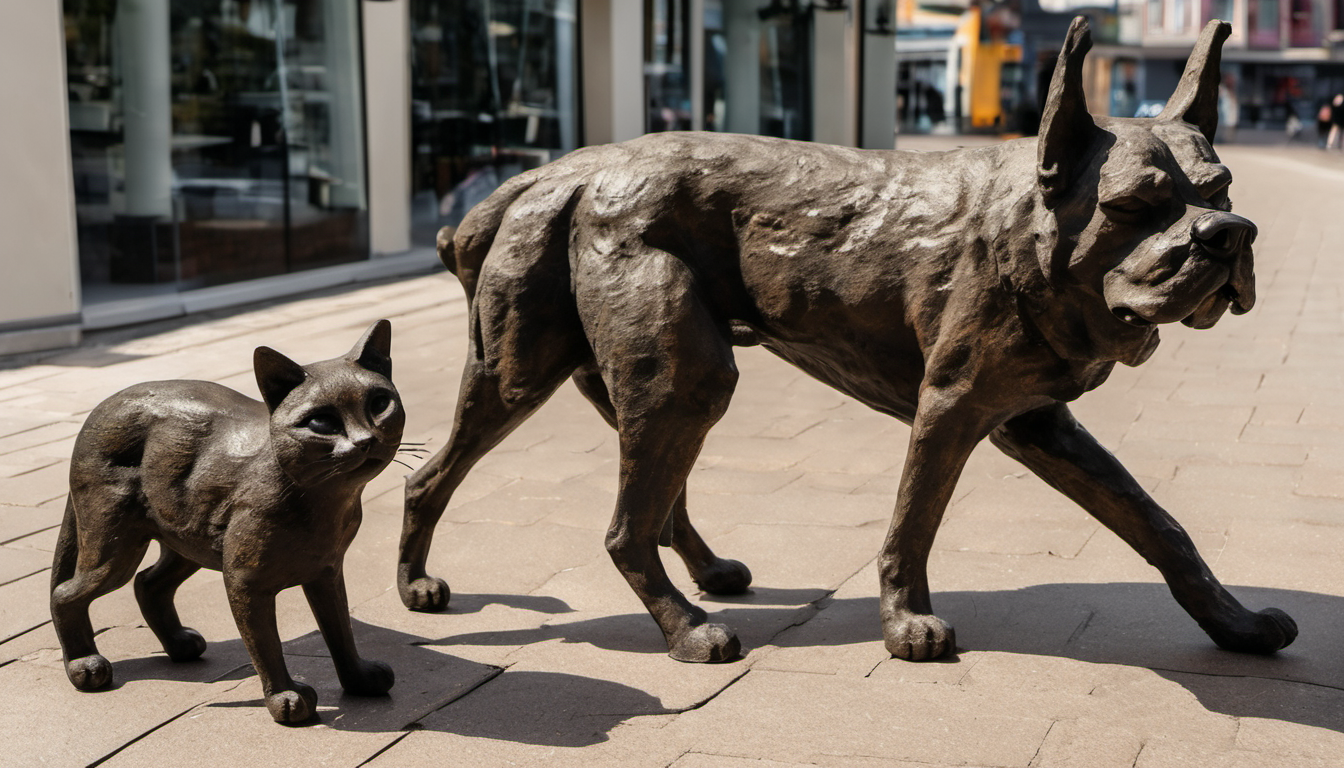
Featured image: A bronze sculpture depicting a dog and a cat. AI-generated image; not a photograph of the reported event.
The statue stands outside the Arsenal shopping center in northwest Tallinn, honoring Žorik—a dog who lived on the city’s streets for over a decade.
Who Was Žorik?
Žorik was born in 2007 in Kalamaja, a former working-class fishing district that has since gentrified. At the time, the area was home to fishermen, shopkeepers, and long-time residents who relied on the harbor for livelihood and identity.
He lost his first owner as a puppy and spent most of his life roaming the harbor and nearby streets. His early years were unstable, common for street animals in cities. He woke with the dawn, moved with the tide, and found shelter in cracks between buildings and under overhangs.
Residents, especially older generations, noticed him early. They often left food in plastic bags or on benches near the harbor. Some brought scraps after long workdays. These small acts became part of the neighborhood’s social fabric.
Locals called him ‘the phantom dog’ because he vanished when animal control tried to catch him. This wasn’t just evasion—it was a survival instinct. Many believed past mistreatment made him wary of people getting too close. That fear likely came from years of being approached, ignored, or threatened.
He earned a Russian nickname, Ugaljok—’little piece of coal’—for his dark head, shaggy muzzle, and black-and-white body. The name, used by Russian-speaking residents, reflects coal’s symbolism of endurance and warmth in cold climates. It bridged language and generations, becoming part of neighborhood identity.
Community and Cultural Impact
Žorik became a bridge between different groups in Kalamaja. Russian-speaking pensioners, many of whom lived there for decades, cared for him. They saw in him a reflection of their own lives—steady, resilient, rooted in place.
Younger residents, especially Estonian hipsters, saw him as a symbol of authenticity. One café owner, Elina, opened a coffee shop in his honor. She chose the name because it felt like a place where people could be themselves. ‘Žorik was always there, watching, waiting,’ she said.
Over time, Žorik became a rare point of social integration in a neighborhood changing rapidly. His presence helped build shared identity among residents, especially during times of transformation.
Health Decline and Relocation
As Žorik aged, signs of senility grew. He lost his ability to navigate familiar routes. He began wandering into unfamiliar areas and getting disoriented during the day.
He was found sleeping on train tracks, tram lines, and roads crossing his territory. Neighbors reported these incidents—sometimes near crossings, sometimes under bridges. One resident, Jaan, found him asleep near a railway overpass, ‘with his tail tucked between his legs, like a child who had lost their way.’
To ensure his safety, he was moved to a foster family’s yard in the countryside. The family, with no prior animal experience, said they were moved by the idea of giving him a safe, quiet space to rest.
Public Response and the Statue
After Žorik disappeared, residents began fundraising for a statue. A group of schoolchildren started a drawing competition with the theme: ‘What does a beloved animal mean to you?’ Žorik’s image won as the most popular entry.
Local sculptor Kain Rezev was commissioned to create the statue. It was funded by donations from 61 people. The bronze was unveiled on World Animal Day, at the exact spot where Žorik used to sit and greet visitors.
The statue shows Žorik with a small cat curled at his feet. This detail reflects the neighborhood cats he was known to sleep beside and watch over. It honors the shared ecosystem of animals in the area.
Life After the Statue
Žorik lived in the countryside after the statue was erected. He stayed quiet and observant, often lying in the shade of a garden shed or near a wooden fence.
He died. His passing prompted local fishermen to organize a candlelight vigil on the harbor. Dozens gathered to light candles and share memories. Estonian television filmed neighbors laying flowers at the memorial, honoring him as the last of a once-large pack of free-roaming dogs from the harbor.
Why This Matters
Free-roaming dogs were already rare in Tallinn by the time Žorik lived. Urban development, rising property values, and stricter animal control policies have made such animals uncommon. Žorik’s story reflects a broader shift in cities—where animals once lived freely, now often face confinement or removal.
Yet Žorik’s legacy shows how one animal can become a symbol of community resilience and shared identity. The statue stands as a quiet testament to the human-animal bond in a city changing rapidly.
Limitations and Open Questions
There is no official record of how many free-roaming dogs once lived in Kalamaja. While Žorik is widely remembered, the broader history of stray dogs in the city remains under-documented. There is no public data on how many residents contributed to the statue or how many still visit it regularly.
His story does not reflect a policy shift in animal welfare or changes in city regulations on street animals. It’s unclear whether other animals in the area have been recognized in similar ways.
What to Watch Next
As Tallinn develops, the fate of public spaces and their animal inhabitants remains uncertain. Future developments may include more public recognition of street animals—or greater efforts to remove them.
Whether more statues follow, Žorik’s story remains a powerful reminder of how ordinary lives can become part of a community’s cultural memory.
For those interested in animal stories in urban settings, a similar story of a dog adopted after a human’s death offers a different perspective on human-animal bonds.
For more on how urban spaces shape community identity, see how political decisions influence public spaces.
The statue stands at 16 Erika tn, Tallinn, Estonia. It is accessible around the clock, with ample parking nearby. The bus stop Erika is just steps away, and the nearest tram stop, Angerja, is a 10-minute walk.
- The statue was unveiled on World Animal Day.
- It was funded by donations from 61 individuals.
- Žorik lived in Kalamaja for over a decade before being moved to the countryside.
- The statue features a small cat curled at Žorik’s feet, reflecting his relationship with neighborhood cats.
For more on this place, visit the original source at Atlas Obscura.