Last week, during the peak of the high season on the east end of Long Island, the Town of East Hampton used its legal resources to file a lawsuit demanding that a work of art—and here I’m using the language of the lawsuit—be “demolished.”
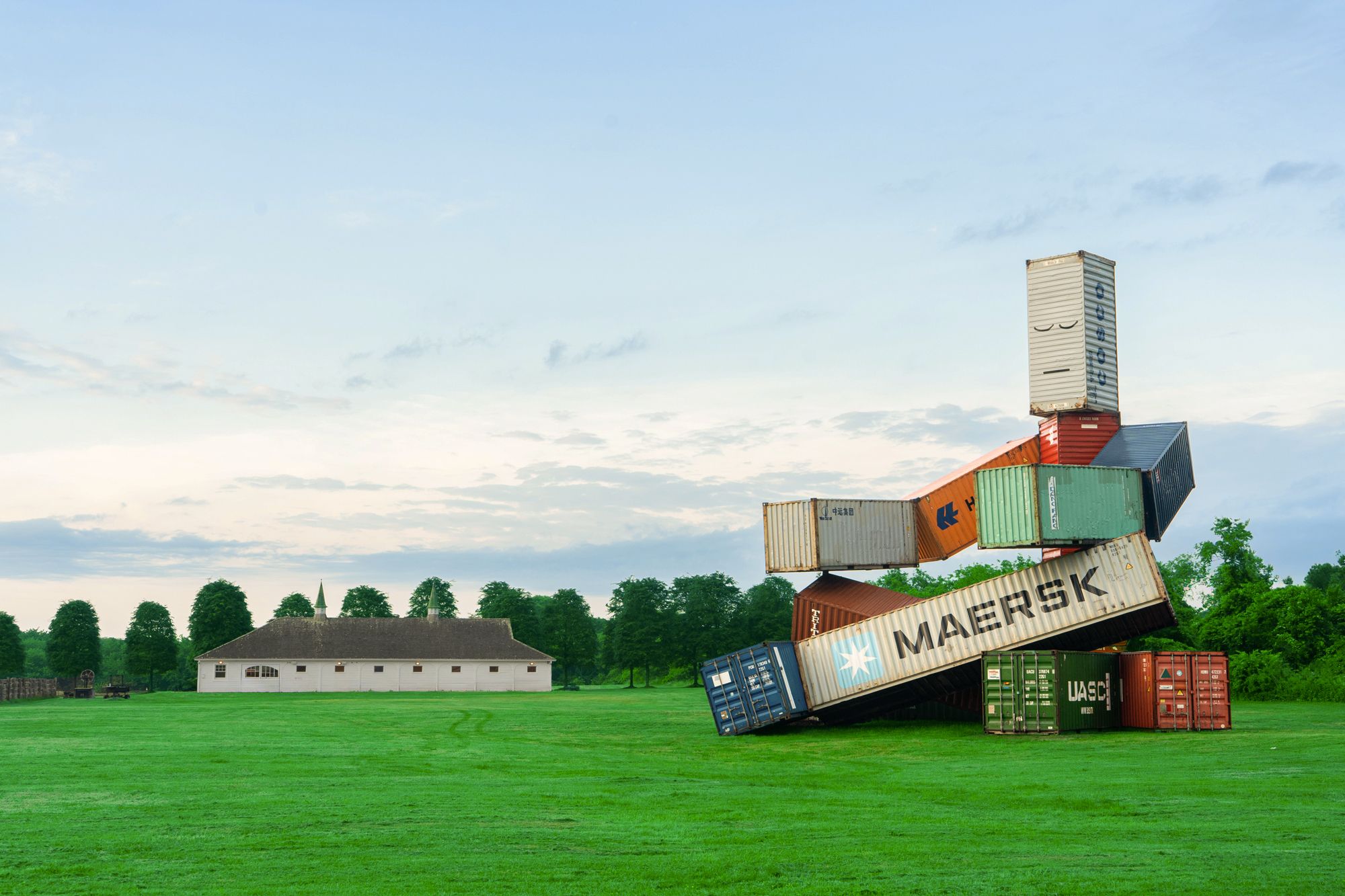
It wasn’t just any work of art. It’s a recognizable statement by a well-known artist—and it’s very, very big. Installed in June at Montauk’s art space The Ranch, Matt Johnson’s sculpture Meditating Figure is a 60-foot-tall installation made of defunct shipping containers that depicts a stick figure in the lotus position. The work is part of a group show called “LA Monumental” that pairs Johnson, whose studio takes up a large tract of land in remote Malibu, with two of the seminal figures of the Los Angeles art diaspora: Nancy Rubins, known for the large-scale sculptures she makes in Topanga Canyon, and Paul McCarthy, the West Coast art hero who’s worked across film, painting, performance, and installation.
Now there’s a lawsuit calling Johnson’s art illegal. The complaint, filed by Assistant Town Attorney Dennis Brown in East Hampton, deems Meditating Figure an “unpermitted structure,” saying it resides on land that is “permanently restricted to use for agricultural production only,” despite the fact that concerts and other art exhibitions have been held on this land without sparking legal action. While the lawsuit states that art dealer Max Levai owns the land itself, it also says that the town has owned the development rights to the parcel in question since 1983. The lawsuit asks for the artwork to be “dismantled or demolished immediately.”
Johnson’s sculpture is a highlight of the art offerings out east this summer. It’s a spiritual sequel of sorts to his previous work Sleeping Figure, a 150-foot-long rendering of a figure in repose made from 12 massive shipping containers that debuted in the Coachella Valley as part of “Desert X,” immediately becoming a favorite of the desert-going public.
Sleeping Figure is now permanently installed in Marfa, the West Texas art oasis built up by Donald Judd. Meditating Figure, meanwhile, is “one of the more ambitious compositions” of Johnson’s career, according to the artist. He told me about how his team of engineers and studio hands helped source shipping containers in specific colors, from specific places—all displaying the wear and tear of their countless jaunts across oceans.
“These objects that exist in our world, I look at them,” he says. “And to me, they are the beginnings of potential artwork.”

Meditating Figure, 2026 by Matt Johnson. Courtesy of The Ranch
It made sense to Johnson to install the piece in Montauk, the farthest point of Long Island, the city that locals have long called “the end of the world.” (For the record: Montauk has never actually been its own incorporated town. The land at the end of Long Island was bundled up with East Hampton in the 17th century, and has remained that way ever since.)
“I think a lot of times, artists—and I certainly feel this way about living where I live—it’s nice to sort of just get yourself a distance away from all the stuff that’s going on,” Johnson says.
Long before the $400 melons, $100 lobster salad, or the $150 million home listing, the Hamptons was known as an artists’ colony—and plenty of institutions have kept that tradition going. That roster includes The Ranch, started by Levai in 2021. For years, it’s been staging ambitious programming on 26 acres that also contain the nation’s oldest horse ranch.
“Whether it’s these great local museums that are all really supportive, or other people doing similar things to what I am in a non-traditional way—and obviously an incredible amount of affluent collectors are out here, looking to see art in a different context,” Levai says.
Given this history, that venue seems like a natural place to stage boundary-pushing, ambitious shows of contemporary art, pieces that can generate both praise and criticism, and make people think about culture in a place absolutely steeped in it. Meditating Figure is, in Levai’s mind, doing exactly that.

Meditating Figure, 2026 by Matt Johnson.Courtesy of The Ranch
“I’d like to think of The Ranch as both a workshop and stage for achieving this sort of mutual dream,” he says. “And that sculpture, certainly, I think kind of defines that, right?”
The Town of East Hampton disagrees. Throughout the suit, the artwork is referred to only as a “structure,” downplaying its power as a cultural object. Residents must get building permits if they want to embark on new construction—homes, offices, renovations. But permits aren’t needed if a collector wants to install an artwork on their own front lawn. By using the law as a form of art criticism, the suit is wading into fraught waters. A public information officer at the East Hampton Supervisor’s Office could not be reached for comment.
The Ranch announced “LA Monumental” on June 18 with an Instagram post showing Johnson in the midst of installing his work: cranes erecting the sculpture, an art handler dangling his legs off one of the shipping containers to show its scale. The carousel quickly drew positive comments from fellow art dealers, collectors, and art lovers. But the art world may have been unaware of another post, by the local news source 27 East, showing the sculpture in the middle of installation, not yet complete.
On that post, the comments were vicious.
“Couple lawn ornaments. Nbd,” one read.
“Ruining montauk officially,” read another
“Thats a construction project that could set a dangerous precedent,” said a third.
“But I need a building permit to walk out my front door in the morning,” complained one more.
The issue was brought up during the East Hampton Town Board Work Session on July 7. During the livestreamed, hours-long meeting, only one councilperson came to the art’s defense: Tom Flight, a longtime Montauk resident who served on the local school board.
“This one I have slight issues with. This is a public work of art. We don’t have a lot of guidance—when are we restricting art to be displayed?” he said in the meeting, held at town hall, just off East Hampton’s ritzy main drag. “To deny people the ability to exhibit art is not something that I personally support.”
“By definition this is a structure,” answered Jake Turner, the town attorney for East Hampton. “They’re welding big pieces of metal together. It needs to go through the building department for applicable safety standard checks.”
Flight and Turner went back and forth about whether a sculpture of found readymades can be deemed art—fairly highbrow stuff for a municipal town hall meeting—until Councilmember Cate Rogers mentioned that they should move for a vote to explore legal action.
“It’s a tool,” she said. “Hopefully we’ll start with a conversation and get compliance.”
The vote passed 4 to 1, with Flight casting the only vote to not move forward with exploring legal action against The Ranch.
It’s not exactly uncommon for the Town of East Hampton to shut down development in the name of what it deems to be the public interest. East Hampton has banned private clubs; the town also went to the mat against Duryea’s, home of the $100 lobster Cobb salad, when the restaurant wanted to expand its outdoor deck. The town is constantly preventing the construction of cell towers, keeping the area charmingly full of service dead zones. In this case, weeks after the July 7 vote—at a time when the council’s exploration period had apparently ended—it filed its legal action against Meditating Figure.
On July 28, the Town of East Hampton sued The Ranch, Max Levai, and Matt Johnson in Suffolk County Supreme Court, calling the artwork an “unpermitted structure” and claiming that it stood on land zoned for agriculture. (Johnson was later removed from the complaint.)
The lawsuit made no qualms about its stated goal: The people behind it wanted Meditating Figure destroyed: specifically, “dismantled or demolished.”
Levai was shocked.
“We were never given a stop-work order or never made aware that there was an issue or that the town was going to take position on this,” he tells me.
Levai says he found out about the board meeting’s vote only after someone forwarded a link to a recording of the proceedings, which was posted on YouTube. “So we were sort of blindsided by it.”
Levai says he would have been happy to assure the Town of East Hampton of the structure’s safety: He tells me he’d have provided them the engineering sets used to install the work, and years’ worth of materials about other complicated sculptural installations he’d overseen at The Ranch. But he says the town never requested such materials from him.
Levai also disputes the claim about installing a structure on agricultural land. In the ’90s, he said, that parcel of the property had been used for a series of concerts called Back to the Ranch, none of which had explicitly agricultural purposes.
According to the suit, the town primarily objects to the piece being put up without the proper permitting—something Levai says isn’t usually required for an artwork. Perhaps this is why the lawsuit labels Johnson’s piece as a “structure.”
There, too, the artist says the lawsuit is misguided. Code enforcers did come by the property on the final day of installation, he says—right after 27 East published its post about the piece. But the enforcers did not issue a stop-work order. Instead, says Johnson, one offered this reaction: “Hey, I’m really sorry. I’ve got to talk to you about this kick-ass sculpture.”
“The code enforcement guy was like, ‘Whatever you’re doing, this is cool. And I’m sorry to have to talk to you about it,’” Johnson adds. “So he was really supportive and really cool. And he was basically like, ‘Look, I get it. You’re two hours from finishing. Just finish it. I’ll drive by tomorrow to make sure you’re not still working on it so that you’re telling me the truth or whatever. But yeah, just finish it. And the property owner will get a citation at some point, but I’m not going to issue the stop-work order so that you can just finish it.’” (East Hampton’s Code Enforcement Department did not respond to VF’s request for comment.)
As of now, Levai and The Ranch are hoping to come to an agreement with the town before an initial court appearance, which is scheduled for September 10. The goal is to establish a clear set of guidelines for installing large-scale art at The Ranch in the future. For now, Meditating Figure remains standing—and its notoriety might be helping the work in the long term. It began as a great large-scale sculpture in an ambitious summer show; now it’s a point of discourse.
“I think in this day and age for people to be arguing about whether something is art or not, I think that’s a pretty good place to be,” Johnson says. “Because I think that argument is so old that it’s rare that it resurfaces.”
Have a tip? Drop me a line at nate_freeman@condenast.com. And make sure you subscribe to True Colors to receive Nate Freeman’s art-world dispatch in your inbox every week.
-
Andrew Tate Was the Toast of Trumpworld. Has That Changed?
-
The 10 Biggest Odyssey Updates From Homer’s Original Text to Christopher Nolan’s Latest Film