Geoffrey Bardon has long been celebrated as the founding hero of Western Desert Aboriginal dot painting. But a new biography challenges that narrative, revealing a story of myth, mental health struggles, and cultural appropriation. The origin story of Aboriginal dot painting — a globally influential art movement — has for decades been framed through a white Australian lens, with Geoffrey Bardon positioned as a visionary teacher who discovered and elevated Indigenous artistic traditions in remote Papunya.
The Myth of the White Saviour
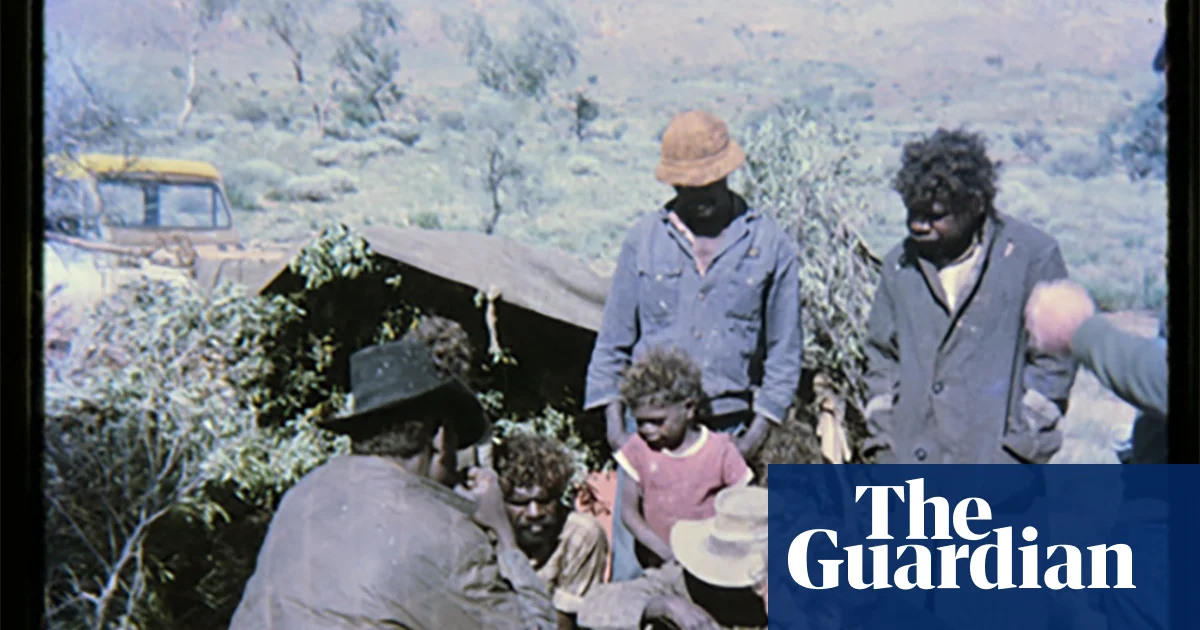
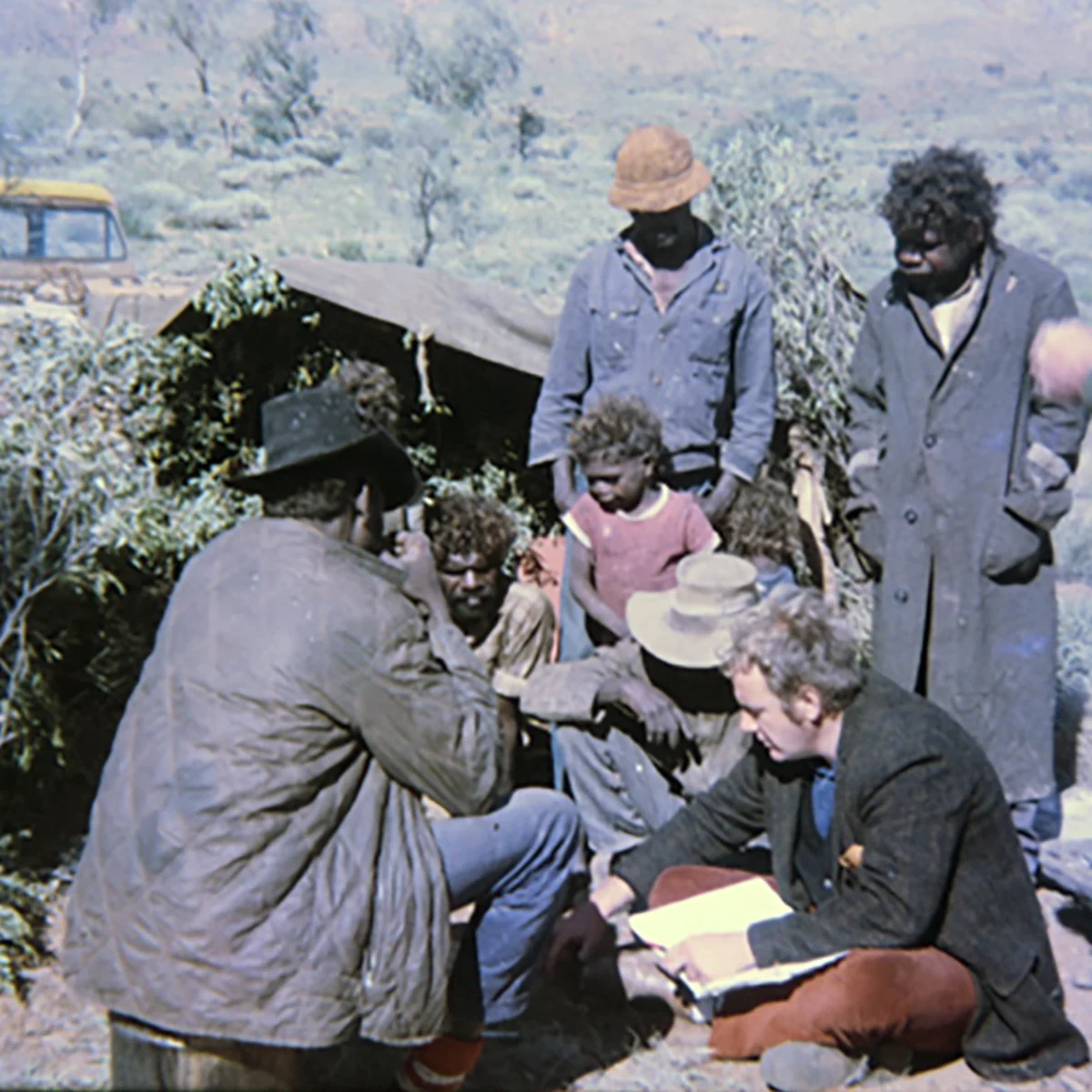
For decades, the origin of Aboriginal dot painting has been told through a white Australian lens. It centres on Geoffrey Bardon, a Sydney art teacher, arriving in 1971 at Papunya, a remote Aboriginal settlement. At the time, Papunya was a settlement of assimilation, where Indigenous people were being pressured to adopt Western forms of work, education, and social structure. The community was composed of diverse groups — Warlpiri, Pintupi, Luritja, Anmatyerr, Arrernte, and Pitjantjatjara — each with distinct languages, traditions, and worldviews.
Bardon met these men and encouraged them to paint stories they had long shared on sand and on bodies. He began with a mural of honey ants on the external school wall — a story of ancestral beings and spiritual journeys. This mural became the symbolic starting point of what would later be known as the Western Desert painting movement. Bardon then began selling the works, launching a global art market. The men became known as the ‘painting men’ — a title that has since been central to the movement’s public identity.
However, this version of events is now being questioned. A new book, Art Mania: Geoffrey Bardon and the Painting Men of Papunya by Kitty Hauser, shows how much of this story is shaped by myth, personal ambition, and the selective memory of white cultural institutions.
What Happened at Papunya?
Bardon taught at the elementary school and supplied paint and boards — materials he personally purchased and brought from Sydney. He saw the men’s work not as a cultural artifact to be collected or studied, but as a legitimate form of artistic expression. His belief in the artistic merit of the paintings was profound and early, even before the market began to grow.
On weekends, he drove his Kombi van to Alice Springs with the paintings, selling them to a fledgling arts centre. The proceeds were returned to the men, who still performed manual duties for white administrators. This arrangement created a complex dynamic: the men were being paid for their art, yet remained under the control of a colonial system that valued labour over cultural autonomy.
Some officials viewed the paintings as a distraction from essential work. Bardon’s chaotic lifestyle — marked by erratic spending, inconsistent record-keeping, and a lack of financial oversight — drew criticism. His status as a single man, with no family or social support network, made him vulnerable to judgment and scrutiny.
He was accused of ‘trafficking’ Aboriginal art — a serious allegation in a settlement where cultural property was tightly guarded. A written note found in his archive reads: ‘I was always tempted to cheat them.’ However, Hauser notes that no evidence has emerged to suggest Bardon actually did so. His financial records were disorganised, and his accounts were often incomplete or inconsistent. This suggests that his actions were not driven by malice, but by a lack of structure and a deep emotional investment in the experience.
At times, Bardon was exposed to sacred stories — stories that were culturally taboo for outsiders to see or hear. These stories were not just about art; they were about spiritual beliefs, ancestral connections, and the transmission of knowledge across generations. Bardon’s presence, while well-intentioned, disrupted these sacred boundaries. He became increasingly paranoid, isolated, and depressed. He believed he was under surveillance — once, by a man named Asio — and felt that his presence was being monitored and judged.
He stayed in a pub and abused anyone he could find. The painting men, many of whom loved him and relied on him for stability and support, followed him into town with their works wrapped tightly like wounded animals. On Sunday, he was hospitalised. His brother, Jim Bardon, crossed the continent to bring him back to Sydney, where he lived with his parents in Randwick.
Deep Sleep Therapy and Mental Health
After returning to Sydney, Bardon was admitted to Chelmsford Hospital in August 1972 for deep sleep therapy. The treatment, administered by psychiatrist Harry Bailey, combined extended heavy sedation with electroconvulsive therapy to ‘reset’ the brain and psyche. This therapy was not a form of psychotherapy or psychological treatment in the modern sense. It was a medical intervention rooted in outdated psychiatric practices, designed to erase symptoms of mental illness through physical manipulation of the body.
By 1990, a royal commission had exposed the treatment as responsible for 24 deaths. The therapy was widely discredited, and its use in psychiatric care was eventually discontinued. Chelmsford was not just a hospital — it was a place where patients were drugged into unconsciousness for days or weeks, with little to no oversight or ethical guidance. The treatment was antithetical to modern psychiatry, which prioritises empathy, individualised care, and evidence-based practices.
Hauser writes: ‘Didn’t both institutions seek to instigate (imperfectly) a deliberate forgetfulness, a whitewashing of minds, in one case, and of entire cultures in the next?’ This is a powerful observation. Chelmsford sought to erase the mental health struggles of its patients — to make them forget their pain, their trauma, their identity. Papunya, in turn, sought to erase the cultural memory of its people — to make them forget their traditions, their stories, their spiritual practices — in order to assimilate them into a Western model of work and reward.
Bardon survived, but never fully recovered. In a 1979 documentary, Mick and the Moon, he said: ‘I did recover but could not hold a proper job and have been an invalid ever since.’ His mental health remained fragile throughout his life. He struggled with depression, paranoia, and a deep sense of shame — feelings that were likely exacerbated by the trauma of his time at Papunya and the institutional neglect he faced.
The Role of Jim Bardon
Geoffrey’s older brother, James Bardon, was a barrister and a writer. He used his brother’s time at Papunya as creative fuel. He wrote two novels, including Revolution by Night (1991), which won the Victorian Premier’s Literary Award. He also made film documentaries and published articles and speeches that portrayed the painting men as heroic figures, cultural icons, or mythic figures.
Hauser writes: ‘Jim got a fair bit of literary mileage out of the painting men, or his idea of them. There could hardly be a better example of appropriation, even if it has gone under the radar (including, perhaps, Geoff’s) because of the obscurity of Jim’s writing.’
Jim’s work shows how white artists have long used Indigenous cultural expressions as inspiration without consent or credit. The painting men were not consulted, nor were they involved in the creation of these narratives. Their stories were reframed through a white lens — as heroic, noble, and timeless — while their actual experiences, emotions, and cultural contexts were omitted or distorted.
For instance, in Revolution by Night, the painting men are portrayed as figures of resistance, of cultural survival, of triumph over colonialism. This narrative is compelling, but it is not grounded in the actual lived experiences of the men. It is a constructed story — one that serves a literary purpose, not a cultural one. The book reflects a broader pattern in Western art history: the use of Indigenous imagery and themes as a source of inspiration, without acknowledging the origins or the people behind the art.
Aboriginal Art Before Bardon?
Hauser’s research shows painting was already happening in Papunya and other Western Desert communities. For example, people at Yuendemu were painting before Bardon arrived. Indigenous art traditions had long existed, with stories and visual forms passed down through generations — not as a result of a single teacher’s intervention, but as part of a continuous cultural practice.
Historians like Donald Thomson and Norman Tindale had previously collected Aboriginal art, often without community consent. Charles Mountford was among the first to export bark art from Arnhem Land — a move that was both commercially driven and culturally exploitative. These early encounters reflect a pattern: white men positioning themselves as discoverers of Indigenous cultures, claiming credit for art that was already present and deeply rooted in community life.

Before Bardon arrived, the art of the Western Desert was not a ‘discovery’ — it was a living tradition. The men at Papunya were not creating art for the first time. They were continuing a practice that had been passed down through generations. The idea that Bardon ‘discovered’ the art is a myth — one that has been repeated in art history, museums, and academic texts, often without critical reflection.
Why This Matters
Geoffrey Bardon’s story is not just about one man. It reflects broader issues of cultural ownership, representation, and power. Indigenous art has been central to global art movements — from the 1960s to the present — yet the narrative of its origin has often been shaped by white perspectives.
Margo Ngawa Neale, an Indigenous art curator and writer of Gumbaynggirr and Wiradjuri heritage, says Bardon’s role was ‘a short story with a long ending’. She says: ‘He was a damaged man but a talented one who gave the best of himself to the painting men of Papunya — he became a messiah in the eyes of many, if not himself.’
His support was sincere. But his vision of the experience was shaped by personal ambition and artistic myth-making. Bardon saw the experience at Papunya as a personal artistic opportunity — a quest, a journey, a transformation — and he framed it through the lens of Joseph Campbell’s monomyth, the hero’s journey. In his writings, he portrayed himself as a quester returning with a communal prize — a narrative that reflects the romanticisation of Indigenous art as a ‘heroic’ triumph.
Yet, this narrative ignores the fact that the men at Papunya were not ‘discovered’ — they were already artists. Their art was not a gift to be given to a white teacher. It was a form of cultural expression that had existed long before Bardon arrived. The movement was not born from a single intervention, but from a complex web of social, political, and cultural forces — including colonialism, assimilation, and the marginalisation of Indigenous voices.
What We Don’t Know
Hauser admits she does not know what happened at Papunya in detail. She writes: ‘There is something else that Geoff could never speak about — or something that tilted the world away from him and made it impossible to stay.’
She says the book is about the limits of knowing. We want to see everything. We want to know the full story — the emotions, the conflicts, the decisions. But some things cannot be directly shown — in art, in life, in memory. Aboriginal art, like human experience, has layers that cannot be fully captured in stories or records. The men at Papunya may have felt a deep sense of pride, but they may also have felt a sense of loss — of being seen, of being understood, of being respected.
There is no record of how the men themselves viewed Bardon’s presence or his actions. Their voices are absent from the central narrative. The story of Papunya has been told from the perspective of a white outsider — a teacher, a visitor, a chronicler — not from the perspective of the people who lived it.
How the Book Was Made
She felt it was ‘too dark to do’ at first. She didn’t want to write a story about mental illness, about colonialism, about cultural erasure. But things kept happening — coincidences, encounters — that made her believe the story was hers to tell. She met people with relatives who had been at Chelmsford Hospital. These encounters made her realise the emotional weight of the institutions involved.
She spent 18 years researching. Her sources include extensive visits to the Bardon family archive at Dorn’s home in Newcastle. The archive includes boxes of writings, photos, personal notes, and letters. Hauser says she ‘came to look forward to my visits’ to Dorn, who cared for the materials with deep respect and love. The archive holds both joy and pain — of a man who tried to make sense of a transformative experience.

She acknowledges the emotional toll of working with such material. The writings are not just records — they are personal, vulnerable, and often contradictory. They reflect the complexity of human experience — the desire to be seen, to be understood, to be remembered.
What the Book Reveals
Geoffrey Bardon is not a saint or a villain. He is complex. He was a man with deep convictions, a sense of purpose, and a desire to connect with others. He saw the art as a form of expression and believed he was helping. But he also saw it as a personal artistic opportunity — a story to be told, a journey to be lived.
In his writings, he used Joseph Campbell’s monomyth — the hero’s journey — to frame his experience. He saw himself as a quester returning with a prize. This is not a denial of the men’s art — it is a reflection of how white men have long interpreted Indigenous experiences through mythic frameworks.
Hauser writes: ‘It was for him the great time, the sacred time when he felt something shift. It was something that could never return for him, he found, except momentarily in the echo of his own repetition of it.’ This line captures the emotional depth of Bardon’s experience — a moment of profound connection, followed by a long period of absence and regret.
Limitations and Open Questions
Hauser does not claim to know the full truth of what happened at Papunya. She does not know why Bardon left. She does not know how the men felt about his presence or his actions. She does not know whether the art movement would have developed differently without him.
She says: ‘We don’t like that. We want to know, want to see everything! That’s true of the art too.’ This desire to know everything is a fundamental part of Western culture — a culture that values clarity, explanation, and closure. But in Indigenous cultures, such closure is not always possible. The stories are not linear. They are layered, cyclical, and deeply connected to land, memory, and identity.
Some Indigenous artists and curators argue that Bardon’s role was overstated. They say the movement was rooted in community practice, not a white-led intervention. The art of the Western Desert was not a product of a single teacher’s vision — it was a response to the needs of a community that had long been marginalised.
There is no record of how the men themselves viewed Bardon’s role. Their voices are absent from the central narrative. This absence is not a gap in the story — it is a deliberate choice, one that reflects the power dynamics of cultural representation.
What to Watch Next
As more research emerges, the story of Papunya art may continue to evolve. Future work could include interviews with the painting men themselves, or with descendants of those who lived at Papunya. Such efforts could offer a more balanced view of how art, culture, and power intersect in remote Indigenous communities.
Art Mania: Geoffrey Bardon and the Painting Men of Papunya by Kitty Hauser, published by Giramondo ($39.95). Available at the guardian.
Sources & further reading
Featured image: original publisher image. Via original publisher. Image source