The automaker’s world-record-setting facility underscores a world-class commitment to safety, it says.
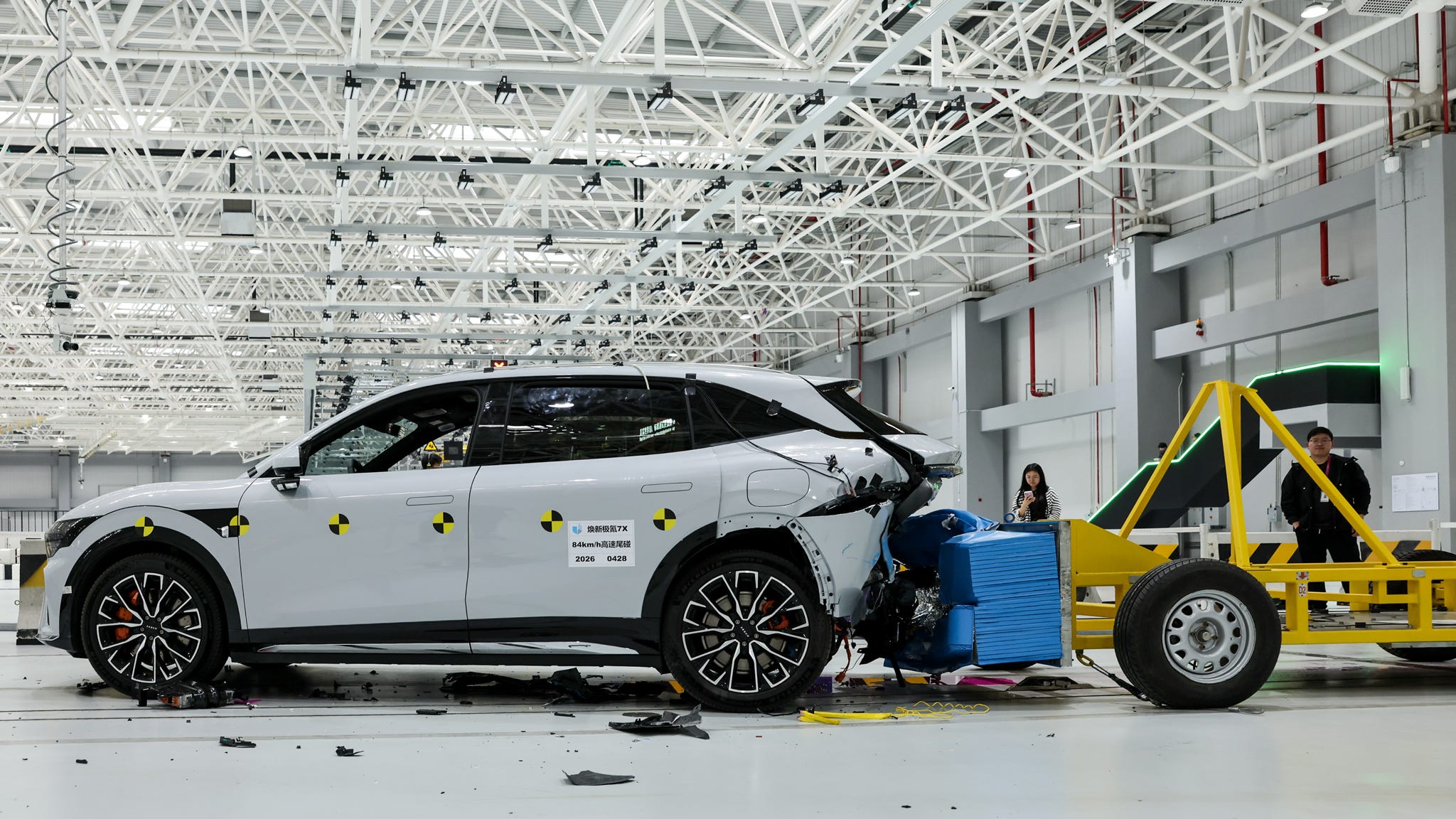
Finally, after the indoctrination tours and the interminable speeches, it’s time for the main event. The light goes on over a Geely 7X SUV positioned behind a set of barriers. “A real car crash test is about to begin.” Horns sound, lights flash, and someone starts counting down over the loudspeaker in Chinese. Suddenly, a construction yellow rolling exoskeleton approaches the SUV from behind at 53 mph. Ramming speed. Whap.
As you’d expect, the 7X EV took a major hit, but didn’t fold like a cheap dime store accordion. In fact, it looked to be in decent shape, all things considered. Yes, we know, Geely wasn’t about to embarrass itself in front of a horde of journalists gathered from across the globe at its massive, record-breaking, world-class safety facility in Nigbo, China, south of Shanghai on Hangzhou Bay, to watch the big show. But it’s also more than confident in its facilities and what it calls a “solemn commitment” to safety.
Putting Its Yuan Where Its Mouth Is
Started in 2022, the main Geely Auto Safety Centre complex was completed in December of 2025. It looks like you could eat off the floor, it’s that industrially clean, with massive concrete walls more than three feet thick in some spots, white painted surfaces, and acres upon acres of girder-supported ceilings. The main building is 45,000 square meters, or 484,376 square feet, and so far, Geely has invested more than 2 billion RMB into it (just south of $300 million).
Geely is especially proud of its five Guinness Book of World Record records for the facility:
- The largest automotive safety laboratory
- The longest indoor car crash test track
- The largest altitude-climate adjustable wind tunnel facility (155-mph max wind speed)
- The largest arbitrary-angle (0-180 degrees) car crash test zone
- The most tests (27 types) available in an automaker safety test laboratory
Ambitious doesn’t begin to describe it, and maybe there’s a bit of overcompensation going on here. But it’s no wonder why Geely has gone all in on the safety front. The Chinese automakers know if they want to make it on the world stage, their cars need to be unimpeachable, safety-wise, given all the negative press the domestic industry endured as it got off the ground some two decades ago. Some cars were folding like those cheap accordions back then during crash tests. (Geely, which is celebrating 40 years this year, started its automotive business in 1997 and prides itself on being privately owned and safety led.)
It has the added benefit of owning and subsequently learning from Volvo since 2010. The Swedish automaker made safety part of its stock and trade, and clearly that mindset rubbed off on Geely. It wasn’t lost on us that two of the presenters in the run-up to the crash test were Swedes. It’s now applying those lessons learned in earnest and putting a huge amount of yuan behind its overall safety efforts.
The Chinese automaking colossus, who also owns Polestar and Lotus in addition to its homegrown Lynk & Co and Zeekr marques (it also owns a major stake in Malaysia’s Proton), made it clear that it’s a global automaker with global aspirations, with major European facilities in Gothenburg, Sweden; Milan, Italy; Frankfurt, Germany; and Coventry, U.K. To that end, one of the points of emphasis it pushed was that its cars are being tested to pass any crash test the world can throw at it, including those of our own National Highway Traffic Safety Administration (NHTSA) and the International Institute for Highway Safety (IIHS).
Dummies for Days and Making It Rain
On our whirlwind tour of the Geely Safety Centre, we saw dummies. Big dummies, baby dummies, old dummies. There are some 60 of them in operation at any one time, and they can be quickly shuttled in their seats right to the test vehicles, and can be fully scanned for damage in just 10 minutes after the crash. Speed of data collection was called out as one of the Safety Centre’s primary advantages.
The wind tunnel area is as big as 30 NBA basketball courts with meter-thick concrete, and can quickly freeze or bake a car and blow 150-plus-mph winds over them while simulating high or low altitudes. Other automotive torture tests include running over battery packs with tanks and simulating penetrating them with bullets. There are also stress tests for cyber security systems and all manner of software and hardware. And, you guessed it, AI is a huge part of it all, from data collection and analysis to problem solving and future proofing.
Then there’s the area where they make it rain, literally. Or snow, or fog, or throw off a wicked glare, even lightning. Geely’s billing it as the world’s first multi-scenario simulation lab, and it can recreate 264 scenarios in all. The primary role of the lab is to help test autonomous vehicle systems in inclement weather conditions.
Impressive? Yes.
Geely claims roughly 1,500 safety patents in all, and it’s not hard to see why after getting a look at what it’s got going on at the Safety Centre.
Yes, it was easy to be taken in by the shininess and enormity of the space, the world records, and slogans like “safety always comes with Geely.” But putting aside the politics of it all and the wariness around what China’s global automotive aspirations mean for the future of the American auto industry, it was hard not to be impressed by our crash-tested tour of what’s arguably the globe’s most comprehensive automotive safety facility.
Stay Ahead of the Curve.
Get the newest car reviews, hottest auto news, and expert analysis of the latest trends delivered straight to your inbox!
A 30-plus year veteran of the publishing industry, Mike cut his teeth in the newspaper business before covering cars full-time in 2000. He’s spent his career on the bleeding edge of digital operations and editorial at MotorTrend, with a stint as editor-in-chief of Automobile magazine along the way.
Read More