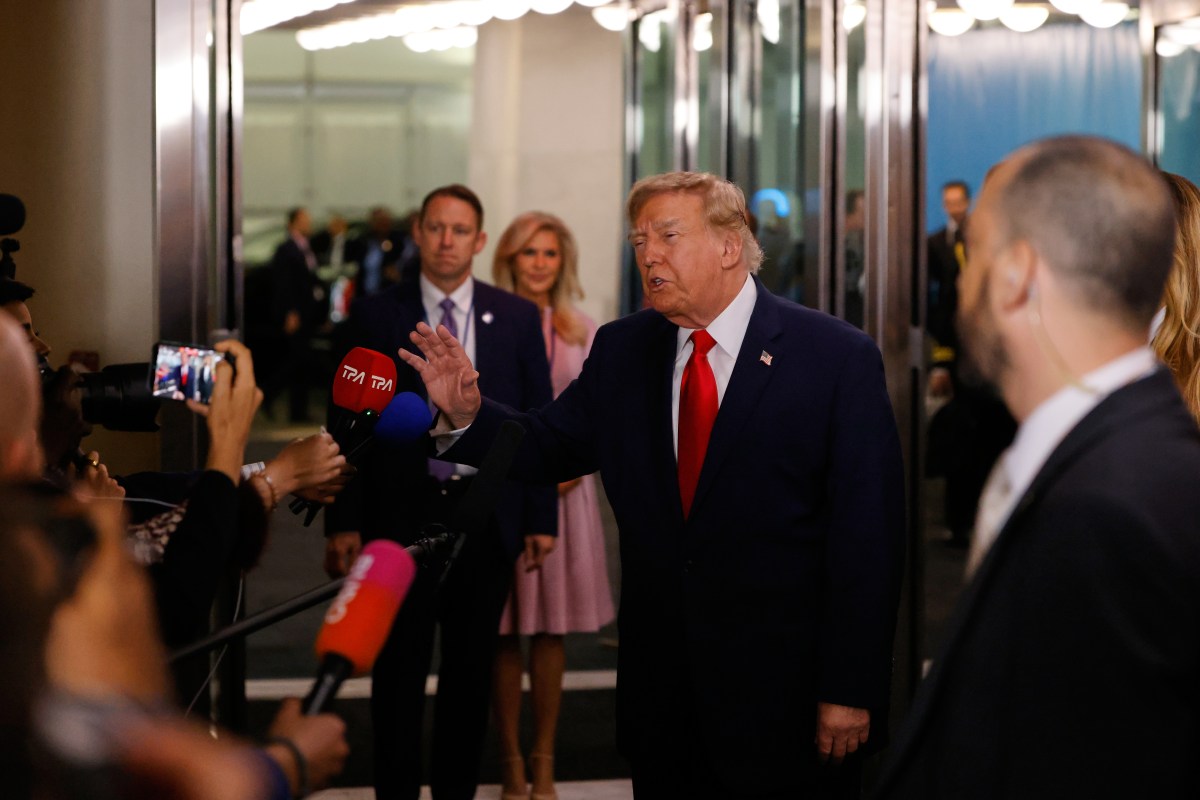
President Donald Trump gave his highly anticipated U.N. General Assembly speech Tuesday morning in front of a standing-room-only crowd.
However, as Trump spoke about the last six months of Iran’s military strikes, that country’s U.N. delegates walked out of the assembly.
During his 40-minute address, Trump told the gathering of world leaders in New York City that he had a “big decision” coming up on Iran.
“Will a deal be made with Iran that lets them rebuild and create a far greater country than it ever was before?” Trump asked.
“Or do I annihilate the Islamic Republic and do it quickly, never giving them a chance to kill and destroy people and countries again?” The president continued: “Do I drive them into hell?”
Later Tuesday, Trump told reporters that U.S. and Iranian officials met for three hours at the General Assembly. He said that his two diplomatic representatives, Steve Witkoff and Jared Kushner, had “a very productive meeting today” with Iranian mediators.
“It was a very good meeting,” Trump said. The president added that the Iranian officials were “not the highest level, but it’s something.”
Iranian President Masoud Pezeshkian and Foreign Minister Abbas Araghchi are in New York for the annual meeting but didn’t attend Trump’s speech. However, their staff and delegates watched the beginning of Trump’s speech, then exited the General Assembly 10 minutes into his remarks. Only one Iranian delegate remained in the hall to listen to the U.S. president.
As the president spoke about Iran, the camera panned to the lone remaining delegate from Iran, who glared stone-faced at the president.
Newsweek reached out to the Iranian Ministry of Foreign Affairs via email on Tuesday for comment.
While the Iranian delegation’s departure drew attention, Richard Gowan, U.N. director at the International Crisis Group, said such demonstrations have become increasingly common at the General Assembly. He noted that Cuba also walked out on Trump Tuesday, Israel’s delegation left during Turkish President Recep Tayyip Erdoğan’s speech and multiple delegations exited during Israeli Prime Minister Benjamin Netanyahu’s address last year.
The Cuban delegation walked out on Trump when he remarked that the communist-led island nation, which has been grappling with a deep economic and energy crisis, is a “failed state” and that “it will fail.”
“I am afraid that this particular piece of theater is now quite routine,” Gowan told Newsweek via email.
Trump Signals Optimism on Iran Negotiations
A few hours later, alongside United Kingdom Prime Minister Andy Burnham, Trump said, “I think that a settlement is going to be reached. They want to talk to us. They have been talking to us, even today. They’ve been talking to us, and the relationship is developing.”
However, in a meeting with Gulf Cooperation Council (GCC) leaders from across the Middle East, the president said bluntly, “Look, it’s going to go one way or another, we’re either going to make a deal or it’s going to end very, very quickly. It’ll end so quickly your head will spend.”
A senior Iranian official told Reuters Tuesday that the U.S. should “announce that it wants to resolve the issue diplomatically, make that official, and then agree on a timeline”.
“The UN General Assembly is a golden opportunity for the US to return to diplomacy,” the official said.
According to Reuters, Tehran relayed a new proposal to Washington through mediators last week, and a senior Iranian official said the Strait of Hormuz could reopen to Gulf shipping within seven days if the U.S. eases military pressure and lifts its blockade of Iranian ports.
The latest outreach comes after ceasefire talks that produced a short-lived agreement in June failed to generate a broader diplomatic breakthrough between Washington and Tehran.
When reached for comment, the State Department referred Newsweek to remarks Secretary of State Marco Rubio made Tuesday on NBC’s Today show. Asked about the prospect of talks with Iran during the U.N. General Assembly, Rubio said Trump has repeatedly indicated he is willing to engage with foreign leaders.
“I think the president has said that he’s open to meeting with anybody,” Rubio said. “This is a president who, for the most part, will meet with anybody because he believes engaging with people is important if you’re going to solve problems. It doesn’t mean you’re going to end up agreeing with them, but it’s important.”

UNGA Speech: Trump Dismisses Midterm Concerns Over Iran War
Trump also said in his speech that he’s not concerned about the war in Iran hurting Republicans in the midterm elections.
The election “doesn’t even enter my mind” when it comes to Iran, he said.
A new NBC News poll found widespread skepticism toward the conflict, with 62 percent of voters saying the war has not been worth it and 57 percent saying they would be less likely to support candidates who back it. The findings arrive amid growing Republican unease over the war’s political costs, particularly in competitive midterm races.
Diesel has risen to a record $6.50 amid ongoing supply constraints from the Iran war and other global pressures, exposing a significant political vulnerability for the GOP.
Gowan said Trump’s remarks appeared aimed largely at a domestic audience ahead of the midterm elections, arguing that the president repeatedly emphasized his “golden age” message while highlighting his foreign-policy accomplishments. He added that Trump’s portrayal of himself as a peacemaker was unlikely to persuade many international leaders, particularly as the economic fallout from disruptions to shipping through the Strait of Hormuz continues to reverberate.
Still, Trump said he’s not concerned with politics.
“They’re waiting to see how I do in the midterm election,” Trump said of Iran. “What they don’t realize is that I’m not running. I did that already, and won in a landslide … and I’ll be here for two-and-a-half years.”
The president also denied the U.S. military is running low on advanced weapons amid strikes on Iran, which began in February.
“We have more munitions than we could ever possibly even think of using, and we’re building them at levels that we have never done before,” Trump said.
Some experts say stockpiles of Tomahawk cruise missiles, along with Patriot and THAAD missile interceptors, will take years to replenish.
“The United States has burned through Patriot, THAAD missile interceptors, and long-range strike missiles at an extraordinary rate,” Kelly Grieco, senior fellow with the Stimson Center’s Reimagining U.S. Grand Strategy Program, told Newsweek in July. “In the near term, this is a force-protection issue.”
“Interceptors are what stand between Iranian missiles and American forces at bases across the Gulf,” Grieco said. “This is the immediate risk, and it gets worse the longer this runs.”

President Trump lashed out at CNN‘s Kaitlan Collins before his address to the U.N. General Assembly in New York amid the White House ban to deny CNN, MS NOW and Politico access.
Those three news outlets are suing the president for violating the First Amendment.
Collins asked Trump as he entered the U.N. building, “Two-thirds of Americans don’t think the U.S. is winning the war with Iran. When will it end?”
Arriving with First Lady Melania Trump, Trump brushed aside the question and told Collins: “You should not be here covering me. You said you weren’t going to cover me. You shouldn’t be covering me.”
After Trump’s comments, Collins said on CNN that the network “never said we were not going to cover the president” and vowed that CNN would continue reporting on him despite the White House’s efforts to restrict its access. She noted that the network was covering the president from the United Nations under U.N. credentials while the legal fight over White House access continues.
The Associated Press contributed to this story.
Newsweek’s reporters and editors used Martyn, our AI assistant, to produce this story. Learn more about Martyn here.
Contact Newsweek editors on this story: Samantha Beech and Gray R. Thomas