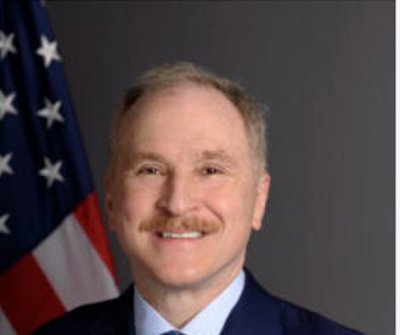
U.S. Ambassador to Argentina Peter Lamelas did not attend a congressional hearing at which lawmakers wanted him to respond to allegations that embassy officials pressured a cooperative to abandon its negotiations with Chinese technology company Huawei. Photo courtesy of the U.S. Embassy in Argentina
Aug. 20 (UPI) — U.S. Ambassador to Argentina Peter Lamelas did not attend a congressional hearing at which lawmakers wanted him to respond to allegations that embassy officials pressured a cooperative to abandon its negotiations with Chinese technology company Huawei.
The Chamber of Deputies’ Committee on Cooperative Affairs, Mutual Associations and Nongovernmental Organizations summoned Lamelas after the Provincial Cooperative of Public and Community Services of Neuquén, known as CALF, alleged that a U.S. official raised the possibility of visa restrictions for its directors, Página/12 reported.
Committee Chairman Aldo Leiva, a member of the opposition Union for the Homeland party, said lawmakers would summon the ambassador again.
Rep. Lorena Pokoik, a member of the same party, also criticized his absence.
“He was supposed to appear before the Chamber of Deputies today to provide an explanation. He did not come, did not respond and did not even offer an excuse,” she wrote in a post on X.
El embajador de Estados Unidos, Peter Lamelas, cree que puede apretar por WhatsApp a una cooperativa argentina, amenazarla con consecuencias sobre las visas y exigirle que abandone sus vínculos comerciales con China.
Hoy debía presentarse ante la Cámara de Diputados para dar… pic.twitter.com/XQwJNQpsik— Lorena Pokoik (@lorepokoik) August 19, 2026
CALF said the controversy began July 12, when its technology manager received WhatsApp messages from Andrew Dilts, the U.S. Embassy’s economic affairs attaché.
According to a statement from CALF, the messages referred to a U.S. policy that could restrict or revoke the visas of directors linked to Huawei’s expansion and asked whether the cooperative could cancel the project. CALF requested a formal clarification from the embassy and the intervention of Argentina’s Foreign Ministry.
Lamelas later confirmed that the communications “faithfully reflect U.S. policy.” The diplomat argued that companies subject to Chinese intelligence laws could be required to hand over data to the government in Beijing and warned that the use of Chinese technology in critical infrastructure in Vaca Muerta could discourage foreign investment, TN reported.
CALF responded that it had not received any specific technical objection and said its network uses equipment from several countries. The cooperative also clarified that the proposed data center remains under evaluation and that Huawei’s participation has not been confirmed, according to La Tecla Patagonia.
Lamelas and CALF representatives met Aug. 12 to discuss data security, the expansion of telecommunications in Vaca Muerta and possible U.S. financing and equipment alternatives.
Opposition lawmakers described the visa warnings as foreign interference. A draft resolution introduced in the Chamber of Deputies condemned the alleged pressure.