
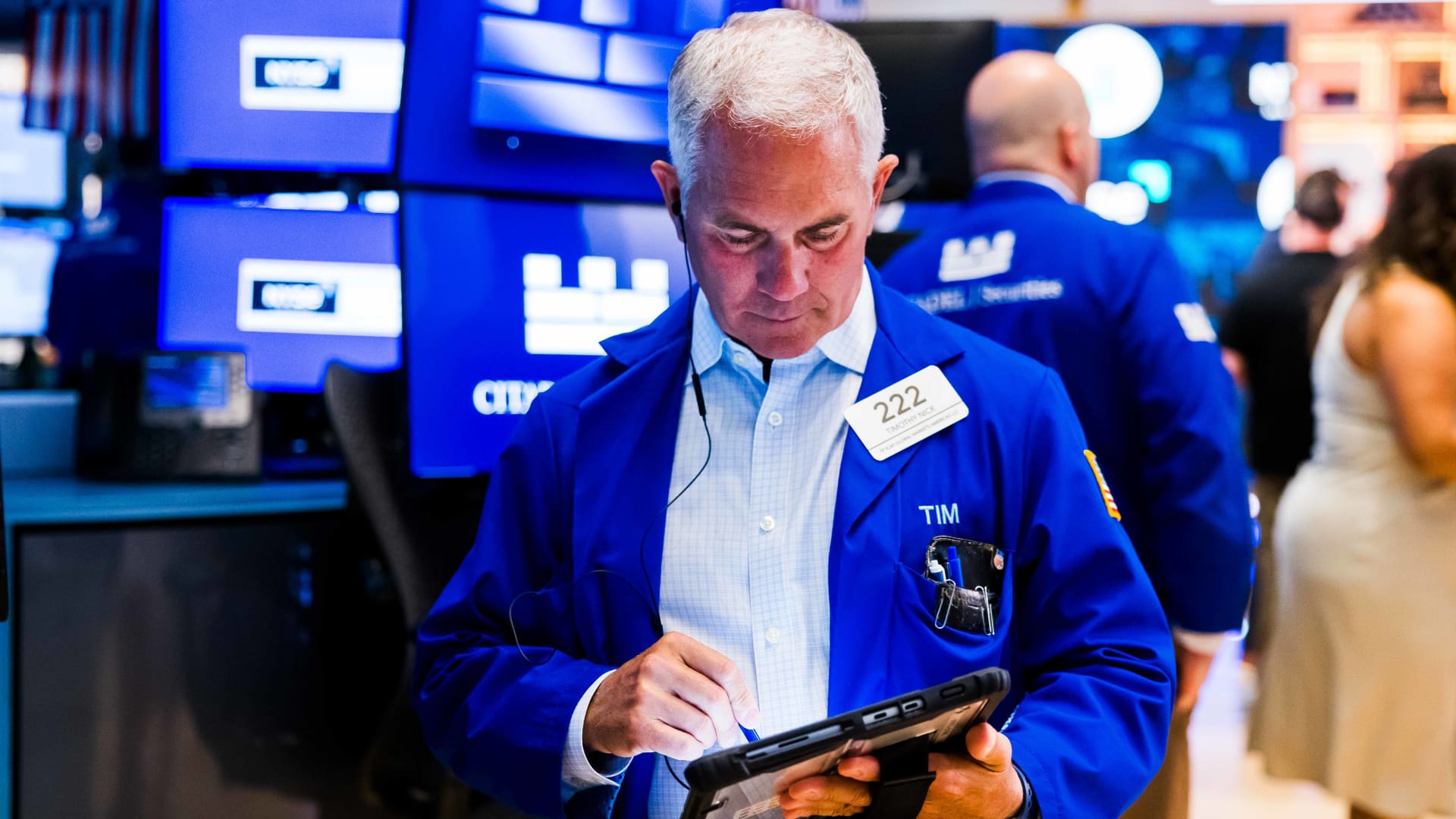
S&P 500, Nasdaq close lower
The S&P 500 and Nasdaq Composite finished in the red on Tuesday.
The broad-based index fell 0.26% to 7,386.65, while the tech-heavy Nasdaq declined 0.97% to 25,678.82.
The Dow Jones Industrial Average rose 86.10 points, or 0.17%, to 50,872.11.
— Sean Conlon
Gold and silver have lowest settles of the year
Gold pure gold bar models captured in Shanghai, China on March 15, 2026.
Cfoto | Future Publishing | Getty Images
Gold and silver prices settled to their lowest levels of the year on Tuesday as energy prices eased on renewed hopes for an end to hostilities between the U.S. and Iran.
Gold fell back by -1.76% to $4,286.4 for the lowest close since December 10, 2025.
Since the Iran war began, gold is down -18.32% .
Silver eased by -4.88% to $65.24 for the lowest close since December 18, 2025.
Brent crude is down to about $91 per barrel. U.S. Energy Secretary Chris Wright said Tuesday that oil traffic will continue to rise in the Strait of Hormuz, a global pinch point for energy commodities that has been squeezed during the conflict with Iran.
— Tobias Burns
Schwab’s Sonders sees ‘too much complacency’ in the market
Markets had gotten too comfortable with the chip trade and were due for a reckoning, according to Liz Ann Sonders, chief investment strategist at Charles Schwab.
Broadcom’s disappointing earnings guidance last week highlighted a problem with the artificial intelligence-fueled trade: “There was concern about too much complacency,” Sonders said in an interview. “You had the Broadcom announcement last week, and I just think that there’s a bit more skittishness. That could mean some of these rotations, and in this case I’m not talking about broader rotations but even rotations within the tech space, even within the AI space.”
Sonders spoke the same day stock surrendered earlier gains on turned negative, with investors worried about the tech trade getting too hot at a time when inflation concerns also are intensifying.
“Valuations are not uber, uber stretched in this environment, because earnings growth has moved up more than prices have,” she added. “But you really had a lot of stocks that went parabolic and got into overbought territory, and I think the trigger finger now is more inclined to sell or take profits.”
— Jeff Cox
More S&P 500 stocks are up than down
The S&P 500 slid more than 1% on Tuesday afternoon, but a peek into the index showed a majority of stocks were actually in positive territory.
There were 301 advancers in the broader market. Nine out of 11 sectors were higher, with real estate, health care and utilities the top performing sectors. Information technology was the biggest laggard, down nearly 3%.
The Invesco S&P 500 Equal Weight ETF was up 0.2%.
— Sarah Min
Old-economy sectors buck selloff
European markets close lower after oil prices slide
The City of London skyline at sunset.
Gary Yeowell | Digitalvision | Getty Images
The Stoxx 600 closed 0.42% lower on Tuesday, with regional sectors and major bourses mixed.
Food and beverage companies led sector gains, rising 2.11%, while mining stocks and oil and gas companies hit reverse, shedding 2.41% and 2.26%, respectively, after comments by U.S. Energy Secretary Chris Wright that Strait of Hormuz shipping traffic is “rising very meaningfully” pulled oil prices lower.
The FTSE 100 closed 1.4% down, as losses among London-listed multinational energy and mining majors dragged the U.K. index lower. Here, shares Fresnillo ended the session almost 5.1% lower, with Antofagasta sliding 3.4%, as BP dropped almost 3% and Shell fell 1.9%.
Elsewhere, the German DAX dropped 0.8%. But France’s CAC 40 ended the day almost 0.1% higher, and the Italian FTSE MIB gained 0.11%.
— Hugh Leask
Existing home sales for May blew past expectations
The housing market posted a strong May, with sales up sharply and a fresh record in selling price, the National Association of Realtors reported Tuesday.
Existing home sales rose 3.2% on the month to a seasonally adjusted annualized rate of 4.17 million. Both numbers topped respective forecasts of 0.7% and 4.05 million.
The median sales price rose to $429,300, up 1.3% from a year ago though the affordability index actually improved as the selling price held well below the inflation rate.
“More Americans are on the move, with home sales rising to the highest level since December. This is great news for the housing market and the economy,” said NAR chief economist Lawrence Yun.
— Jeff Cox
UBS sees more than 20% upside ahead for TJX
A customer shops at a T.J. Maxx store on May 21, 2025 in Chicago, Illinois.
Scott Olson | Getty Images
UBS believes TJX is going to continue to take market share from department store peers over the next few years — and its latest survey of off-price and department store consumers confirms its case.
“Plus, we believe TJX’s newer businesses such as HomeSense and Sierra Trading Post have significant potential, as does its international operation, particularly given its entrance into Spain with its TK Maxx banner in Q1,” analyst Jay Sole said in a note Tuesday.
UBS’ survey found that 71% of consumers believe TJ Maxx is associated with “good value for the money.” In comparison, 47% said Macy’s and other department stores fit that description.
Plus, TJ Maxx customers expect a 14% net increase in shopping frequency over the next 12 months, versus the -1% for the overall retail survey average, Sole noted. Some 78% said a “[l]arge variety of merchandise and selection” is a reason to shop at TJ Maxx, up from 44% in the prior survey.
Sole has a buy rating on the stock and a $197 price target, which implies 23% upside from Monday’s close.
— Michelle Fox
Stocks open higher
The three major averages began Tuesday’s session higher.
The S&P 500 rose 0.5%, while the Nasdaq Composite added 0.7%. The Dow Jones Industrial Average climbed 248 points or 0.5%.
— Sean Conlon
Trade deficit fell 49% this year as tariffs take root
A container ship is seen docked at the Port of Los Angeles on March 13, 2026 in Los Angeles, California.
Justin Sullivan | Getty Images
In the year since President Donald Trump announced his “liberation day” tariffs, the U.S. trade deficit has been cut about in half.
The goods and services imbalance totaled $55.9 in April, bringing the year-to-date deficit down $213.5 billion, or 49%, from a year ago, the Commerce Department reported Tuesday. The monthly shortfall represented a $700 billion decrease from March and was below the Dow Jones consensus outlook for $56.1 billion.
— Jeff Cox
Apple conference gets tepid reaction on Wall Street
Apple CEO Tim Cook wipes a tear during his final Apple Worldwide Developers Conference at Apple Park in Cupertino, California, on June 8, 2026.
Josh Edelson | Afp | Getty Images
Analysts were less than bowled over on Monday by Tim Cook’s final keynote as Apple CEO, which centered on artificial intelligence upgrades to its voice assistant robot, Siri.
“We believe investors will be underwhelmed with the offerings,” David Vogt at UBS wrote in a Monday note to clients, saying the upgrades wouldn’t be enough to drive demand for iPhones, which accounted for about half of Apple’s revenues in 2025.
Key Banc’s Brandon Nispel saw “no clear signs of monetization of AI” and only “a slightly better standalone Siri, which is still worse than other [large language models].”
William Power at Baird said the new Siri AI features were “roughly in line” with expectations, though they could prove to be “a massive unlock if executed correctly.”
With rising inflation and falling wage growth and personal savings, Apple is facing headwinds at the consumer level.
Weakening consumer demand is a key risk for Apple, according to Goldman Sachs analyst Micahel Ng.
“Any weakness in the macroeconomic environment could reduce demand for Apple products and services,” he wrote to clients on Monday. “Lengthening replacement cycles due to macroeconomic headwinds, improved product durability, or lackluster product innovation could all negatively impact upgrade demand.”
— Tobias Burns
GSK, J.M. Smucker Company and SailPoint among the stocks making premarket moves
Check out the companies making headlines before the bell:
- GSK, Nuvalent — Shares of U.S. drugmaker Nuvalent rose nearly 39% after U.K.-based biopharmaceutical company GSK announced an agreement to acquire the company for $10.6 billion.
- J.M. Smucker Company — Shares jumped 3.5% after the maker of Smucker’s jam and Jif peanut butter reported fourth-quarter results that topped expectations. Earnings of $2.77 per share, on an adjusted basis, exceeded the $2.64 FactSet consensus estimate. Revenue of $2.27 billion also topped the anticipated $2.26 billion.
- SailPoint —The identity, data and security intelligence platform plunged more than 12% after issuing lackluster full-year guidance, even as its first-quarter earnings exceeded estimates. SailPoint expects adjusted earnings of 30 cents to 34 cents for the full year ending January, while analysts polled by FactSet were anticipating 32 cents. Expected revenue of $1.265 billion to $1.275 billion for the full year came in the low range of the expected $1.27 billion.
Read the full list here.
— Sarah Min
Nuvalent soars after GSK announces acquisition
Sheldon Cooper | Lightrocket | Getty Images
Shares of U.S. drugmaker Nuvalent rose nearly 39% after U.K.-based biopharmaceutical company GSK announced an agreement to acquire the company for $10.6 billion.
The all-cash deal will value Nuvalent at about $124 per share. Nuvalent is home to two drugs currently under review by the U.S. Food and Drug Administration to treat a form of lung cancer.
In a press release, GSK CEO Luke Miels said the acquisition presents the company with immediate new sales growth opportunities. U.S.-listed shares of the drugmaker were down by 1% in premarket trading Tuesday.

Nuvalent 5-day.
— Davis Giangiulio
European stocks open higher
European shares were in broadly positive territory shortly after the opening bell. The pan-European Stoxx 600 was 0.2% higher, with most sectors and major bourses rising.
The regional Stoxx 600 Technology index added 0.3%, extending its recovery from a tech sell-off that gripped global markets on Friday.
— Chloe Taylor
Asia markets close mostly higher; South Korea’s Kospi pops 8%
Japan’s Nikkei 225 was over 2% higher, ending the trading day at 65,416.63, while South Korea’s Kospi rebounded from Monday’s slump to jump 8.18% to 8,096.93.
Hong Kong Hang Seng Index edged 0.15% higher, while the mainland’s CSI 300 was up 1.87% to 4,801.81. Australia’s benchmark S&P/ASX 200 was down 0.24% to 8,604.2.
— Lee Ying Shan
China’s May shipments to U.S. soar 35% as overall exports jump on tech boost
A cargo ship is loading and unloading foreign trade containers at Qingdao Port in Qingdao City, Shandong Province, China on July 28, 2025.
CFOTO | Future Publishing | Getty Images
China’s trade growth held up better than expected in May, as surging AI-related exports helped buffer the economy against disruption from the Iran war, with U.S.-bound shipment logging the strongest jump in five years.
Overall exports rose 19.4% from a year earlier in U.S. dollar value terms, customs data showed Tuesday, accelerating from the 14.1% gain in April. Economists polled by Reuters had pegged growth at 15%.
Shipments to the U.S. soared nearly 35.4% in May from a year earlier, the highest growth since March 2021, according to Wind Information, extending a rebound following a long streak of double-digit declines for the most of last year, pressured by President Donald Trump’s tariffs.
“The war is boosting demand for green exports, such as electric vehicles, batteries, solar products, and AI-related technology goods,” said Shena Yue, senior economist at Oxford Economics, expecting the “outperformance” in high-tech product export growth to persist.”
Read the full story here.
— Anniek Bao
Asia chip-linked shares recover after U.S. peers bounce back
Asian technology stocks rebounded Tuesday, tracking Wall Street’s gains, as investors returned to artificial intelligence-linked names.
South Korean memory chip giant SK Hynix climbed 6.44%, while Samsung Electronics gained 3.38%. Seoul Semiconductor jumped over 12%.
Japanese semiconductor equipment makers also advanced, with Tokyo Electron rising 5.65%, Advantest adding 1.51%, and Renesas Electronics gaining 2.54%.
However, shares of Japanese tech investment giant SoftBank extended their slide, dropping 2%.
“The rotation back to domestic defensives we saw yesterday will be short lived for now,” said Andrew Jackson, an equity strategist at ORTUS Advisors.
While it remains unclear whether the recent pullback will be enough to reset valuations, Jackson said markets were likely to remain volatile through the week as investors brace for the pricing of SpaceX’s highly anticipated initial public offering on Thursday and the start of trading on Friday.
Read the full story here.
— Lee Ying Shan
Pentagon expands list of China military-linked firms to include Alibaba, Baidu and BYD
FILE PHOTO: The Pentagon is seen from the air in Washington, U.S., March 3, 2022.
Joshua Roberts | Reuters
The Pentagon added a slew of Chinese companies, including Alibaba Group, Baidu Inc and carmaker BYD, to a list of entities it believes have aided the Chinese military, complicating the fragile diplomatic relationship between Washington and Beijing.
The Defense Department published an updated “1260H list” Monday evening stateside — a roster of companies the Pentagon considers affiliated with China’s military or defense industrial base.
The designations do not impose sanctions explicitly, but mean the Defense Department will be prohibited from contracting directly with listed companies starting later this month, and from procuring their products or services through third parties beginning in 2027.
Shares of Alibaba Group declined 1.18%, BYD fell 1.16%, while Baidu was up 1.05%.
Read the full story here.
— Anniek Bao
Japan’s Nikkei 225 gains over 1%; South Korea’s Kospi rebounds 4%
Asia-Pacific markets traded mixed early Tuesday. Japan’s Nikkei 225 added over 1% while the Topix rose 1.22%.
South Korea’s Kospi rebounded from Monday’s sell-off to jump 4%, and the small-cap Kosdaq advanced 3.7%. Australia’s benchmark S&P/ASX 200 was down 1.33%.
Hong Kong Hang Seng index futures last traded at 24,555, lower than the index’s last close of 24,657.06.
— Lee Ying Shan
Asia markets set for mixed open as investors assess fragile Iran-Israel ceasefire
Asia-Pacific markets were set to open mixed Tuesday, as investors weighed a fragile ceasefire between Iran and Israel, with U.S. chip stock rebound overnight likely offering support to regional tech names.
The Chicago futures contract for Japan’s Nikkei 225 was at 65,450 and its Osaka counterpart last traded at 65,400 compared with the index’s previous close of 64,024.6.
Hong Kong Hang Seng index futures last traded at 24,555, lower than the index’s last close of 24,657.06.
Australia’s benchmark S&P/ASX 200 is set to fall after resuming trade following a holiday, with futures last at 8,533, lower than the index’s previous close of 8,625.1.
Iran on Monday halted military strikes against Israel, but warned it would resume attacks if Israeli forces continue operations in Lebanon, Tehran’s foreign ministry told CNBC on Monday. Hours later, Israeli Prime Minister Benjamin Netanyahu said the conflict with Iran and Hezbollah was “not yet over,” despite arguing that both adversaries had been significantly weakened.
— Lee Ying Shan
Vail Resorts falls after lowering its full-year adjusted EBITDA guidance
Shares of Vail Resorts were trading about 4% lower in Monday’s after-hours session after the company cut its guidance for adjusted EBITDA for the full year.
MTN 5D chart
The luxury ski resorts operator now sees adjusted EBITDA coming in between $739 million to $761 million for the year, versus prior guidance of the lower end of the $745 million to $775 million range. Analysts polled by FactSet were expecting the figure to come in at $748.7 million.
However, Vail Resorts reported adjusted EBITDA and revenue for its fiscal third quarter that came in above analysts’ forecasts.
— Lisa Kailai Han
OpenAI confidentially files for IPO
OpenAI has confidentially filed for an IPO with the Securities and Exchange Commission.
OpenAI’s filing comes just a week after rival Anthropic’s, and days before Elon Musk’s SpaceX is slated to go public.
The artificial intelligence company, currently valued at more than $850 billion, could go public as soon as the fourth quarter of this year. But OpenAI said on Monday it has not yet decided on exact timing.
“We recently submitted a confidential S-1. We expect it to leak so we’re just announcing it. We have not decided on timing yet; it may be a while because there are things we want to do that are likely easier as a private company. But it’s a complicated set of tradeoffs and this gives us the option to go public sooner if that ends up being best,” the company said in its post.
— Ashley Capoot and Lisa Kailai Han
Stock futures open little changed
Stock futures traded near flat on Monday evening.
Shortly after 6 p.m. ET, futures tied to all three major averages were trading around the flatline.
— Lisa Kailai Han

