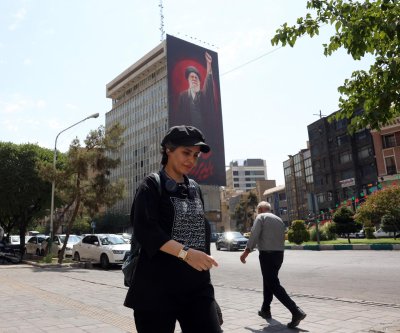
Iranians walk near a banner of late Iranian leader Ayatollah Ali Khamenei in Tehran, Iran, on Sunday. The conflicts between Iran and the USA over the Strait of Hormuz continue, as US strikes have targeted several locations across southern Iran. Photo by Abedin Taherkenareh/EPA
July 20 (UPI) — The U.S. military and Iran traded strikes for a ninth consecutive night on Sunday and into Monday morning as their war over the Strait of Hormuz showed no sign of abating.
U.S. Central Command said in a statement that it completed its latest wave of attacks at 10 p.m. EDT. It targeted Iranian military command centers, maritime capabilities and communications networks, as well as missile and drone launch sites and air defense and coastal surveillance sites.
The strikes sought “to further diminish Iran’s ability to attack commercial vessels and civilian mariners transiting the Strait of Hormuz,” CENTCOM said.
“The U.S. military is holding Iran accountable at the Commander in Chief’s direction,” CENTCOM said.
State-run Islamic Republic of Iran Broadcasting reported explosions in Bandar-e Mahshahr and Bandar Imam Khomeini, in southwestern Iran’s Khuzestan province.
Hours later, Iran’s Islamic Revolutionary Guard Corps announced strikes against U.S. military assets in the region.
The IRGC said it attacked U.S. aircraft stationed at Jordan’s Aqaba Airport. It said 20 warehouses were struck in the Al-Azraq region and claimed additional U.S. forces had been killed. The claims could not immediately be independently verified.
Iran’s Fars News Agency also reported that U.S. military assets were destroyed or damaged in Kuwait and Bahrain. Meanwhile, the Kuwaiti military repeatedly said its air defenses were confronting Iranian drones. Bahrain’s Ministry of the Interior also announced sirens were blaring while urging residents to remain calm and find shelter.
Around the time CENTCOM announced its attacks, the UK Maritime Trade Operations Center said an unspecified vessel was on fire about 8 nautical miles northwest of Kumzar, Oman, in the Strait of Hormuz. The cause was not immediately known, though UKMTO said “military authorities” had informed it of the fire.
The IRGC later said two oil tankers had “exploded” after attempting to travel through the Strait of Hormuz. It was not clear whether either vessel was on the one mentioned by the UKMTO.
The U.S. Embassy in Bahrain’s capital of Manama issued a statement early Monday local time stating it “has information to suggest that Iran may seek to target unspecified locations in central Manama.”
“We urge all Americans to remain vigilant, follow local authorities’ instructions and review the latest guidance from the U.S. Embassy,” it said.
The attacks came after the U.S. military on Sunday announced the death of a U.S. service member, the third to be killed since fighting resumed nearly two weeks ago and the 17th killed since the war began late February.
U.S. Secretary of State Marco Rubio told reporters late Sunday at Joint Base Andrews, Md., that CENTCOM will continue to strike Iran as long as Iran tries to assert control over the strait.
“The only reason why the U.S. is conducting strikes is against assets of Iran that are being used to attack global commercial shipping,” he said, while urging allies to become involved.
“Other countries should join us in this effort, but the United States is involved not just in protecting those ships but in targeting the places that they use to launch these missiles and drones.”
Ask about prospects for the resumption of diplomacy, he said the United States is open to it, but only if it is “real.”
“It has to be a deal they’re willing to live by,” he said. “Their behavior has to change in order for ours to change.”
While the United States began the war seeking to eliminate what it described as Iran’s nuclear weapons ambitions and encourage Iranians to overthrow their government, the latest phase of the conflict has centered on the Strait of Hormuz, a vital energy transportation route.
The United States says it is fighting to restore the prewar freedom of navigation through the chokepoint, while Iran claims authority to determine which vessels may transit the waterway.
The two sides agreed to a fragile cease-fire in April and later signed an agreement intended to lay the groundwork for ending the war. But they remained divided over its terms: Iran claimed that the agreement recognized its control over the strait, while the United States maintained that it required a return to the prewar status quo. The cease-fire fell apart early this month after three vessels transiting the strait were attacked. The United States blamed Iran and retaliated with strikes against Iranian targets.