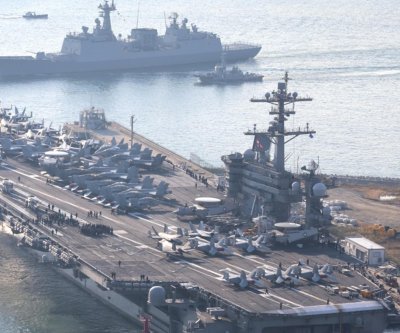
The USS George Washington nuclear-powered aircraft carrier docks at a naval base in Busan, South Korea, on Nov. 5. File Photo by Yonhap/EPA
Aug. 20 (UPI) — The USS George Washington reached the Arabian Sea in the U.S. Central Command’s area of responsibility, following reports of poor conditions for sailors aboard the USS Lincoln.
The USS George Washington crew is expected to relieve the Abraham Lincoln Carrier Strike Group as part of what Acting Secretary of the Navy Hung Cao called a planned rotation. It may take a month or more for the Lincoln to return to the United States.
The USS Lincoln has been on deployment since leaving port in San Diego in November, marking the longest deployment without stopping at a port. The long deployment has led to reports of sailors and Marines suffering mental health crises.
Cao said in a social media post last week that the USS Lincoln group “crushed their deployment” while downplaying reports of shipmen experiencing mental health struggles some making suicide attempts, including at least one sailor who deliberately jumped overboard.
The USS Washington’s move to the Arabian Sea leaves the U.S. Navy without an aircraft carrier in the Western Pacific, a region that has been a focal point of its deployment.
The USS Lincoln was originally deployed off the coast of Venezuela. When the United States and Israel launched strikes on Iran in February, the ship was sent to the Middle East.
There are about 5,000 people on board the USS Lincoln. Family members of several on board have expressed concerns about their loved ones’ wellbeing.
Some Democratic lawmakers have also shared concerns about the USS Lincoln’s deployment and its mental health toll on passengers. Last week, Sen. Richard Blumenthal, D-Conn., a member of the Senate Armed Services Committee, shared concerns about supply shortages and other issues on the ship.
“These reports warrant immediate attention, but they also raise a broader question: whether the Navy can sustain the operational tempo now being demanded of its carrier force, particular as this Administration repeatedly commits U.S. forces to conflicts of its own choosing and increasingly relies on aircraft carriers to sustain those operations,” Blumenthal said in a statement.


President Donald Trump speaks during a meeting with technology leaders in the Roosevelt Room of the White House on Wednesday. Photo by Al Drago/UPI | License Photo