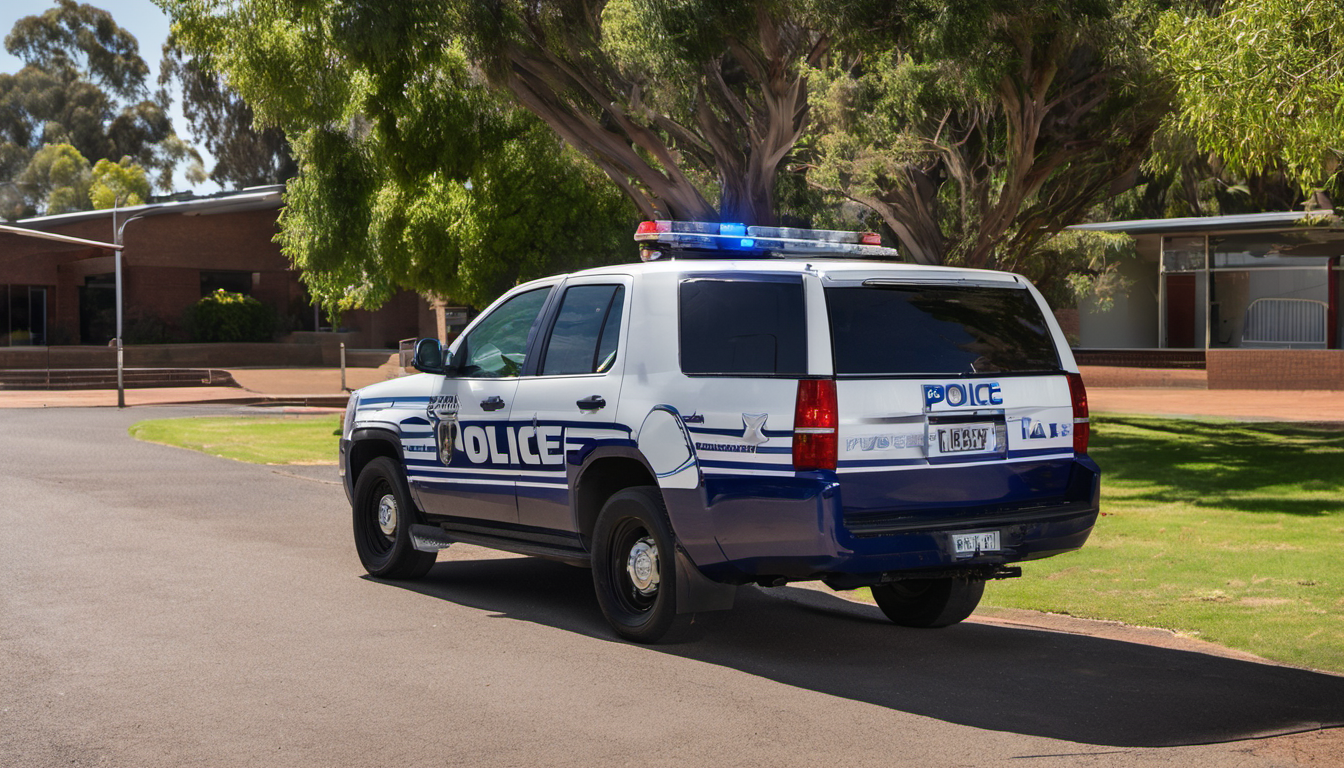
Featured image: A white police vehicle, with blue lights on the roof and a ‘POLICE’ sign on the side, is parked on an asphalt road. AI-generated image; not a photograph of the reported event.
Warning signs over threats to Australian politicians were rising before MP hit by car Source: bbc.co.uk.
Independent MP Helen Haines was struck by a car outside her office in Wangaratta, Victoria, on Monday. The incident has sparked concern about rising threats against public figures in Australia. While police have not confirmed that the attack was intentional, Prime Minister Anthony Albanese described it as an apparent attack, emphasizing that it was not a random accident.
What happened
A 43-year-old man was arrested at the scene. Police recovered a knife, though it remains unclear whether it was used or planted. The incident occurred during a period of heightened public discourse over policy, with tensions rising between political parties and growing polarization in public debate.
Albanese, who has previously faced multiple bomb threats, stated during a press briefing that the act ‘would appear to be deliberate’ and that such incidents are now a growing concern within the political community. He stressed that while no motive has been confirmed, the incident reflects a broader pattern of increasing hostility toward public office holders.
Key facts
- Helen Haines is an independent MP representing the regional town of Wangaratta, known for her active engagement with constituents in local communities.
- She is particularly respected for her openness and accessibility, often hosting public meetings and interacting directly with residents.
- Government data shows 1,067 reports of threatening and harassing behaviour against high office holders in the year to June — a significant increase from the previous year.
- Female MPs and their families have faced sexual threats, including messages and calls that have been reported to parliamentary offices.
- Small Business Minister Anne Aly received a wave of death threats after a political comment criticizing a tax policy, with one message suggesting she should be ‘shamed and stoned in the square’.
Background: A growing trend
Violence against politicians has historically been rare in Australia. The only major incident in recent history is the 1966 assassination attempt on Labor leader Arthur Calwell, which remains a distant memory in public consciousness.
Yet, experts now argue that the threat landscape has evolved dramatically over the past decade. What was once considered an outlier is now seen as part of a broader trend of increasing hostility and radicalization.
Josh Roose, a professor at Deakin University specializing in violent extremism, has long warned that Australians have been dismissive of the possibility of political violence. He notes that such incidents have been occurring for over a decade — often in subtle, indirect forms.
“We tend to bury our head in the sand and say, ‘Not here’, but this has been happening now for well over a decade.”
Roose identifies several contributing factors: rising socioeconomic inequality, deteriorating mental health among segments of the population, the spread of extremist content online, and political figures who exploit public discontent for electoral gain.
Mike Burgess, the head of Australia’s Australian Security Intelligence Organisation (ASIO), has repeatedly warned about the growing risk of politically motivated violence. In his 2026 annual threat assessment, he compared the situation to climate change — a phenomenon that increases the likelihood of extreme weather events without predicting specific storms.
“Just as climate change increases the likelihood of extreme weather but does not forecast specific storms, politically motivated violence is more likely even though we cannot predict a specific attack.”
Commissioner Krissy Barrett of the Federal Police has stated that many threats stem from a sense of grievance — individuals who feel isolated, marginalized, or excluded from society are more likely to turn to extremism as a source of identity and purpose.
“They’re feeling distanced, they’re feeling alone, they’re looking for something to attach to, to give them meaning and purpose.”
Why it matters
Public engagement remains a cornerstone of Australian democracy. It is not unusual to see MPs at local markets, football matches, or community events, where they interact directly with constituents.
Albanese emphasized the importance of this form of engagement, stating that face-to-face interactions are essential to maintaining trust and transparency in governance.
“I don’t want to see a political system in which you can’t have conversations with people at the supermarket, in the street, at street meetings, public forums — that’s an important part of our democracy,” he said.
However, the recent incident raises serious questions about the safety of such interactions. If political figures are increasingly targeted, then the very foundation of democratic participation — open, accessible public discourse — may be at risk.
Some MPs have expressed frustration that security arrangements have not evolved in tandem with the rising threat environment. While physical protection protocols exist, many believe they are outdated and insufficient for modern threats.
Limitations and open questions
While the incident appears deliberate, no motive has been confirmed. There is no evidence that the attack was politically motivated, nor is there any indication that Haines was targeted for her views or policies.
It remains unclear whether the knife found at the scene was used or if it was planted. The full context of the incident — including the driver’s background, the vehicle’s origin, and any prior interactions — is still under investigation.
Experts agree that threats are rising, but the full scope of how widespread or dangerous they are remains unclear. The incident may be an isolated event, or it could signal a broader shift in the political climate.
What to watch next
Police will continue investigating the incident with the help of the federal counter-terrorism squad. As more reports of threats emerge, the government may need to reassess its approach to public safety and political engagement.
Public engagement by politicians remains a core part of Australian democracy — but the incident raises urgent questions about how safe that engagement may be.
Source: BBC News — https://www.bbc.co.uk/news/articles/cq398rk4p3exo?at_medium=RSS&at_campaign=rss