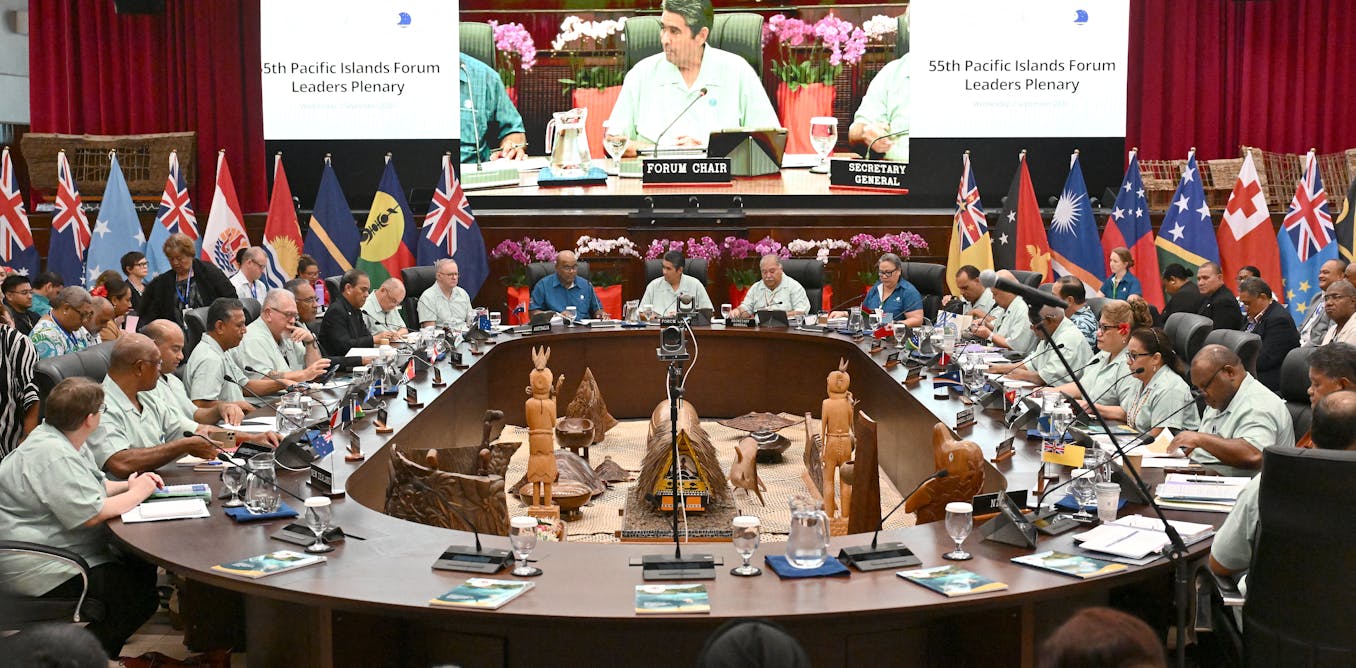
Many participants at the Pacific Islands Forum in Palau this week would like to talk about anything but great power rivalry: transnational crime, energy security, climate change, development finance, seabed minerals, transport links.
Instead, the meeting has been pulled toward the question that now shadows every Pacific regional gathering: what happens when the world’s great powers decide your part of the world is strategically important?
The answer does not have to involve choosing between them. For the Pacific’s small states, a more useful approach could be to seek shelter collectively.
Shelter theory was developed to explain a basic problem of small-state politics: countries with limited military, economic and diplomatic resources cannot provide everything they need for themselves.
They can instead choose to get collective protection and support from international and regional institutions or a larger power.
In the Pacific, sheltering together is becoming painfully urgent.
Growing pressure from China
In June this year, a Chinese Liberation Army (PLA) submarine fired a long-range nuclear-capable ballistic missile with a dummy warhead into waters near Tuvalu.
Last year, a PLA air force and navy flotilla, which included a submarine, conducted live-fire drills in the Tasman, without any warning to Australia or New Zealand. The flotilla travelled through Papua New Guinean waters and sent a military drone into PNG airspace.
The Chinese media said the live-fire exercises signalled the beginning of the “normalisation of the deployment” of PLA forces in the South Pacific.
China is attempting to create competing regional architectures to undermine the existing Pacific order, including the 18-member Pacific Island Forum.
Beijing has become increasingly aggressive in its interventions in Pacific Island Forum events, trying to exclude Taipei’s participation in Pacific diplomacy.
Both the Republic of China (ROC, Taiwan) and the People’s Republic of China (PRC) are partners of the Pacific Island Forum. Three forum members – Tuvalu, the Marshall Islands and Palau – recognise the Republic of China while all other forum nations have diplomatic relations with the PRC.
Beijing is widely believed to have pressured some Pacific leaders not to attend the forum this week.
Acting collectively
Meanwhile, the Trump administration’s foreign policy has exacerbated the crisis in Pacific security, from withdrawing aid to most states in the Pacific in 2025 to launching the war in Iran in 2026, which created an energy crisis in the region.
Increasingly, mainstream narratives portray Pacific nations as pawns on a chessboard or the Pacific Island Forum as “fractured” by the China-US contest.
But Pacific nations are not passively waiting for their loyalties to be switched from Beijing back to Washington. They are states with their own agency, interests and histories. Nor is the Pacific Island Forum broken. Its members have been together for 55 years and have weathered many upheavals.
The question is not which great power the Pacific should follow. It is how Pacific countries can acquire enough shelter, collectively, so they do not have to follow anyone.
A useful security partnership should help make a nation more resilient, without requiring it to surrender diplomatic choices. Development finance should build self-sufficiency, not create political dependency.
This is why the Pacific Islands Forum matters.
Strengthening regional cooperation
The forum is imperfect. Its members have different diplomatic relationships and security concerns, and different views on matters such as seabed mining. They will not always agree.
But diversity is an argument for stronger regional institutions, not weaker ones. A Pacific country negotiating alone with a great power is negotiating from weakness. Eighteen countries negotiating together have a collective voice.
They also have something the great powers want: access to an ocean whose strategic and economic significance is rising rapidly.
The Pacific’s leverage lies partly in its geography. Its maritime spaces are vast and its nations are key nodes along routes and resources that have always been valuable to larger powers.
The Solomon Islands’ recent proposal for a region-wide security arrangement should be recognised as an attempt to ensure no Pacific country faces coercion alone.
While the initiative’s proponent, Prime Minister Matthew Wale, is absent from the forum due to political upheaval back home, his delegation remains in Palau to speak up for the motion.
The expansion of bilateral agreements between Australia, New Zealand and Pacific partners has created opportunities for Pacific small states to gain shelter from two larger Pacific Island Forum nations. Deepening cooperation across the forum could add another layer of resilience.
The overarching goal should be to move from bilateral agreements to collective capability. That means more shared maritime surveillance across the Pacific, better disaster response capacity, energy security, climate adaptation and infrastructure standards.
The strongest form of Pacific security will be the ability to prevent the region from becoming militarised by outsiders. The Pacific needs an order in which its own governments have room to say no. That may be the most important test of sovereignty in the years ahead.
The great powers will continue to compete in the Pacific. Will Pacific states face the challenge individually or collectively, with enough shelter to preserve their freedom of action?
For small states, independence has never meant standing alone. The Pacific now needs to build that shelter together.