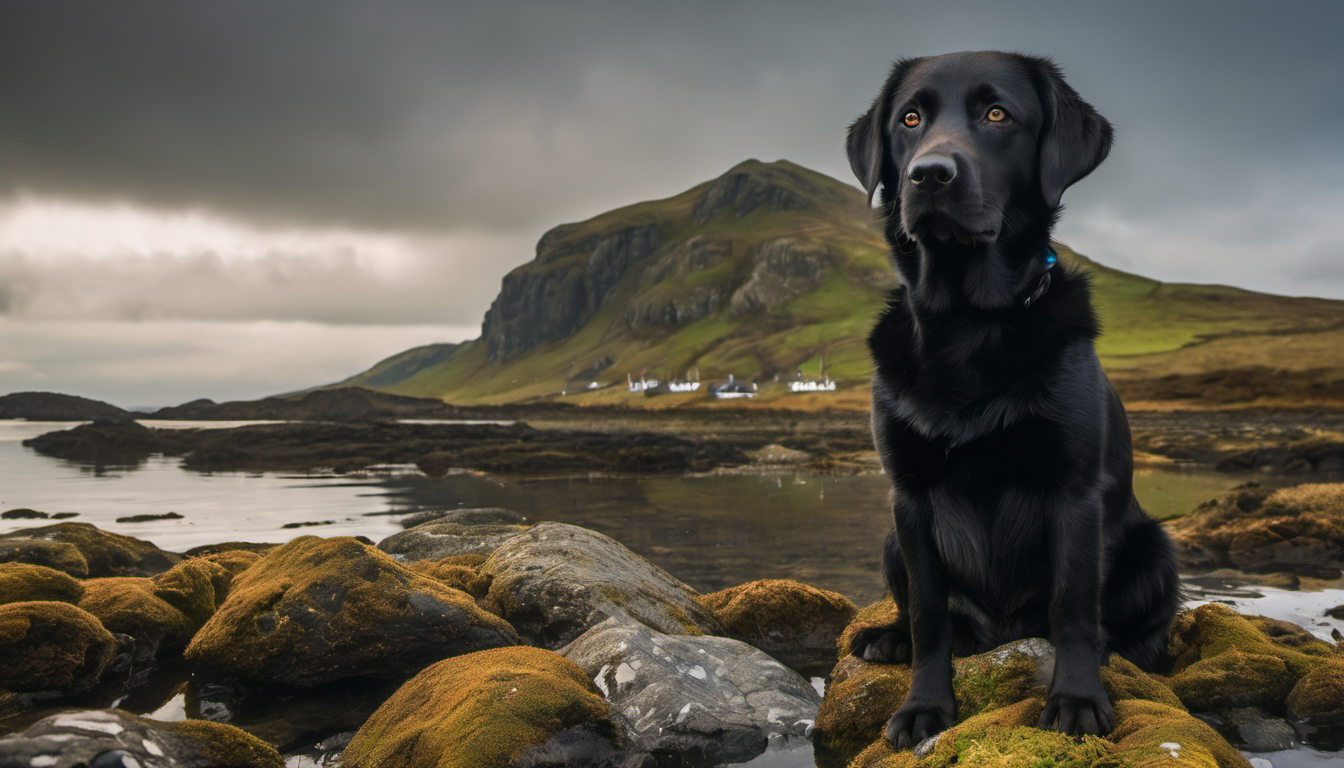
Featured image: A black Labrador dog is the main subject. AI-generated image; not a photograph of the reported event.
A black Labrador named Sgiath has been named animal of the year by the International Fund for Animal Welfare (IFAW). The award celebrates her role in detecting the invasive marine organism known as the carpet sea squirt. Source: bbc.co.uk.
What Happened
Sgiath, a six-year-old labrador, works with marine ecologist Dr Texa Sim near Glencoe in the Scottish Highlands. Together, they search for carpet sea squirt colonies at low tide.
Dr Sim trained Sgiath as a mountain rescue dog when she was a puppy. The dog now uses her sense of smell to detect the carpet sea squirt, which blends into seaweed and marine structures.
Key Facts
- Sgiath is believed to be the UK’s first dog trained specifically to detect the carpet sea squirt.
- Dr Sim has trained her since puppyhood, starting with mountain rescue work. Sgiath showed strong problem-solving and adaptability from the start.
- The carpet sea squirt, scientifically named Didemnum vexillum, was first found in southern England and Wales in 2008.
- It spreads quickly in warmer months and has now reached multiple UK coastlines, including the west coast and south-east.
- Removing the species costs millions annually across Europe, affecting aquaculture and tourism.
How It Works
The carpet sea squirt competes with native species for nutrients and space. It can clog aquaculture pens, boat propellers, and marine equipment.
Dr Martyn Kurr from Bangor University says non-native species often go unnoticed without monitoring tools. Dogs can detect subtle water scent changes that signal invasions.
Sgiath uses a passive indication — a focused stare or freeze — to signal findings. This avoids disturbing the environment and allows precise detection.
Why It Matters
Without action, the sea squirt could spread further as sea temperatures rise. It threatens biodiversity and coastal livelihoods.
Dr Sim started the project as a proof-of-concept. She doubted it would work at first. But Sgiath consistently finds colonies early, before they spread.
Limitations and Open Questions
No formal system exists for training or deploying sniffer dogs along UK coastlines. Large-scale use remains experimental.
Scientists are just beginning to understand how animals detect marine invasions. More research is needed on training, consistency, and long-term results.
What to Watch Next
The International Fund for Animal Welfare will present the Animal Action Award to Sgiath on 15 October. The ceremony marks her recognition as animal of the year.
Dr Sim and her team plan to expand the project to the Isle of Wight and North Sea coast. They aim to train more dogs and create standard procedures for marine detection.
This case shows how scent detection skills can be adapted to new challenges. It offers a practical, cost-effective tool for managing invasive species.
For more on marine conservation efforts, see the BBC’s original report: BBC News.
Animal-assisted conservation is growing. Sgiath’s work shows how human-animal collaboration can solve real-world ecological problems.