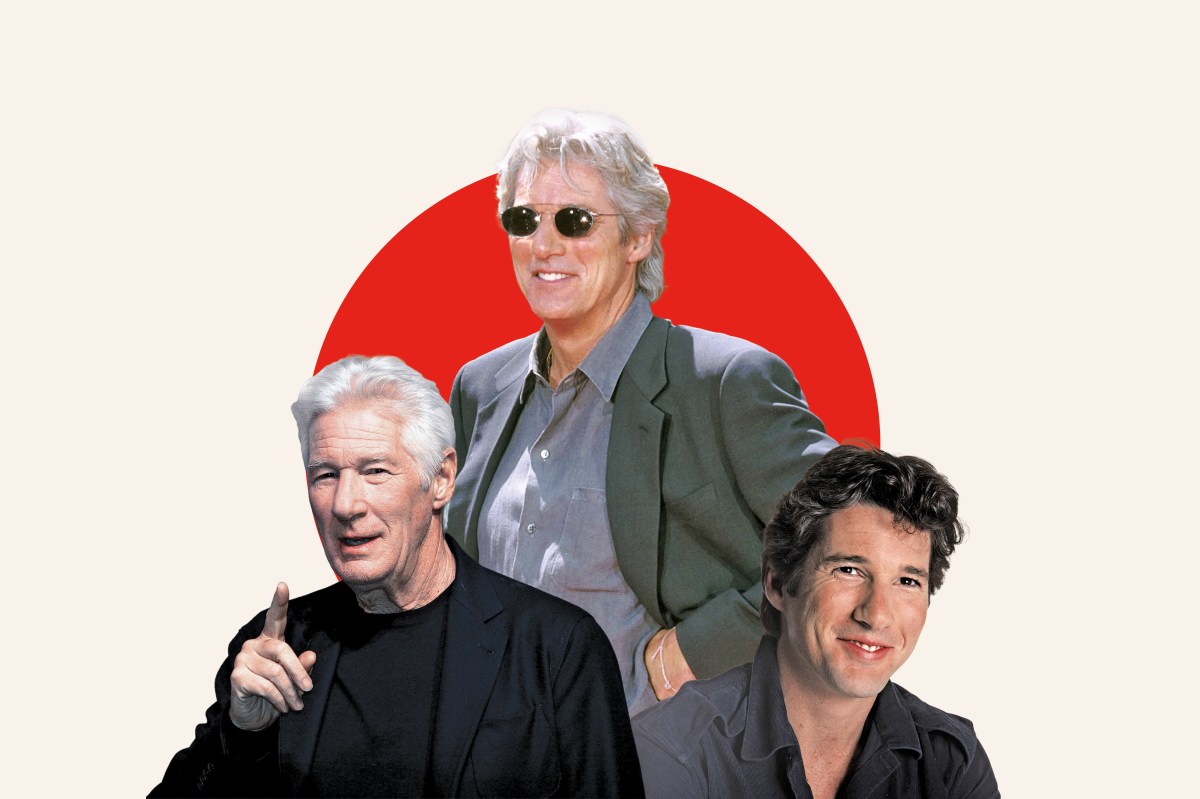
From the Poltergeist curse to the Munchkin who supposedly died by suicide on the set of The Wizard of Oz, Hollywood is built on urban legends. (The latter has been widely debunked.) But no legend has been snickered about more than the one involving Richard Gere and a gerbil.
Yes, a gerbil.
(This is a respectable magazine, so let’s just say that in this legend, which has no basis in fact, Gere and the gerbil got to know each other very well at some point in the 1970s or ‘80s.)
Now, The Hollywood Reporter is going all the way down the rabbit hole. Gerbil, a new 12-episode investigative podcast from journalist Allen Salkin, digs into where the rumor came from, debunks much of it along the way and asks why it refuses to die four decades later.
Photo illustration by Newsweek/Getty
“Many, many people heard this. Many people remember hearing it when they’re a kid, whether or not they did,” Salkin tells Newsweek. “And the rumor has never died. I’m very skeptical that it’s true, but it’s an investigation in that way. It’s also an investigation of why. What can we learn from the durability of this rumor?”
Salkin spent six years on the project, and he did it the old-fashioned way. He interviewed real people, ordered obscure magazines off eBay and went to Cedars-Sinai to ask questions in person. Among his finds: an apparent earlier version of the rumor out of Philadelphia, centered on newscaster Jerry Penacoli.
With a rumor this absurd on its face, the real question isn’t whether it’s true. It’s what its staying power says about Gere and how he’s handled it and, maybe more uncomfortably, what it says about us, the ones who kept it alive.
Salkin is also fully aware of the irony of naming his show after the thing. “I’m riding on the proven viral success of this rumor by naming the podcast Gerbil,” he admits. “Perhaps though, like a vaccine, we’re taking some of the dead material and creating an inoculation for it.”
Gere has only referenced the rumor in passing, once quoted in The Village Voice saying that rumors like it are one of the reasons he stopped reading press about himself. Understandable. But as Salkin points out, Gere’s silence may be exactly what’s kept this thing running on its wheel.
“The lack of Richard Gere ever saying ‘I didn’t do it’ is also very interesting,” Salkin says. “Crisis communications PR was not in the ’80s what it is now. There’s almost a playbook now, and ignoring it is not usually a good idea.”
The proof is still airing. Salkin notes a recent It’s Always Sunny in Philadelphia sitcom episode featured an explicit gerbil gag. “So, it has not stopped,” he says. “If ever, it’s like a PR teaching tool for celebrities—this is not the way to do it.”
Whether Gere should address it is another matter. Anything he says could just as easily make it a bigger story. But one thing is clear: The rumor isn’t going anywhere. And that may have as much to do with Gere’s reputation as it does with any gerbil.
“Richard Gere is a wonderful humanitarian and a political activist, spiritual man,” Salkin says. “Much to be admired, and I admire him. But when he was young, he was a d***.”
Salkin goes further, suggesting the rumor has shaped Gere in ways the actor will likely never cop to. He believes it “has motivated career choices and has infiltrated other parts of his life that are quite astonishing.”
As for who started it, Salkin won’t say. That answer arrives in episode 12. But the rumor about the rumor has long pointed to Sylvester Stallone, Gere’s short-lived co-star in 1974’s The Lords of Flatbush. Stallone told Ain’t It Cool News in 2006 that Gere was eventually fired from the film after clashing with him.
Salkin isn’t sold on a single culprit. He says he’s “very skeptical” that it was just one person who started the rumor, “like Sylvester Stallone,” he says. “I really do think I know the answer.”
However it started, thanks to Gerbil, this rumor isn’t burrowing away anytime soon.