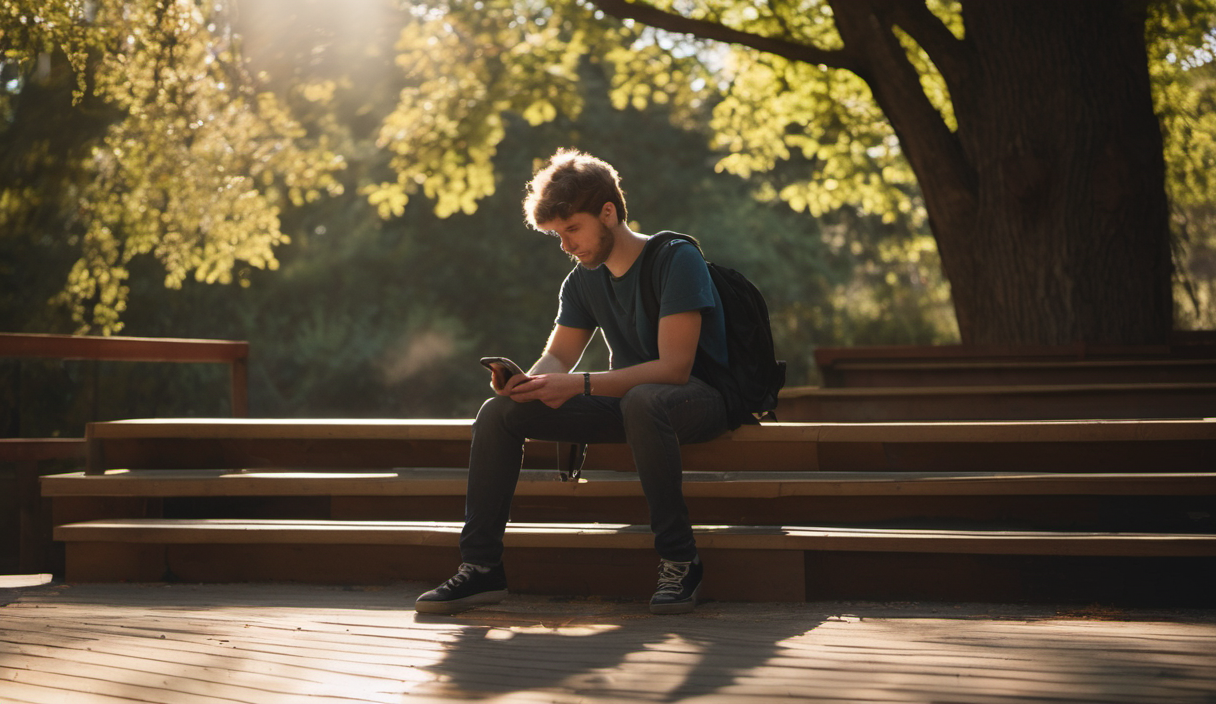
Featured image: A young Black woman is sitting on a wooden park bench, holding a smartphone in her hands. AI-generated image; not a photograph of the reported event.
At four universities across the country, students are practicing how to connect with people who hold different beliefs, backgrounds, or values. Source: greatergood.berkeley.edu.
Your Voice Matters
Mrs. Dawn Collins, a founding member of the Bowie State University and University of Maryland Social Justice Alliance, says: “Your voice matters and everyone has a part to play.”
She made this statement after her son, Lt. Richard Collins III, was murdered on the University of Maryland campus. The alliance was formed to confront hate and systems that normalize indifference or justify injustice.
Her words emphasize dignity and responsibility. Every person has a role in fighting intolerance and building empathy.
Small Moments Can Lead to Meaningful Choices
In a Dickinson College episode, Ryan Thies met Matthew Craig at a Halloween party. Matthew was dressed as Donald Trump.
Ryan could have walked away, made assumptions, and left. Instead, he leaned in and got to know Matthew.
That small choice led to a friendship and eventually to roommates. It reflects a form of empathy: choosing to engage with someone even when it challenges your worldview.
At Bowie State and Maryland, the stakes are higher. Students and faculty confront a painful history—the murder of a student—and choose to show up, listen, and participate.
These moments show that courage isn’t always about grand gestures. It’s often about saying: “This matters. I’ll attend. I’ll listen.”
Connecting Isn’t About Erasing Differences
At Iliff School of Theology, students imagine different versions of America that reflect their values. They do not need to agree on a single vision.
At Dickinson, Republicans and Democrats engage deeply without abandoning their beliefs. They listen to each other, not to change, but to understand.
True connection does not require compromise. It allows differences to exist while building mutual respect.
Why This Matters
These stories come from real student experiences. They show how empathy and active listening can grow from everyday choices.
They offer practical lessons for people in classrooms, workplaces, or communities where differences are present.
These moments are not rare. They are possible when people choose to stay curious and open.
What to Watch For
As more students and institutions explore these practices, look for how they are being adapted in classrooms and campus life.
Watch for how these lessons are shared beyond universities—into communities and public conversations.
For more on how to build empathy in education, see the Bridging Differences in Higher Education Playbook.
Learn how students at Bowie State and Maryland are working together through the BSU–UMD Social Justice Alliance.