AI-powered dating apps are growing fast. Services like Overtone and SciMatch use artificial intelligence to match users based on preferences and behavior. These apps claim to predict compatibility—before people meet. Source: greatergood.berkeley.edu.
How AI Claims to Work
AI dating apps collect data on user behavior: who they swipe on, what they chat about, and which profiles they ignore.
Some algorithms use traits like personality similarity or reciprocity. For example, Fate uses ‘similarity and reciprocity of personality’ to suggest matches.
Research shows that similarity may predict attraction before a meeting. But once people interact, similarity matters less—often vanishing entirely.
What Science Actually Shows
Studies from Amanda Montoya and Sarah Humberg suggest that personality similarity predicts attraction only in early stages.
Another study by Annika From found little evidence that couples are happier when they are more similar.
Reciprocity—where two people have complementary traits—has even less support in the data.
AI’s Blind Spots
People often dismiss profiles based on trivial details: a name like ‘John’ or a bad haircut.
These preferences change quickly and are not consistent. AI learns from swipes—but may not capture the full picture of what people truly value.
AI is trained on what users say and do. If users don’t reveal real preferences, AI will reflect only surface-level choices.
Is Love Predictable?
Relationship scientists do not agree on whether love can be predicted.
Some believe AI could one day detect patterns that predict compatibility.
Others argue that love evolves through interaction—shared jokes, rituals, and moments—and cannot be forecasted.
Early research shows that random pairings rarely spark chemistry. Repeated meetings may help—but no clear trigger has been found.
What This Means for Users
AI tools may offer insights—but they don’t guarantee accurate matches.
Users risk seeing only the profiles AI thinks are compatible, without understanding how those decisions were made.
AI reflects the beliefs of its creators. If science hasn’t found what makes people compatible, AI will not either.
As one researcher puts it: ‘We don’t know what makes two people fall in love. So we can’t build an algorithm to predict it.’
For a more open approach, consider exploring diverse partners—different beliefs, experiences, and personalities.
Paul Eastwick advises: ‘If you have serious dealbreakers—like wanting children or strong religious views—make sure they’re respected, not avoided.’
For deeper exploration of human connection, see can consciousness exist without a body? or zen, feng shui, and life-balancing philosophies.
More research is needed. Current studies combine app data with real-life interactions to understand when chemistry develops—and what sparks it.
Until then, AI remains a tool—not a solution—for finding love.
Sources & further reading
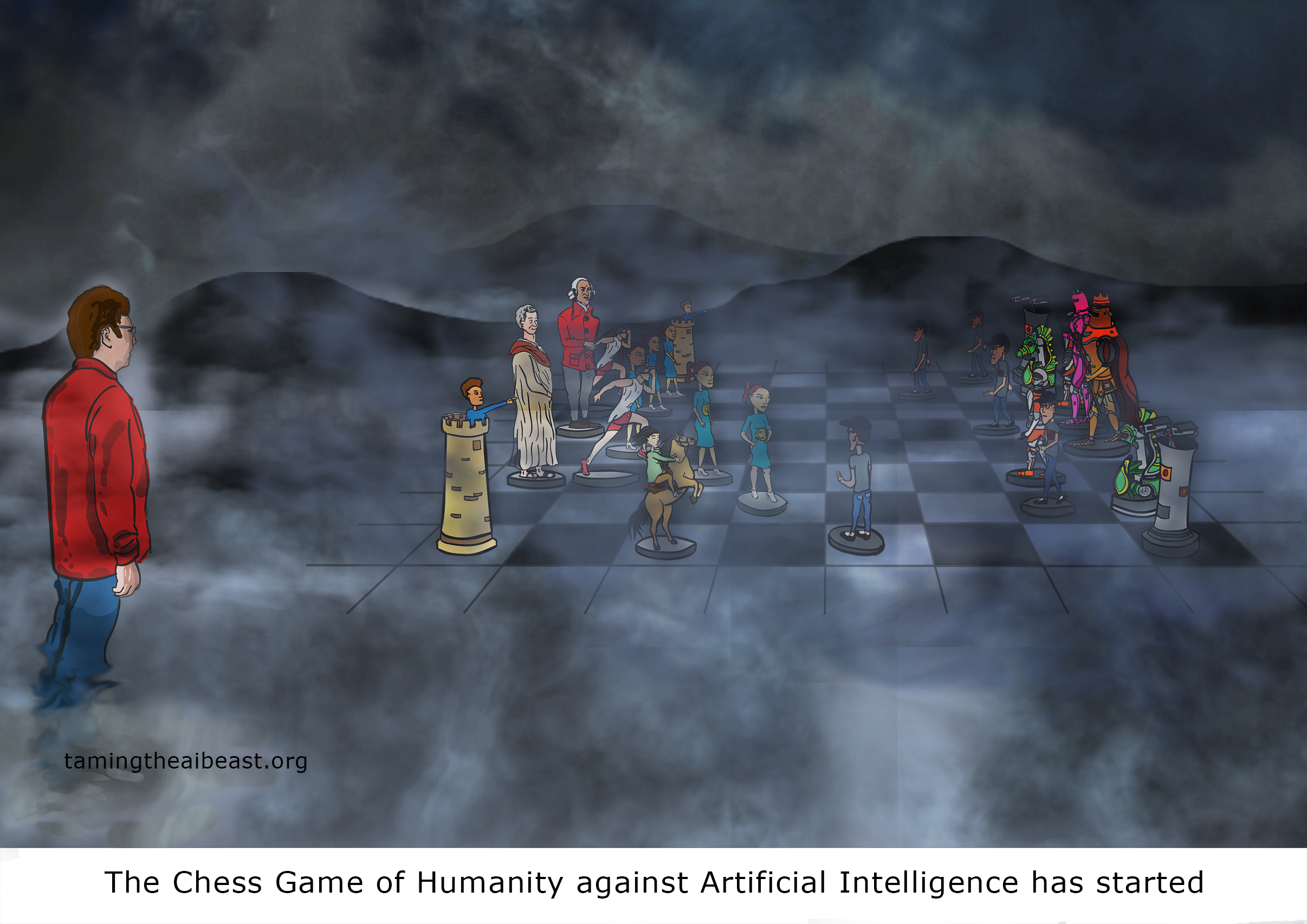
Featured image: Chess Game of Humanity with Artificial Intelligence.png by tamingtheaibeast.org, CC BY-SA 4.0, via Wikimedia Commons. Image source · License