A student who struggled with reading built a detailed cardboard model of the Titanic. This simple act reveals a deeper truth about how children learn and how AI might interfere with that process.
Executive Function Through Hands-On Practice
Executive function isn’t a fixed trait. It grows through meaningful, active practice—especially when children are engaged in tasks they care about.
One student in a classroom had difficulty with reading. He needed frequent adult support to decode words. Yet, he built a two-meter-long cardboard model of the Titanic with precision.
He included smokestacks, lifeboats, a captain’s quarters with a ship’s wheel, and even painted it in the real ship’s black and red. His fine motor skills were strong. He rebuilt the model multiple times, adjusting parts as they failed.
He didn’t do this as part of a history project. It was self-directed learning. He worked on it alone for two months. Each failure led to a new design. This process showed a clear example of executive function in action.
Executive function encompasses a range of cognitive skills, including working memory, attention control, cognitive flexibility, and self-regulation. These are not innate or static; they are developed through repeated, purposeful engagement with tasks. When a child works on something they find personally meaningful—like building a ship—they are naturally motivated to persist through challenges, manage their time, and adapt when something doesn’t work.
Research by Adele Diamond and Daphne Ling (2016) found that programs designed to improve executive function show the most significant gains when children engage in activities that are both challenging and personally relevant. The transfer of these skills is strongest when the practice involves similar cognitive demands—such as problem-solving, planning, and adjusting strategies—across different contexts. For instance, a child who learns to troubleshoot a broken toy may later apply that same reasoning to writing a story or organizing a school project.
What Children Learn Through Trial and Error
Developmental psychologist Alison Gopnik describes young children as ‘rational Bayesians.’ They test ideas, observe outcomes, and revise their beliefs based on what actually happens.
Each time the student tried a lifeboat design or a smokestack that didn’t hold cotton, he was conducting a small experiment. When something failed, he tried again. That process is how children build problem-solving skills.
Children don’t just learn from correct answers—they learn from the process of testing, failing, and adjusting. This form of learning is deeply rooted in cognitive development. It involves forming hypotheses, gathering evidence, and updating beliefs in real time. This is not a passive process; it requires active engagement, emotional resilience, and sustained focus.
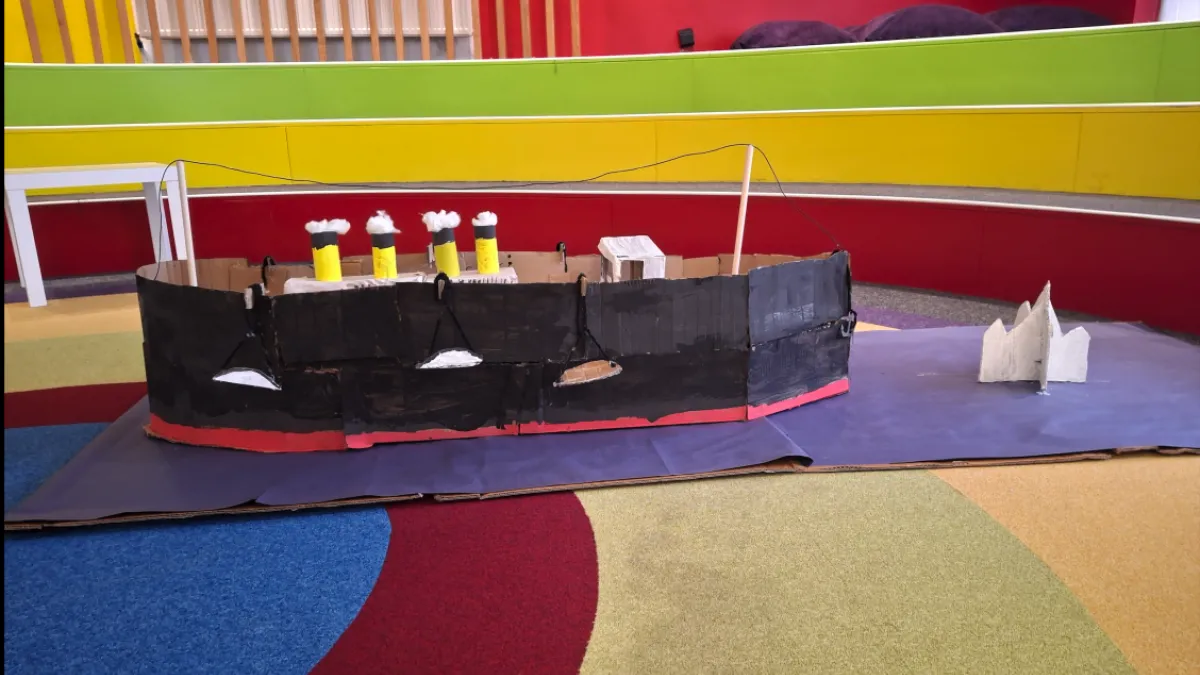
For example, when the student tried to attach the lifeboats with pipe cleaners and they didn’t hang properly, he didn’t accept that as a dead end. Instead, he experimented with different configurations, tried new materials, and eventually found a solution. This kind of iterative learning is central to executive function development. It teaches children how to manage uncertainty, evaluate options, and make decisions under incomplete information.
AI Tools and the Risk of Reducing Exploration
AI tools can generate detailed plans for building a model. They can suggest step-by-step instructions for any project.
But giving a child an AI-generated plan changes the nature of learning. It replaces trial and error with a pre-defined path.
When children are shown the answer upfront, they stop exploring. A 2011 study by Elizabeth Bonawitz found that preschoolers who were shown one function of a toy explored fewer of its other uses. They assumed the search was over.
Even more striking is a 2024 study by Yiu, Kosoy, and Goping. They tested 4-year-olds learning how a machine works. The children explored the machine themselves and discovered its rules.
When the same information was given in words to AI language models, the models could not discover the underlying rules. They could only repeat what was already known.
These findings show a key difference: children invent through variation. AI imitates through repetition. A child’s invention comes from trying something not suggested. AI does not.
When a teacher provides a student with an AI-generated blueprint for a science project, they are essentially offering a shortcut. The student may skip the process of testing materials, observing results, and adjusting their design. This reduces the cognitive load of problem-solving and diminishes the opportunity for the child to develop resilience, creativity, and critical thinking.
Why This Matters in Education
AI tools can be helpful. But when they offer ready-made solutions for open-ended problems, they risk replacing the messy, creative process of learning.
Students may grow up with access to instant answers. They may learn to rely on AI to produce essays, summaries, or homework. This makes the effort of producing something feel easier and cheaper.
Yet, the thinking behind a project—like building a model or writing a story—still grows through struggle. The personal effort, the trial and error, the failure and revision—these are what build real understanding.
For the student who built the Titanic, reading improved not because sounds clicked instantly. Instead, he learned to build words by piecing sounds together in a physical puzzle—like how he built the ship.
Both cases relied on discovery, not instruction. The student was never given a ready-made answer. He was given a method to find connections on his own.
What This Means for the Future of Learning
Technology should support learning, not replace it. AI can assist, but it should not take the place of active exploration.
Teachers have a role in protecting the classroom environment—where students are allowed to fail, rebuild, and discover on their own.
As AI becomes more available, schools must ensure that students still engage in open-ended, self-directed tasks. These are where executive function grows.
For instance, instead of giving students a pre-written outline for a science fair project, teachers could present a challenge—like designing a device that can move a small object across a surface—and allow students to explore, experiment, and iterate. This kind of open-ended inquiry mirrors how children naturally learn and develop cognitive skills.
The student’s journey shows that learning isn’t about what is taught. It’s about what is discovered through effort and persistence.
That is the thinking behind the Titanic. And that is what children must continue to build.
- Children develop executive function through hands-on, meaningful activities.
- AI tools can imitate, but they cannot discover new rules or ideas.
- Showing children answers upfront reduces their exploration and learning.
- Real problem-solving grows through trial, error, and revision.
- Education must protect time for self-directed, messy learning.
Original source: What a Cardboard Titanic Taught Me About Children and AI
Sources & further reading
Featured image: original publisher image. Via original publisher. Image source