A former appliance store in Hong Kong’s SoHo district has been transformed into Mius, a neighborhood cocktail bar. The conversion reflects a growing trend of repurposing industrial spaces into intimate, design-focused hospitality venues.
From Appliance Store to Cocktail Bar
The space at 29 Gough Street was once a retail appliance store. Now, it serves as Mius, a small-scale cocktail bar designed with simplicity and functionality at its core.
Owner Shelley Tai envisioned a genuine neighborhood bar—something that feels authentic and unpretentious. She emphasized comfort and clarity in both drink offerings and the overall experience. According to her, the bar should feel like a place where people naturally gather, without the need for elaborate presentation or performance. This vision directly influenced the design approach taken by the team behind Mius.
Design Philosophy and Execution
Kevin Yiu, principal of Minus Workshop, led the spatial design of Mius. The project was completed in just eight months, a tight timeline that shaped key design decisions.
Yiu embraced mid-century modern aesthetics—characterized by clean lines, natural materials, and balanced proportions. He described the design process as one of restraint, where every element serves a purpose rather than drawing attention to itself. ‘We didn’t aim to create something flashy,’ he said, ‘but something that feels lived-in and quietly confident.’
- High ceilings allow for ample daylight during the day, creating a sense of openness and connection to the outside environment.
- Leather blinds are installed to regulate light, functioning as both a day-to-night transition tool and a design feature that adds texture and warmth.
- A low structural beam clad in oak now serves as a visual anchor, guiding the flow of movement through the space and helping to define different zones within the bar.
- Electrical and mechanical systems are concealed behind joinery, preserving the space’s clean aesthetic while ensuring that maintenance remains accessible.
The material palette combines organic textures with metallic accents. Wood veneer adds warmth and a tactile quality, while bronze and silver metals introduce subtle sheen without overwhelming the space. Copper and brown tones ground the palette, offering a natural, earthy foundation. Yiu noted that the use of minimal paint—rather than glossy lacquer—helps maintain a grounded, human scale, avoiding the artificiality often associated with commercial interiors.
Functional Layout and Flow
The 14-foot stainless steel bar top is both a statement piece and a practical surface. It integrates essential bar equipment, allowing staff to operate efficiently without sacrificing visual continuity. As Yiu explained, ‘The bar is not just a surface—it’s a functional hub that supports both service and atmosphere.’
Travertine slabs form elevated tables where guests enjoy small plates and signature cocktails. These tables are designed to be both functional and visually engaging, offering a balance between comfort and design clarity.
To manage peak-hour traffic, the bar is divided into four service counters. This layout reduces congestion and maintains a smooth service flow. Guests move from the front to the bar, with stools framing the activity in the main area. Yiu observed that this configuration allows for a more intimate interaction between staff and patrons, enhancing the sense of community and service.
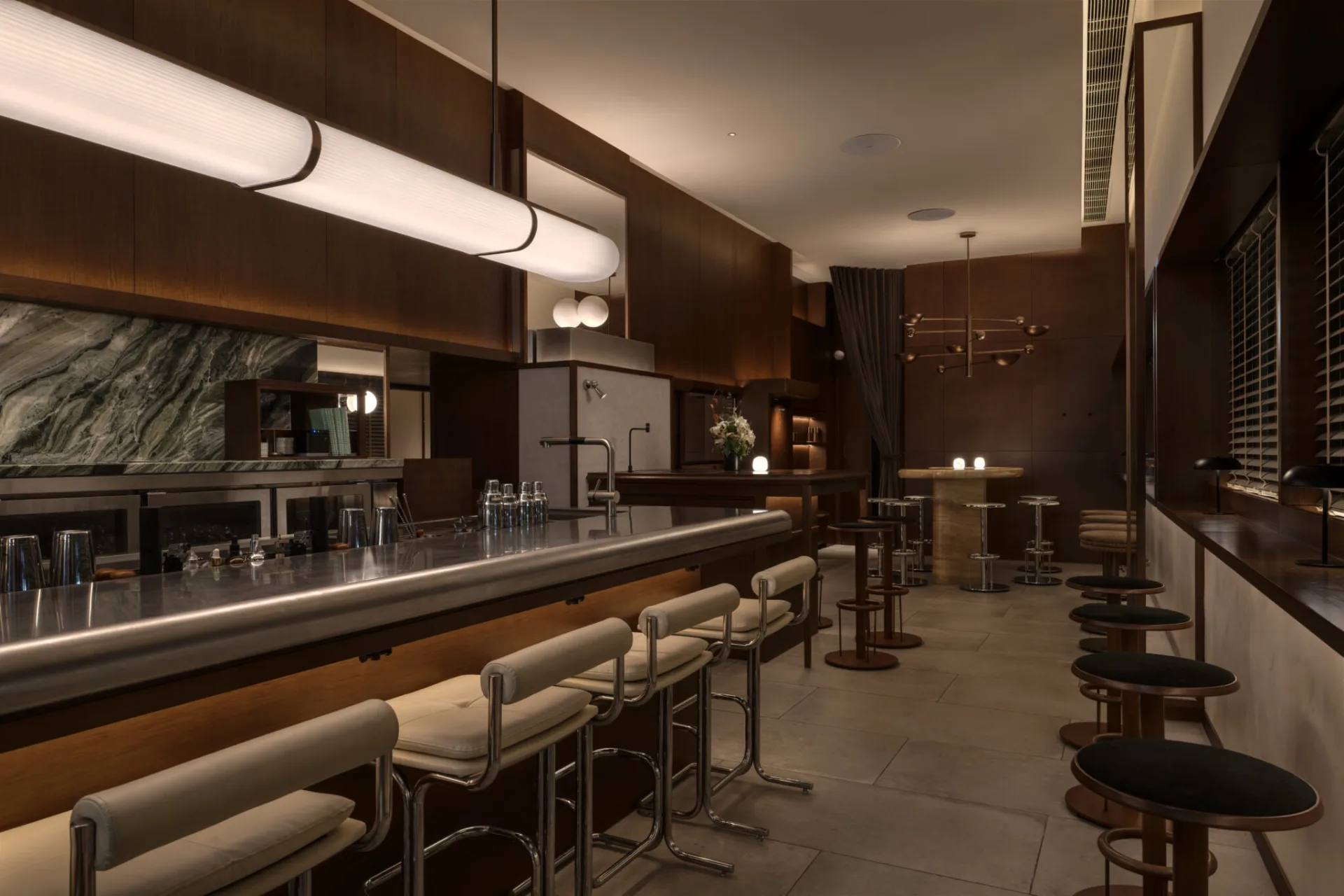
A floating chandelier by Lee Broom features celestial orbs that provide even, soft lighting. The chandelier casts a gentle glow over the crowd, contributing to a calm and inviting atmosphere. Plush velvet curtains drape over storage room doorways, adding warmth without clutter. Accent lamps complete the lighting scheme, reinforcing the space’s bespoke yet unpretentious character.
Design Intent and User Experience
For Yiu, Mius is not about spectacle. It is designed to unfold quietly—like a well-prepared meal. The interior architecture supports a contemplative atmosphere, elevating the hospitality experience. ‘The space is meant to be savored,’ he said, ‘not rushed through. It’s a sanctuary of simplicity, where design doesn’t dominate, but rather supports the experience of being present.’
This philosophy aligns with owner Shelley Tai’s desire for a neighborhood bar that feels familiar and welcoming. The bar offers classic cocktails and simple, uncomplicated food—no overcomplicated menus or excessive presentation. This focus on clarity and authenticity resonates with the local community, making the bar feel like a true part of the neighborhood fabric.
While the space is compact, design choices—such as strategic voids and reflective surfaces—make it appear more expansive. These subtle interventions enhance the guest experience without relying on large-scale features or visual gimmicks.
Design and Community Context
Mius is located in SoHo, a district known for its mix of creative industries and urban revitalization. The transformation of a former appliance store into a hospitality space illustrates a broader trend of adaptive reuse in urban environments. Such conversions often preserve historical elements while reimagining their function. In this case, the building’s original structure is honored through careful integration into the new design.
Yiu noted that the project reflects a growing interest in design that respects both the built environment and human behavior. ‘We’re not just designing a space,’ he said, ‘we’re designing a rhythm—one that matches how people move, how they interact, and how they feel at home.’
For those interested in interior design and urban transformation, Mius offers a clear case study in how simple, intentional design can elevate everyday experiences. It demonstrates that meaningful spaces do not require extravagance—they only require thoughtfulness, honesty, and a deep understanding of human needs.
Learn more about the design firm behind Mius at Minus Workshop. Visit the bar itself at mius.hk. Explore the original project at design-milk.com.
Sources & further reading
Featured image: Minus Workshop designed Mius as an intimate neighborhood cocktail bar in Hong Kong’s SoHo district. Photography by Steven Ko.. Via original publisher. Image source