Sonos remains a leading brand for multi-room audio systems, known for elegant design and seamless integration across homes. Despite a rocky 2024 app update, the company has rebounded with new products and improved software in 2026. Source: livingetc.com.
How Sonos Systems Work
Each Sonos speaker connects directly to your home Wi-Fi. Music streams from the internet, not your phone. This means your phone acts only as a remote.
Speakers automatically sync through SonosNet, a wireless mesh network. This allows them to coordinate playback, even when rooms are far apart.
TruePlay technology adjusts sound based on room acoustics. It works on most models, especially when an iPhone or iPad is used as a trigger.
Bluetooth support was added in 2019 with the Move. Today, models like Roam 2, Move 2, and the Era 100 and Era 300 support Bluetooth. This lets music follow you outside the home.
Portable speakers like Play and Move 2 can link up to four devices over Bluetooth. This is ideal for garden parties or outdoor gatherings.
What Is Sonos 27?
On September 8, 2026, Sonos released Sonos 27 as a free software update for all products made in the last decade.
It replaces the older S1 app and introduces a cleaner interface. The name follows Apple’s iOS model, making updates easier to track.
After a 2024 app redesign that caused user frustration, Sonos has focused on stability and usability in 2025 and 2026.
Key features of Sonos 27 include:
- Portable surrounds: Two Play or Move 2 speakers can act as rear channels for a soundbar during movies, then return to their original locations after credits.
- Headphone linking (Early Access): One press switches music between Ace Ultra headphones and any Sonos speaker or group — no phone needed.
- Presets: Save a playlist or station with volume and room settings. Start it with one tap.
- AI assistant integration (Early Access, US English): With permission, AI tools like ChatGPT and Claude can control your speakers.
- Chattier voice assistant (Early Access): Understands natural requests like ‘play something mellow in the bedroom’ instead of strict commands.
- Custom agents (planned for 2027): Users can design their own AI assistant with a unique voice and personality.
Behind the scenes, Sonos has developed a technology called Sonos Fabric. It enables automatic pairing, grouping, and surround sound. It powers both portable surrounds and headphone linking.
Which Speaker Should You Buy?
There are seven models in the current lineup. The Sonos One and One SL have been retired, replaced by the Era 100 family.
Here is the range from cheapest to most expensive:
- Era 100 SL: $189/£169. No microphones. Ideal for bedrooms or as rear speakers for a soundbar.
- Roam 2: $179/£179. Lightest speaker, about the size of a water bottle.
- Era 100: $219/£199. Best all-rounder. Offers voice control, Bluetooth, and USB-C line-in.
- Play: $299/£299. Mid-size portable. IP67 rated. Runs 24 hours. Has a fabric carry loop and sand colorway.
- Move 2: $499/£449. Largest portable. Weighs 3kg. Handles open-plan spaces and parties. Has a built-in handle.
- Era 300: $499/£499. Designed for Dolby Atmos. Features upward-firing drivers for immersive sound. Hourglass shape, elegant design.
- Five: $599/£549. Most powerful single speaker. Six drivers. Can stand upright or lie on its side for stereo. Includes 3.5mm line-in for turntables.
According to Sonos, the Era 100 SL is recommended for first-time buyers. It offers excellent sound for its size and avoids voice controls, which may be unwanted in private spaces.
Roam 2 is best suited for users who frequently move speakers between rooms — such as from a bedside table to a bathroom. Its compact size and water resistance make it ideal for daily use.
Play sits between Roam 2 and Move 2 in size and usability. It is easier to carry than Move 2 but still delivers strong sound. It runs for 24 hours and docks on a charging base.
Move 2 is best for larger homes or open-plan spaces. It can serve as a main speaker or pair with another for surround sound during movie nights.
The Era 300 is designed for immersive audio experiences. Its drivers fire upward and outward, creating a 3D sound field. It works best when placed in open areas, not tucked into bookcases.
The Five is ideal for serious listening. It can fill a large living room on its own. It supports a turntable via 3.5mm line-in and has no Bluetooth or microphones — it relies solely on Wi-Fi and AirPlay 2.
Soundbars and Subwoofers
Four soundbars and two subwoofers are available. The Beam Ultra is the most significant new addition.
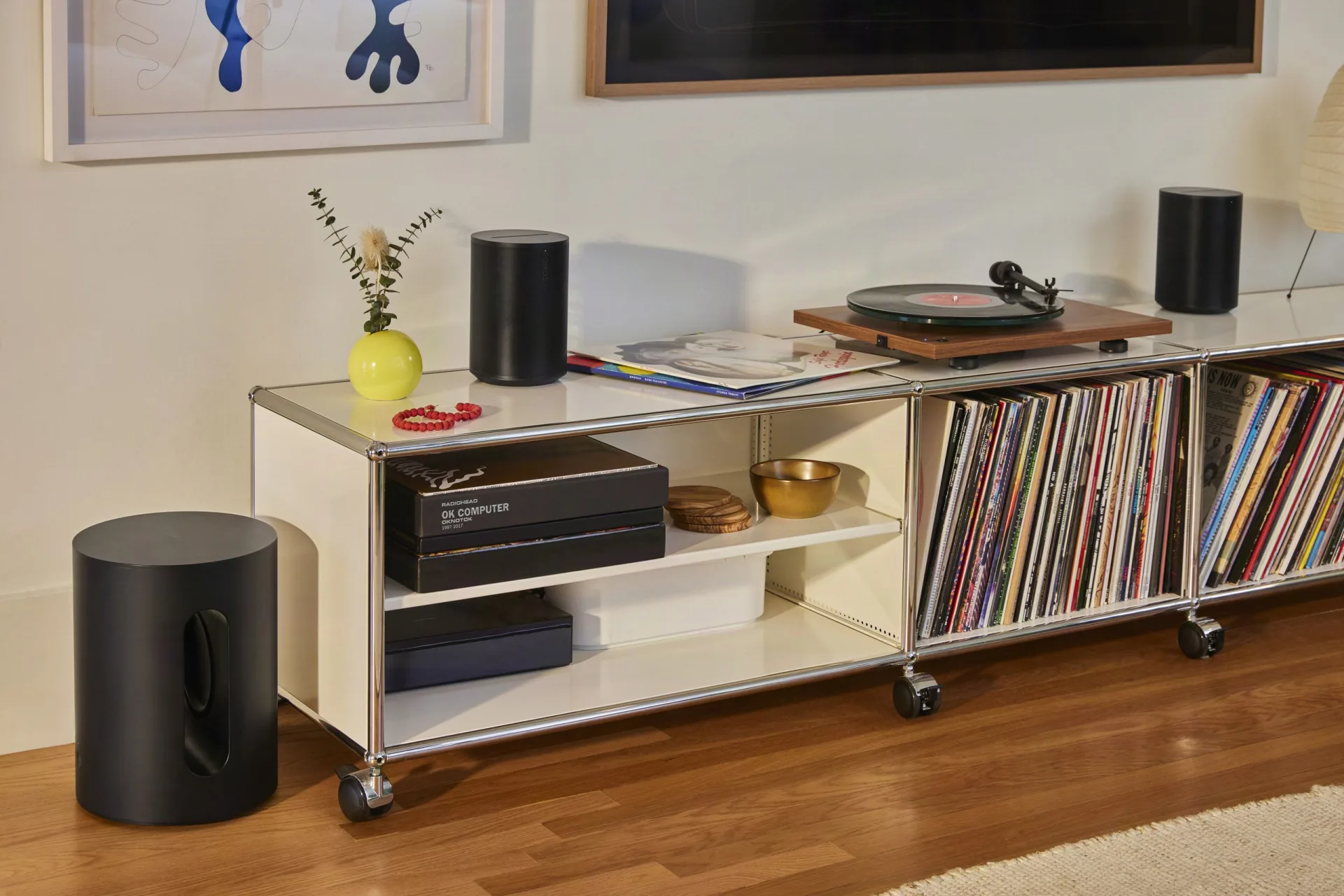
Ray: $219/£199. Simple soundbar for small TVs. No Atmos, no microphones. Connects via optical. Ideal for bedrooms or offices.
Beam (Gen 2): $499/£449. Compact, supports Dolby Atmos through processing. No up-firing drivers. Voice control, Night Sound, and Speech Enhancement. A popular choice for mid-sized homes.
Beam Ultra: $699/£699. Features up-firing drivers for true height effects. Includes AI Speech Enhancement with four levels of dialogue boost. No DTS:X support. Beam owners upgrading must get a new wall mount.
Arc Ultra: $1,099/£999. 9.1.4 Dolby Atmos with 14 drivers. Offers Sound Motion, a new woofer that delivers deep bass from a slim bar. Ideal for large living rooms with big screens.
Sub Mini: $499/£429. Minimal cylinder. Best paired with Ray or either Beam.
Sub 4: $899/£799. Full-size subwoofer. Works with Arc Ultra, Beam Ultra, or Five. Can stand upright or lie flat.
Headphones: Ace and Ace Ultra
Two noise-cancelling headphone models are available.
The original Sonos Ace ($399/£349) is a standard Bluetooth pair. It’s one of the most comfortable in the market.
The new Ace Ultra ($449/£399) connects via Wi-Fi to your entire Sonos system. One press moves music between speakers and headphones. It offers up to 35 hours of battery life, replaceable ear cushions, and a replaceable battery.
Colors include black, soft white, agave (muted sage), and sand — designs that blend with interior spaces.
Streaming and Compatibility
Most major streaming services work with Sonos. These include Spotify, Apple Music, Amazon Music, TIDAL, Deezer, YouTube Music, Qobuz, BBC Sounds, Audible, and TuneIn.
Music from other apps can also be played directly. Apple’s AirPlay 2 works across the current range. Spotify Connect lets users select a Sonos speaker from within Spotify.
Turntables and CD players can connect via line-in. The Five, Era 100, Era 300, Amp, and Port all support this. Music stored on NAS drives or in iTunes libraries also plays — a feature from Sonos’s early days.
Voice Assistants and Privacy
Most Sonos speakers with microphones support two voice assistants: Sonos Voice Control and Amazon Alexa.
On Beam Ultra, only Sonos Voice Control is available. This is a notable limitation for users who prefer Alexa.
Sonos Voice Control processes requests on the speaker itself. No data is sent to the cloud. This ensures privacy. Features vary by country.
Amazon Alexa runs on Amazon’s servers. It can manage smart home devices and answer general questions. It is not yet available on Beam Ultra.
Google Assistant was available on older models like the Sonos One but has been phased out. Newer models no longer include it.
For privacy-focused users, the Era 100 SL has no microphones. It also allows users to turn off microphones via a switch or button.
Practical Tips for Setup and Use
Set up in minutes:
- Plug in the speaker and open the Sonos app.
- The app detects new devices and walks you through Wi-Fi connection, sign-in, and music services.
- To add more devices, tap settings, select ‘Add Speaker or Component,’ and follow prompts.
There is no need for a hub. Every current Sonos product connects directly to your Wi-Fi.
In large homes, a single speaker can build a SonosNet mesh network. This allows automatic speaker coordination. You can turn it on or off via Settings > Network > SonosNet.
For late-night TV, use Night Sound to reduce sudden loud moments. Pair it with Speech Enhancement for clearer dialogue. On Arc Ultra and Beam Ultra, this is AI-powered with four settings.
Create presets to save favorite content and volume levels. For example, a morning radio station in the kitchen at a gentle volume.
Set alarms to start a playlist in any room. Replace your phone’s beep with music.
Enable explicit content filtering to keep music family-friendly. Go to Settings > General Settings > Parental Controls > Filter Explicit Content.
Turn off the status light on speakers — especially in bedrooms. Go to Settings, select the room, and disable the status light under Hardware.
Limitations and Considerations
Some features are still in early access. For example, AI assistant integration and custom agents are not yet available to all users.
Beam Ultra requires a new wall mount for upgrades. Existing owners must replace their mounts to use it.
Only the Era 100 SL lacks microphones. Other models have voice assistants, which can be disabled.
The IKEA Symfonisk line, which used Sonos technology since 2019, ended at the start of 2026. No new models are planned, though existing units remain compatible and receive updates.
While Sonos offers strong integration, it does not support DTS:X. This may limit options for users who prefer that format.
Custom AI agents are planned for 2027. These will allow users to design their own voice assistants with unique personalities and voices.
Further improvements to AI features may expand voice control and music discovery.
More updates to the Sonos ecosystem may include deeper integration with smart home devices and new architectural speaker options.
For those considering a new system, Sonos is currently offering Black Friday deals. These are available on Sonos’ Amazon storefront until Monday.
Deals include:
- Roam 2 — Save £40
- Move 2 — Save £90
- Era 300 — Save £100
- Five — Save £150
- Beam Gen 2 — Save £110
These savings make it a good time to explore the Sonos ecosystem — especially for first-time buyers or those upgrading an older setup.
For a detailed comparison of Sonos and Bose, see our article on Sonos vs Bose.
Visit the official Sonos store at Amazon.co.uk to explore full product details and availability.
Sources & further reading
Featured image: sonos speaker in a modern, slightly retro home. Via original publisher. Image source