LlamaIndex has released OCRia-nano-1, an 8.1M-parameter OCR model that runs entirely on a CPU. No GPU is needed. This makes it accessible for businesses and individuals without high-end hardware.
What Is OCRia-nano-1?
OCRia-nano-1 is the smallest model in LlamaIndex’s OCRia family. It is not a single network. Instead, it uses seven specialized models chained inside LiteParse.
These models were trained using labels from the larger OCRia-1 vision-language model. That ensures accuracy in text, table, and layout recognition while keeping the model small.
How Does OCRia-nano-1 Work?
Each page goes through six stages:
- Text layer check: PDFium reads native text from digital PDFs. If no text is found, OCR kicks in.
- Line detector (0.08M): Finds text lines at 250 DPI, enabling precise line segmentation.
- Script router (0.04M): Identifies the main script. Confident lines can override it. It also flags upside-down pages.
- Four recognizers: Handle Latin, world-script, right-to-left, and CJK writing systems. Each is optimized for its script.
- Merge stage: Combines OCR lines with native PDF text. Both sources are preserved.
- LayoutNet (4.27M): Predicts table, row, column, cell, and block relationships across 13 layout classes. It rebuilds document structure accurately.
Outputs include Markdown, JSON with bounding boxes, or plain text. Tables that span columns appear as HTML to keep formatting clear.
Performance Benchmarks
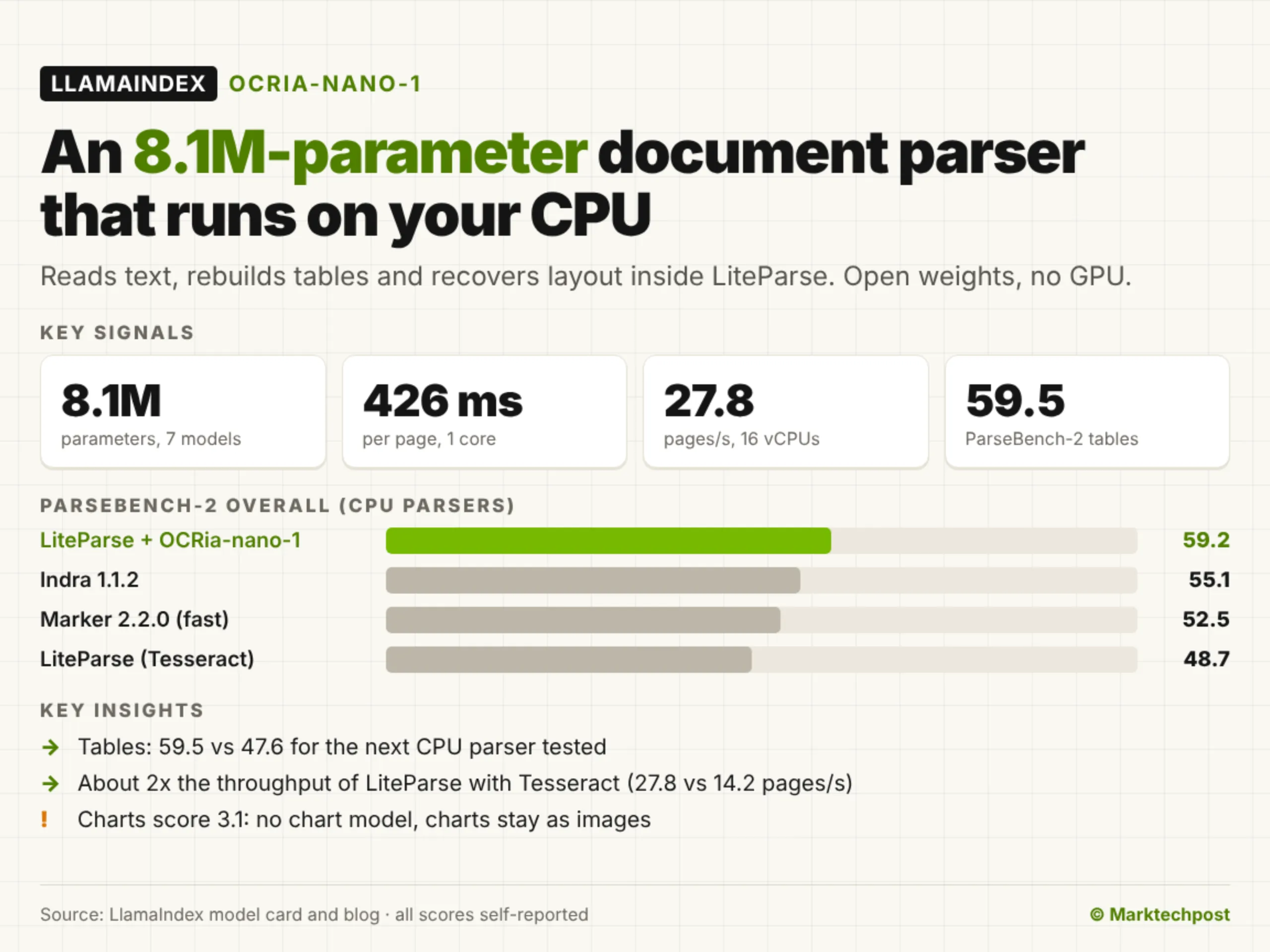
On ParseBench-2, a benchmark LlamaIndex created, OCRia-nano-1 scores 59.2 overall.
- It beats Indra 1.1.2 (55.1) and Marker 2.2.0 (fast) (52.5).
- It leads in tables (59.5 vs 47.6), showing strong table reconstruction.
- It scores 72.4 on layout and 82.2 on formatting—both top-tier results.
On other benchmarks: 74.8 on OmniParseBench, 52.7 on ParseBench-1, and 60.9 on olmOCR-bench. Its character error rate is 0.048—very low and indicates high precision.
It trails Indra slightly on forms (69.8 vs 70.2). LiteParse with PP-OCRv6 small scores 59.9 but runs at 5.7 pages per second. PP-OCRv6 tiny reaches 58.9 at 14.7 pages per second—showing a trade-off between speed and quality.
Speed and Efficiency
On one CPU core, it takes 426 ms per page. 90% of pages finish in under 862 ms.
With 16 single-core workers, it processes 27.8 pages per second—about twice as fast as default Tesseract in LiteParse (14.2).
Indra runs at 29.6 pages per second. Removing LayoutNet boosts speed to 37.2 pages per second, but formatting quality drops to 51.2.
In a browser via WebAssembly, a scanned page takes 1 to 4 seconds on a laptop. This is acceptable for basic use but not for real-time processing.
How to Run OCRia-nano-1
Install and run using these commands:
pip install liteparse— for Python workflows.lit models pull ocria-nano— pulls the model from Hugging Face.lit parse doc.pdf --format markdown— parses a document and outputs in Markdown.
LiteParse is also available via npm and cargo. A browser version is @llamaindex/liteparse-wasm, with subsets as small as 1.5 MB.
Inputs include digital PDFs, scans, and Office files. OCRia-nano-1 only works inside LiteParse.
Comparison with Other Parsers
OCRia-nano-1 outperforms Indra and Marker in formatting and layout. It leads in table reconstruction. It’s faster than standard Tesseract setups but doesn’t match PP-OCRv6 in raw speed—though it keeps better structural accuracy.
License and Commercial Use
The model uses a custom license based on Open RAIL-M.
- Research and personal use are free.
- Any product competing with LlamaParse or LlamaCloud needs a commercial license—regardless of size.
LiteParse itself is under Apache 2.0, making it open and compatible with most development environments.
Why This Matters
OCRia-nano-1 lets organizations parse documents without GPUs or cloud services. It’s ideal for first-pass processing of large backlogs in legal, financial, or healthcare records.
Its strong table and layout performance makes it useful for structured data. Running on CPU improves privacy and keeps data on-premises.
Limitations and Open Questions
It works best on clear digital PDFs and scans. It does not support handwritten text or low-quality images.
Performance drops on pages with poor contrast, overlapping text, or low resolution.
There is no public data on real-world use or user feedback. Long-term stability under varied conditions is unverified.
What to Watch Next
LlamaIndex may release larger OCRia models. Performance on non-English scripts and complex layouts will be key to adoption.
Integration with enterprise document systems and batch processing are likely next steps.
For more details, see the official model card at MarkTechPost, or the model weights on Hugging Face. The full LiteParse repository is available at GitHub.
Sources & further reading
Featured image: LlamaIndex Releases OCRia-nano-1: 8.1M-Parameter OCR Model for CPUs. Via original publisher. Image source