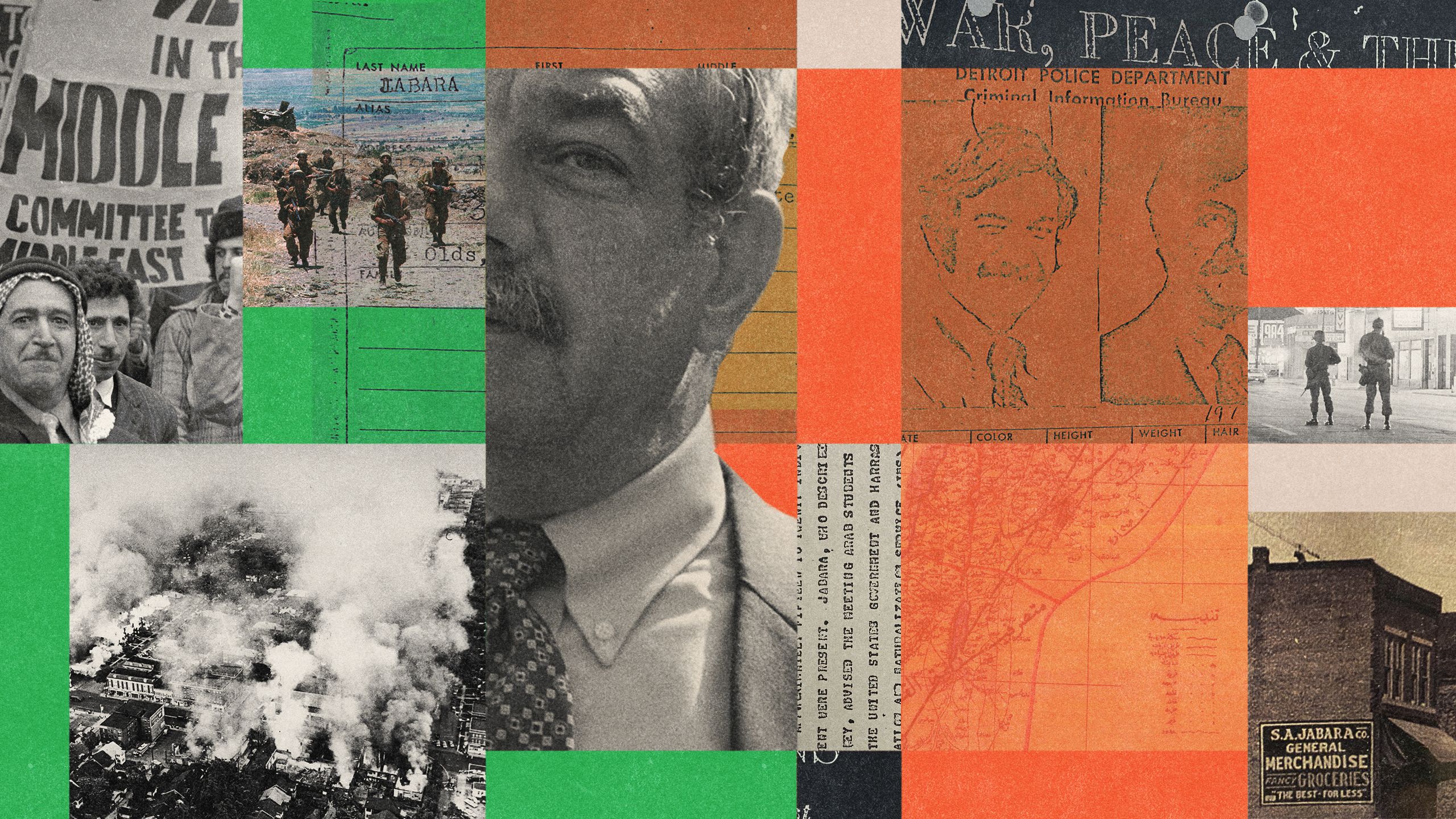
Abdeen Jabara stretched out his crimson-stained fingers. Balancing on his toes, the eight-year-old boy met a tree branch that his elder brother Khalid had lowered for him. Quickly, he pulled off a few plump mulberries and dropped them into a basket below.
The brothers were on a patch of land in northern Michigan, circling a pair of wide, leafy trees that belonged to an elderly couple who didn’t quite know what to do with the fruit they bore. But the mulberries would be a boon to the boys’ mother, Mymonie. Her fondness for their sweet-tartness was a family inheritance, passed down from her own mother, who was Syrian. Mymonie would bake the berries into a cobbler when the Jabaras returned home to the small town of Mancelona, fifteen miles away.
Abdeen sneaked a few berries into his mouth, with one eye on his sister Essie, who stood nearby. When Abdeen, the youngest of the seven Jabara children, was born, Mymonie had been so busy caring for his siblings that Essie, the eldest, became a second mother to him. They had a decade and a half between them, and it was Essie who often rocked Abdeen to sleep; read him his favorite book, about a lion in the jungle; and turned her gaze away from his mischief.
In front of the Jabara family, the turquoise waters of Torch Lake gleamed alluringly in the July heat. While the kids’ father, Sam, took them for a swim, Mymonie sauntered by the road and searched for wild-grape leaves. Maybe next week, the boys could wade into the river near Mancelona and collect bushels of watercress, which carpeted the surface there. Abdeen was sure that his mother was the only one in town with two ovens: an electric one, just like everyone else had, and a wood-burning one, which she used to make flatbread. Their table was always lined with fatayer stuffed with spinach and meat, and warm pitas that they would dip in dense yogurt.
Soon, the days would cool, and the boys would start another seasonal pastime. Khalid had given Abdeen a toy rifle a short while ago. Abdeen, donning a white cap over his golden curls, had studied his elder brother as he crouched down to the dirt and aimed his own, real rifle at a rabbit. In a few months, Abdeen’s siblings, cousins, and uncles would go off on their annual Christmastime hunts. For now, though, there was still summer to be had. The Jabara family loaded themselves and their treasure of berries into Sam’s black Dodge truck and headed back toward Mancelona.
The S.A. Jabara Grocery store stood on the corner of State and Maple Streets, west of the post office. On windy days, whiffs of smelting iron blew in from a factory, just beyond a set of train tracks, that produced ingots for the rest of the United States. Technically, the area around the factory was unincorporated land, but workers and their families settled there in bare-bones housing, often without indoor plumbing, and came into Mancelona to attend school or buy groceries. Jabara may have been an unusual name to visitors, but perhaps not more so than Moeke or Rahilly or Ludwig, whose businesses also lined the streets.
The first time that Sam and Mymonie met was on their wedding day, in 1924. Sam had been in his early twenties when he travelled from his birthplace, a village on the slopes of Mt. Hermon, then a part of Greater Syria under the Ottoman Empire, to the U.S. He had left an entire life behind, one in which he was born Mohammed Ali Jabara. His parents mortgaged a bit of land to pay for his ship passage from the Beirut harbor to Marseille to New York, where he became Sam. He travelled west, toward Boyne City, Michigan, where he peddled, worked at a tannery, got injured, and spent his recovery learning English. He served in the U.S. Army during the First World War—just as fourteen thousand other Arab Americans did—and then was medically discharged for severe asthma. He became a grocery merchant in Mancelona, and decided it was time to settle down. Sam phoned family friends of his who lived in Flint. Did they know of a nice Arab girl? They did, in fact, know a family in Ross, North Dakota—the Mellems, who had emigrated from a village in Greater Syria not far from Sam’s own. They had a lovely daughter.
Mymonie rode a train to Saint Paul, Minnesota, where her uncle lived, and where the wedding would take place, in a small afternoon ceremony. She wore a simple and delicate dress; her only embellishments were a pearl necklace and a rose pinned below her right collar. Sam towered above her in a crisp three-piece suit with a gold pocket watch. Mymonie could see that behind his thick mustache he was handsome. Sam gave his new wife the option of settling in Mancelona, where they could build his grocery business, or in Detroit, where he had some relatives and where a few hundred Arab families had formed a budding community. Mymonie had grown up in the isolated farmlands of North Dakota; a city would be foreign to her. She chose Mancelona.
At the time, the town was not much more than a few unpaved roads and wooden boardwalks. There was a dime store, a haberdashery, and a newspaper; for a while, Sam delivered fresh produce and cured meats by horse and buggy. It would be a couple of years before the first snowplow passed through. The family grew with the town itself. When Abdeen was born, in 1940, one of the original settlers was still alive.
At the store, customers would sometimes ask where the Jabaras hailed from. Sam would draw a map, sketching out the coastline of the Levant and marking a dot. He and Mymonie were from that tiny corner, just by the Mediterranean Sea, Sam explained. They were Syrian.
“You mean Assyrian?” the reply usually came.
Khalid and Essie, who often helped at the store, hated when their father traced the family tree, or when he spoke to them in Arabic in front of the townspeople—or worse, still, their friends. “Baee,” they pleaded, with embarrassment. This annoyed Sam. He didn’t care who heard, he snapped back.
The Jabaras tussled over which customs to preserve, and which to compromise on. One day, Abdeen remembered, there was a tense discussion in the house. One of his elder sisters, Frieda, was participating in a pie-baking contest at school. Everyone knew that the crust tasted better if you used lard instead of Crisco, but lard was made of pig fat, and no one in the Jabara household consumed pork. After much arguing, Sam and Mymonie agreed that Frieda could make the crust with lard—as long as she didn’t eat her own pie. She won.
One evening in 1948, when Abdeen was eight, he found Sam sitting in a chair in the family room. The china cabinet behind him held an English translation of the Quran, gathering dust. It was strange to find his father alone. Sam was always at the store, or otherwise in the garden with Mymonie, tending to violets, chickpeas, and peppery leaves. A neighbor once remarked that Mymonie could “plant a broomstick and make it grow.” Sam had come to love gardening, too, and every year the couple competed with their neighbor Frank Schroeder, across the street, to see who could produce the season’s first ripe tomato.
But tonight Sam was inside, by himself. Abdeen wasn’t sure if his father had even noticed him enter. Sam’s head was bent low, his ear angled toward the mesh of their brown Stromberg-Carlson radio. Usually, Sam cut a strong figure in any room. Abdeen had never seen his face contorted as it was now.
The voice on the radio was crackling, urgent. Abdeen only knew that it was speaking in Arabic. Later, he realized that he had been hearing news of the Nakba, in which tens of thousands of Palestinians were driven out of their homes by Israeli forces. But that night, watching Sam, all Abdeen could gather was that something very bad was happening, somewhere very far away.
Sam was going to drive over to the wholesale market in Traverse City to pick up groceries for the store. Did Abdeen want to join?
It was a cool June morning in 1951. Abdeen would be eleven soon, and he wanted to prove that he, too, could contribute to the family business. He also savored any chance to go somewhere with Sam, just the two of them. He bounded over to the truck. Sam grabbed the keys and turned to Essie. “Make your grandfather some coffee,” he instructed, referring to Mymonie’s father, who had come to live with them. Then he closed the door and left.
Across the street was a plot of land that Sam and Mymonie had bought several years earlier, where they kept chickens and rabbits. On Eid, they brought a goat to the lot; Mymonie’s father said, “Bismillah,” and slaughtered it. Now the animals had been taken away, and ground had been broken for a new house for the family. Lately, Abdeen saw his mother resting only when she and Sam sat at the dinner table late at night, coffee in hand, huddled over issues of Better Homes & Gardens. Contractors had started on the basement, and soon they would build the rest: fourteen rooms, a brick façade, a stone fireplace, a garage, multiple bathrooms. It would be the largest house in town.
Abdeen and Sam drove out of Mancelona, and Sam began to sing a quiet, haunting melody. As far back as Abdeen could remember, these car rides were the only time his father sang the ataaba, songs of the villages from the old world. Through the open window, a breeze tickled Abdeen’s hair. His mouth watered thinking of Mymonie’s kibbe, and he hoped that his uncle Albert would stop by for dinner that night.
The countryside glided by, and Abdeen took in the moving sky and the fields. Soon, Traverse City rose up ahead. He looked at a drive-in theatre that they were approaching, and then at an oil tanker that was suddenly in their path—and that was now crashing into them.
The singing stopped. Abdeen felt his body lurch forward. He didn’t see anything more, not the shattered glass, or Sam’s blood that stained the road.
Mymonie’s father had crossed the ocean at the end of the nineteenth century. He sailed from the Port of Beirut to Mexico, where he worked for a time, before continuing on to a remote corner of North Dakota. The trip was fraught with peril. One Arab American man later recalled that his great-grandfather, who pursued a similar route, never made it to the Midwest—his train was stopped by a group of bandits from Mexico who forced the passengers to hand over their belongings. He was carrying a small chest of Ottoman gold coins that he wrapped in his coat and tossed under the train, but one of the bandits saw him and slit his throat.
Mymonie’s father was lucky. He made it to America’s vast plains intact, and, a few years later, his wife and Mymonie, who was then three years old, joined him. There was no sea in North Dakota like there was back home, no hills blanketed in cedar trees, but there were a hundred and sixty acres of land to their name and an invitation from the U.S. government to till it. The winters were brutal and the soil stubborn. Every morning, Mymonie milked the cows. The weather could be so severe that she had to follow a rope tied between the house and the barn to not get lost. Some years, the land wouldn’t yield, and there wasn’t enough food.
The migration wasn’t unusual: at the turn of the twentieth century, millions of people from around the world were arriving at America’s borders. Letters and rumors from relatives and friends lured many to what were described as “streets of gold.” A significant portion of newcomers found their way to the Detroit area, where an ambitious businessman named Henry Ford was offering five dollars a day to those willing to work in his automobile factories. “It was like a mecca, a destination for these people to come here,” Muhammad (Mike) Karoub, a Michigan resident whose father was a pioneering local imam, once said. One could walk down Victor Avenue, near the factory, and hear half a dozen different languages. An Arab resident later recalled coming home one day to find his great-grandmother and two of her friends—a Ukrainian and a Spaniard—chatting in broken English as they peeled vegetables. All three women had their heads covered, and from a distance he couldn’t tell who was who.
By 1924, about two hundred thousand Arabs were living in the U.S., many in the Midwest. Most were Christian, but a growing number were Muslim, including Sam and Mymonie. Muslims arrived from all over the world—India, Yemen, Albania, Syria—and it seemed every nationality had its own prayer hall or social club. Only sometimes did Muslims find common cause. When the Great Depression shuttered factories, unemployed workers lined up at soup kitchens. They had no choice about the food they received, which was often prepared with lard. Muslims in the Detroit area relied on the charity of friends as they banded together to demand that the government supply provisions that they could eat.
There was no mosque in Mancelona, and Mymonie and Sam found kinship in the Masonic temple. Abdeen guessed that they were drawn to the familiar symbols that the Masons borrowed from what the French had dubbed the Orient, such as the tarboosh, a brimless and tasselled hat. Americans were becoming increasingly fascinated with Arabia, as loose translations of “One Thousand and One Nights” appeared in bookstores, and cigarettes branded with names such as Red Kamel and Mecca became household staples.
Sometimes Sam and Mymonie hosted Mike Karoub’s father, Hussien, whom Sam had befriended. During those visits, Hussien and Sam would close the living-room doors and pray. These were the only times that Abdeen remembered his father doing so. Hussien was from a small village in the Bekaa Valley and had followed his elder brother to America. He was one of the few in Michigan’s Muslim community who could recite the Quran from memory, and he had apprenticed with a sheikh in Damascus, so it was natural for him to assume the role of imam. He married couples, officiated death ceremonies, and raised funds to build a mosque in Detroit. He didn’t serve only Arab Americans—Black residents from the rural South who were part of the Great Migration also appeared at Hussien’s door. Excluded from jobs and housing, some of these new arrivals had turned to Islam as a welcoming alternative to the white society that denigrated them. (Scholars estimate that nearly a third of enslaved people in the U.S. were once Muslim and were forced to convert to Christianity, the religion of their masters.) “Didn’t anybody see me? Couldn’t anybody see how hungry, how ragged I was?” a man from Georgia who had converted to Islam wondered. As Detroit’s Muslim community expanded, Hussien incorporated more English into his services.
Abdeen’s parents didn’t follow many Muslim rituals. “They lived their life in a way that practiced goodness,” Essie later recalled. “They taught us to be honest and do good in the world.” Mymonie didn’t read the Quran, but, after Sam and Abdeen’s car accident, something shifted. Suddenly, at forty-five, she was left alone with seven kids. Now the English Quran sat by her bedside as she reached for God and clawed her way out of grief.
Sam’s funeral was the largest that Mancelona had ever seen. Townspeople, friends, and relatives from Michigan and Canada gathered at the Masonic temple, where a minister officiated alongside Hussien. The Jabara children could hardly register the singing of “Be Still, My Soul,” or the procession that carried Sam’s casket, draped in an American flag, through the same streets he used to march down every Memorial Day in his Army uniform. His tombstone was inscribed with a Quranic verse.
The accident had shattered one of Abdeen’s legs, and he was still in the hospital the day that his father was buried. The family wanted to shield him from the news until he had recovered, but he learned of Sam’s death from a fellow-patient, who offered his condolences.
Grief pervaded the Jabara household. Khalid, the eldest son, then in his early twenties, hardened under the pressure to take care of his family. After Abdeen healed, Khalid brought him to the store on weekends and evenings to stock shelves. The Sunday picnics stopped, as did the fruit-picking excursions and trips to the river. The work on the dream house continued, but, when it was finished, the children had to beg Mymonie to move in. It felt silly to live in such a big place now, she said. There was no Sam, and, one by one, the children left, for marriage or college or the Army.
Abdeen’s Rolodex of memories of his father was thinner than those of his siblings. He hadn’t even known that Sam’s real name was Mohammed Ali until after he died. As the house emptied of siblings, Abdeen spent his free hours with books. He inhaled whatever he could find about Sam’s previous life, about the Middle East, anything that would keep his father alive. But even this history felt mutable, unsteady. After the Ottoman Empire fell, the region had been carved up, and the Jabaras now hailed not from Syria but from Lebanon.
When a cousin from Canada visited, he brought news from overseas. It was true that Palestine had been divided and people had been forced to flee, but the cousin also told Abdeen, with excitement, about a young military officer named Gamal Abdel Nasser who, in 1952, had led a successful coup against the British-backed monarchy in Egypt. Nasser, who would soon become the country’s President, spoke about land reform and pan-Arabism, about justice and independence for Palestine. Arab Americans were enthralled. The Nakba had provoked anger, but Nasser inspired hope. “Whenever a party is opened in the name of the Prophet, no one is particularly moved,” one Muslim woman in Detroit told a visiting Jordanian official. “If it is opened in the name of God, no one cares either. But the name of Gamal Abdel Nasser electrifies the hall.”
Abdeen was enamored, too. When a teacher encouraged him to enter a regional speech contest, Abdeen wrote his address about Nasser. In front of an audience in Traverse City, Abdeen boomed in Arabic, “Long live Arab nationalism!” He won first place. “I glommed on to this Arabness out of a need for some identity,” he later admitted.
He knew that the first chance he could, he would venture to that part of the world. An opportunity came in the early sixties, when Abdeen was a student at the University of Michigan. In between semesters, he visited relatives in Cairo and then caught an Italian freighter from Alexandria to Beirut. From the boat deck, the bay from which Sam once embarked came into view. He marvelled at Beirut’s French architecture and its trams. He traced his parents’ route in reverse, from the port to the houses stacked atop the hills of the Bekaa Valley. At his mother’s village, he met a man selling biscuits outside the family house and learned that the man was his namesake, Mymonie’s uncle.
Abdeen meandered toward his father’s village. Perhaps Sam had thought he might return home one day and hug his brother, whom Abdeen now embraced. From uncles and aunts, Abdeen collected bits of his father’s life; he hadn’t known, for instance, that Sam had been sending money from Mancelona to build a school in the village. Abdeen drove across the highways of newly independent countries. Empires had fallen, and rulers had been driven out. To a young man, barely out of his teens, the world seemed in the throes of something spectacular.
As a child, the admonishment Abdeen heard most often was “You talk too much.” Years before he won the contest in Traverse City, he would fashion a makeshift podium from an empty wooden crate, taken from his father’s store, and hold forth in front of the neighborhood kids on the topics of community service and crosswalk safety. (He had been an eager member of the Boy Scouts.) After college, he decided to put these rhetorical skills to use by enrolling at Wayne State University Law School, in Detroit. Black Americans were struggling against the legacy of Jim Crow, and Abdeen interned with Ernest Goodman, a civil-rights lawyer who was reviving the National Lawyers Guild, a collective of progressive legal professionals. When Abdeen passed the bar, in 1965, he envisioned assisting on civil-rights cases from time to time, but planned to make a living as a personal-injury lawyer.
Later, he would describe 1967 as the year that changed his life. That summer, Detroit was paralyzed by a violent uprising, which erupted after the city’s predominantly white police force raided a night club in a Black neighborhood. In the following days, looters tore through the streets, setting hundreds of buildings on fire. The National Guard descended on the city and beat Black residents. Forty-three people were killed, and scores more were injured.
Meanwhile, on the other side of the world, a war had broken out between Israel and the Socialist regimes of Egypt and Syria. Abdeen pored over the reports in the newspaper, searching for familiar names, villages he had once passed through. What had happened to his relatives in Lebanon, his friends in Cairo, that nice woman he’d met in Beirut?
Israel’s military proved to be far more powerful and adept than the Arab states had expected, and within a week it was victorious, swallowing up even more Palestinian territory. The loss felt like a rebuke of Nasserism and his dream of a secular, socialist Arab-nationalist movement; it also felt like a death knell for the liberation of Palestine.
Abdeen tried to make sense of what he described as the “cataclysmic political earthquake” around him. His city had been the epicenter of the worst American riot in generations, and his country had thrown its support behind Israel, helping to devastate parts of his ancestral home. Abdeen had previously treated the Middle East as a cultural and intellectual pastime. He had learned Arabic, mainly as an attempt to maintain a connection to his father. In college, he debated the Algerian revolution with his classmates, but now he couldn’t ignore an urgent feeling that he needed to do something.
A few months later, Abdeen joined a group of Arab American scholars in Ann Arbor that launched the Association of Arab American University Graduates (A.A.U.G.). The purpose was straightforward: to educate the American public about Palestine, and, through that process, change U.S. foreign policy. Arab Americans, the group reasoned, would need to organize to resist what was becoming reflexive support for Israel. The A.A.U.G. concentrated its efforts on college campuses, but Abdeen recognized other opportunities.
Just ten miles from downtown Detroit, residents of the Southend neighborhood of Dearborn, a blue-collar immigrant community with a growing Arab population, were locked in a battle against the city. Mayor Orville Hubbard, who made no secret of his dislike of Arabs—his campaign slogan was “Keep Dearborn clean”—was pursuing an ambitious plan to transform the area into an “industrial park.” This would mean razing hundreds of homes. Flyers appeared in English and Arabic:
We are Italians, Greeks, Roumanians, Armenians, Syrians, Lebanese, Yemeni, Southern, Northern, In-Between, and Many More! We are Catholic! Protestant! Moslems! Hindu, or what have you! But we’re all Americans and human beings who want the right to be sure of renting or owning our own homes, have help in fighting pollution, and be treated like adults, not children!
As community members organized marches and protests, Abdeen helped bring a class-action lawsuit against the city, arguing that demolishing the neighborhood would violate residents’ civil rights. They won.
Southend was stitched with purpose. Palestinians and Lebanese displaced by the 1967 war were joining relatives or acquaintances in Dearborn, and residents arranged food and medical services for the new arrivals. The marches continued, now in protest of the government’s support for Israel or against the roaring war in Vietnam. Men who worked at the automobile factories donated their paychecks to help Palestinian refugees. It was increasingly clear to Abdeen that Arab American political power would be cultivated here, in coffeehouses and on the streets, not just on college campuses.
Abdeen’s days and evenings were swallowed by work and activism. He wasn’t wealthy, but he loaned small amounts to the Organization of Arab Students. He joined friends and colleagues at public forums hosted by the Socialist Workers Party, and lectured about Palestine. He travelled to the Middle East, attending conferences and organizing trips for delegations of National Lawyers Guild members, so they could learn from attorneys and activists on the ground there. Sometimes they spoke with formerly detained Palestinians, who shared harrowing stories about Israeli prisons. During one of Abdeen’s visits to the region, he met with Yasir Arafat, the leader of the Palestine Liberation Organization, a nationalist group established by the Arab League that had taken up arms for the Palestinian cause. The world was alight with similar independence struggles. Abdeen often thought of Algeria’s success in 1962, against the French occupation, and he became convinced that armed resistance could help deliver a Palestinian state.
By the early seventies, Abdeen was working at a civil-rights firm in a town house on Pallister Street, a quiet road just a few blocks from some of Detroit’s biggest businesses. Several partners at the time were busy with cases fighting the Vietnam War draft or defending antiwar protesters. One afternoon, Dennis James, a colleague of Abdeen’s and an old college friend, walked in. He looked a bit strange, like something was amiss.
“I went to our bank today,” James told Abdeen. A secretary at the firm was dating one of the bank clerks, and when James entered, the clerk had beckoned him over. Discreetly, the clerk showed him a piece of paper listing a handful of organizations and individuals. The clerk told James that banks were being instructed to provide information on these clients’ financial transactions.
Abdeen could guess who was asking. They were living in J. Edgar Hoover’s America. The F.B.I. director’s intelligence division, which he called the Radical Division, was known to surveil civil-rights groups considered anti-American—Black Panthers, Malcolm X, the Nation of Islam, Martin Luther King, Jr. The intent, Hoover once wrote, was “to expose, disrupt, misdirect, discredit and otherwise neutralize the activities of black nationalist, hate-type organizations and groupings.”
But James knew all this. One of their colleagues had even brought a lawsuit against the Detroit police for its surveillance of political activists. Why, then, does James seem so disturbed now? Abdeen wondered. James pulled a scrap of paper from his pocket. He had scribbled the names he could remember from the list that the clerk had showed him, he explained. Abdeen looked at the paper, stopping on one name in particular: his own.
In early September, 1972, a Palestinian militant group called Black September infiltrated the Olympic Games in Munich and killed eleven Israeli athletes. The group had recently splintered off from the guerrilla organization Fatah, which, in the aftermath of the 1967 war, had taken over the P.L.O. The Arab countries’ defeat in that war had also given rise to a new Marxist militant group called the Popular Front for the Liberation of Palestine, led by a Greek Orthodox Palestinian man named George Habash, which gained particular notoriety after hijacking several transatlantic flights.
The factions disagreed over aims and tactics, but they all wanted to “internationalize the Palestinian cause,” as Abdeen put it, and now the Munich incident eclipsed those efforts. The killings were “sad and stupid,” he said. Television networks had broadcast the unfolding hostage situation live, and the violent end captivated the American public. In response, the White House established the Cabinet Committee to Combat Terrorism, headed by Secretary of State William Rogers, to address what was perceived as a growing threat of terrorism.
The committee moved quickly, and publicly. The following month, Abdeen was sitting in his kitchen, reading a copy of Newsweek, when a news brief caught his eye:
Fears of Arab terrorism, sparked by the Munich murders and fed by later “letter-bomb” attacks, have caused Federal lawmen to almost double (to about 60) the number of security wiretaps in place. The concern centers on the safety of Israeli officials—but not exclusively. A telephone threat was made against President Nixon during his recent Los Angeles visit, allegedly by Al Fatah, the main Palestine guerrilla group.
The wiretaps, Abdeen would come to learn, were part of a new surveillance program called Operation Boulder. The State Department and the Immigration and Naturalization Service were applying elevated scrutiny to visa applications of Arabs seeking to enter the U. S. Meanwhile, the government cracked down on Arabs who were already in the country.
Abdeen began receiving calls almost immediately from local Arab college students who had been questioned by law enforcement. Nationwide, I.N.S. agents approached students to ask if they supported Fatah and what they thought of Israel. One graduate student in California, who was visited at home, ended up in an interrogation room because agents saw a pro-Palestine poster on his wall. Another was questioned because he worked at a humanitarian organization helping Palestinian refugees. Officials looked for minor infractions, such as violating the terms of a student visa by working part time, and deported offenders.
In Dallas, F.B.I. agents broke into the office of the Arab Information Center, the U.S.-based affiliate of the Arab League, without a warrant, in search of names of Fatah agents whom they believed were residing in the U.S. and Canada. “Wherever we drive, they shadow us,” the center’s press officer told a Times reporter. “We are extremely resentful of this. We regard it as obnoxious in a country under the rule of law.” An Arab League official, who was Palestinian, recounted that two F.B.I. agents stopped his car outside Washington, D.C., escorted him to their office, and took his photos and fingerprints. During his interrogation, they accused him of being a “terrorist,” he said.
The F.B.I. dismissed allegations that it was engaged in racial profiling when investigating terrorist threats, but, in reality, it was paying attention to a particular ethnic group. According to an internal agency report from 1970, any potential terrorist “will almost invariably be an Arab national, having been born and raised in Palestine or one of the Arab countries most involved with Israel.” The terrorist would probably be in their twenties or thirties. If an attack happened on American soil, the F.B.I. believed it would be enabled by “sympathetic Arab students residing here for at least the planning stages of the operation.”
Though the F.B.I. was guiding its agents to look for “Arab nationals,” it was also interrogating U.S. citizens of Arab origin, including some of his friends. Abdeen already knew that his financial transactions were under surveillance, and now he suspected that other parts of his life were being more widely monitored, too. He decided to sue the government, alleging that it had violated his constitutional rights.
When the government responded, it maintained that it could not divulge whether Abdeen had been wiretapped—that was a state secret. But, as the case continued, the F.B.I. was forced to admit that it had indeed monitored him, arguing that it had the right to do so because Abdeen was an agent for a foreign government. He wasn’t, and a federal court eventually forced the Bureau to reveal exactly what information it had gathered. The revelations came in trickles, but, ultimately, Abdeen learned that the government had amassed an extensive file, covering his organizational affiliations, his travels through the country and abroad, transcripts of phone conversations, and notes from interviews with more than a hundred acquaintances, bank transactions, and summaries of speeches. There were details about his family background and the people he was meeting with. Virtually his entire life was narrated in the scribbled observations of police and F.B.I. agents.
Even more chilling, Abdeen learned that the government had been keeping tabs on him since 1967—triggered, he guessed, by his political activism after the war—and had received information on him from a domestic Zionist organization. The U.S. had shared the collected data among seventeen federal agencies and with three foreign countries, though he never learned exactly which ones.
Abdeen did discover the involvement of another, little-known arm of the government. It turned out that the National Security Agency, then a relatively new part of the Defense Department, had monitored his correspondence with people overseas. For a few weeks, this disclosure, and Abdeen’s name, was splashed across national headlines: it was the first time the N.S.A. admitted to intercepting the communications of an American citizen.
In April of 1975, as Congress pursued more robust oversight mechanisms in the wake of Watergate, the State Department announced that it was ending Operation Boulder. “It was not worth the manpower that went into it,” one official explained. The government had checked a hundred and fifty thousand names against its files, actively monitoring immigrants and citizens alike, and deported at least seventy-eight people. No one had been charged with a crime.
Abdeen’s case dragged on in appeals, and when it finally came to a close, more than a decade later, the F.B.I. agreed to destroy all the files it had collected on him. A federal judge ruled that Abdeen’s Fourth Amendment and privacy rights had been violated. But an appeals court offered a victory to the government, too. It ruled that the N.S.A. could track the communications of U.S. citizens corresponding with people abroad, establishing a legal precedent that would come back to haunt fellow-activists and countless Americans decades after.
Already, Abdeen’s work in support of Palestinian statehood and Arab Americans’ civil rights was transforming in terrifying ways. In the coming years, his life would be shaken by arsonists and assassinations, and dramatically shifting public views about Arabs. It would not be until after September, 2001, that Abdeen would fully appreciate the implications of the two rulings that emerged from his lawsuit. As the war on terror expanded in the aftermath of 9/11, the N.S.A. and the F.B.I. quietly began to monitor the electronic communications of Muslim American community leaders. Among their targets were an attorney who represented defendants accused of terrorism, a professor of international affairs, the head of a Muslim civil-rights organization, and a Republican candidate for public office. Abdeen was spared this round of scrutiny, but these leaders, and countless ordinary citizens, would be ensnared in the government’s new dragnet. ♦
This is drawn from “Seasons of Fury: Four Families and the Rise of Islamophobia in America.”