Climate finance demands grow in Africa as nations push for more support at UN summit. Source: bbc.co.uk.
Climate Crisis in Africa: Real Lives, Real Impact
In Uganda’s Karamoja region, Elijah Lobur and his family now eat just one meal a day. A severe drought began in April and has destroyed local crops. Imported food has become unaffordable. Lobur, 44, lives with his grandmother, wife, and five children.
“Seven months without rain has brought us to this point where we now live in hunger,” he told the BBC. “Even some of the wild plants we used to eat have withered and dried up.”
Over 90% of crops in the region have failed. Agriculture there is rain-fed, making it highly vulnerable. The drought has eliminated traditional food sources, leaving families with few options.
Historically, Karamoja has faced recurring droughts. In 1982, Lobur’s grandmother lost eight children during a famine. The memory haunts the family. Lobur fears a repeat of that tragedy is now possible.
Malawi Faces Repeated Climate Disasters
Further south, in Malawi, Mathews Nkhambala has faced devastating floods. In April 2024, just one year after Tropical Cyclone Freddy, heavy rains flooded Chikwawa district.
Nkhambala fled to higher ground with his wife and four children. As they reached safety, they watched their home disappear. “Everything I had was gone,” he said. “My house, my tools, my harvest — all gone in hours.”
He lost 15 bags of sorghum and part of his farmland. His children stopped attending school for months. “They refused to go to school,” he recalled. “They were too traumatized.”
Now, Nkhambala fears no harvest this season. “I have no clue what I will do,” he said. Climate impacts are not isolated. One disaster often leads to another.
A government assessment found Malawi has faced over 50 climate disasters since 1980 — including storms, floods, landslides, and droughts. These events have strained infrastructure, damaged livelihoods, and deepened poverty.
Why Many African Countries Lack Adaptation Plans
Of 23 African countries, none have submitted National Adaptation Plans (NAPs) to the UN climate convention. These plans detail climate impacts, risks, and adaptation strategies.
Without them, experts say it’s hard to secure funding. Milton Lorpia of the Warrior Squad Foundation said Karamoja has faced droughts for decades — but no action plan exists. “There has been no action plan to tackle these climate impacts,” he said.
David Abudho of Oxfam noted these countries face debt, economic pressure, and limited public funds. “Their ability to invest in climate adaptation is severely limited,” she said.
Sheila Apiny of ActionAid said the absence of NAPs shows a broader gap in financial and technical support. “The absence of NAPs is evidence of a capacity gap,” she argued. “It creates a cycle: no support to build plans, and no plans to access funding.”
Amos Wemanya of Power Shift Africa said governments are forced to respond to disasters instead of preventing them. “Scarce public resources go to emergency relief, not prevention,” he said. “This costs more and leaves communities more vulnerable.”
What African Negotiators Are Asking for
At COP31 in Turkey, African negotiators are pushing to triple adaptation finance by 2035. The target rises from a baseline of $40bn annually — a commitment developed countries pledged by 2025. The interpretation of that pledge remains contested.
The proposal was not formally accepted. But African delegations continue to push for it. They argue adaptation is essential — especially in nations already facing food insecurity and economic fragility.
Europe’s Response: Focus on Existing Commitments
The European Union, a major climate finance provider, says the focus should be on delivering existing commitments, not setting new targets.
Darragh O’Brien, leading the EU delegation, said: “We haven’t come to the table with additional monies. It’s about what we have committed and ensuring it’s deployed.”
Wopke Hoekstra, EU climate commissioner, said pledges are meaningless if they don’t reach the ground. “If money is in the bank but doesn’t land on the ground, it’s effectively meaningless,” he said. “Other wealthy nations must contribute more.”
How Much Funding Is Actually Needed?
Sub-Saharan Africa needs about $51bn annually in adaptation finance. The Middle East and North Africa needs $112bn. Globally, developing countries will need $300bn annually by 2035.
Yet in 2024, developing countries received only about 10% of that total.
Why the Gap Persists
Many African countries lack the capacity, expertise, and funding to develop NAPs. Without such plans, governments can’t clearly present their needs to donors.
Even when NAPs are completed, implementation remains unfeasible. Sheila Apiny said: “Countries that have completed NAPs have not received funding close to what they need.”
Successful Examples of Climate Resilience
Kenya offers a working example. In its arid and semi-arid south-east, concrete sand dams slow seasonal rivers. Sand builds up underground, storing water.
Communities access stored water during dry seasons using hand pumps or scoops. UK charity Sand Dams Worldwide and its partner, the Africa Sand Dam Foundation, have built about 1,300 such dams.
These have improved water access during droughts. The solution is proven and scalable. But many other communities still wait for such interventions.
In Karamoja, Lobur regrets that small-scale irrigation could have helped. “We have underground water in some areas. If there were proper plans and programmes, we could have grown food. Instead, we live in hunger,” he said.
Without both strong adaptation planning and sufficient funding, African nations remain at risk of repeated climate shocks. The path forward must shift from emergency responses to long-term, supported planning and investment.
The debate continues at COP31 — with Africa pushing for more, and Europe urging action on existing commitments.
Read more on the BBC Africa story.
Sources & further reading
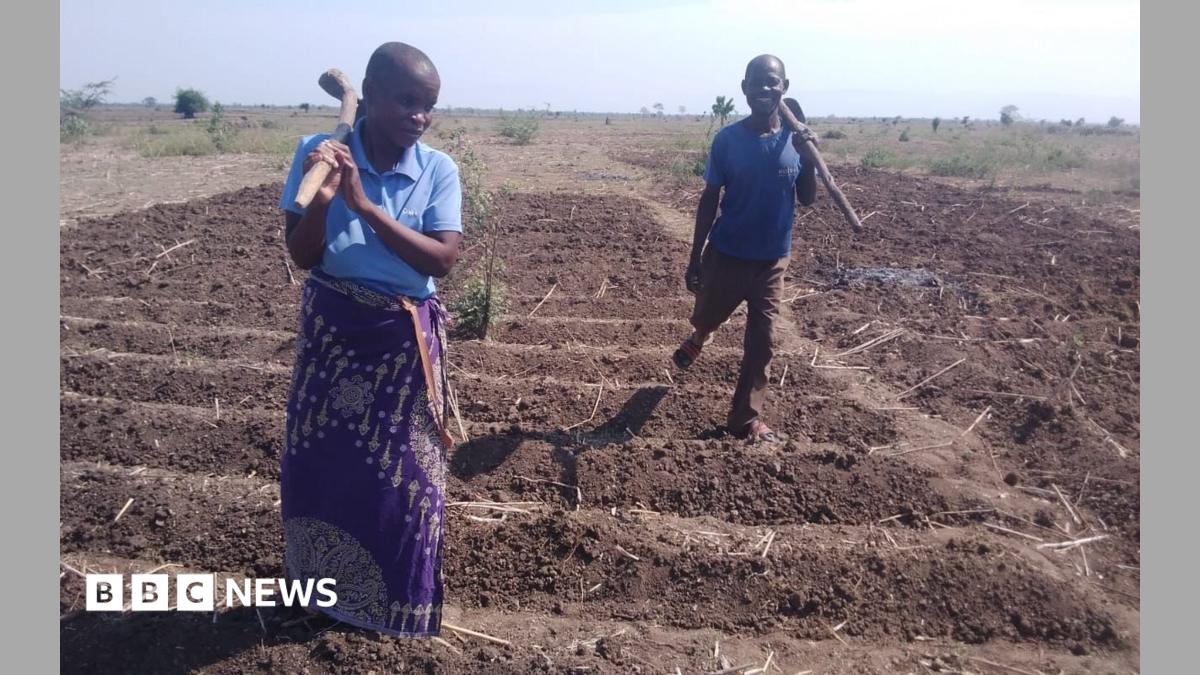
Featured image: A woman dressed in a blue shirt and wearing a pink wrapper tied around her waist. She is standing besides a man dressed in a blue shirt and brown trousers in a ploughed field. They are both carrying hoes over their shoulders. Via original publisher. Image source