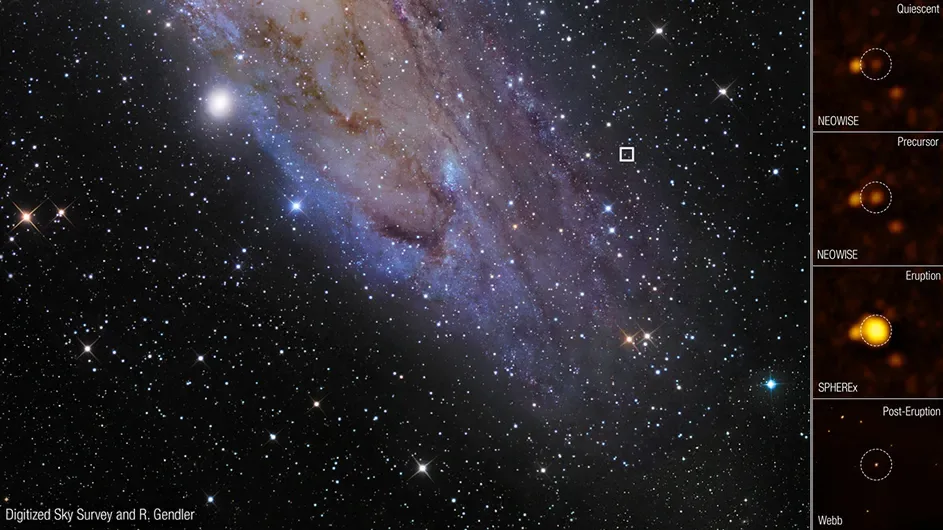
Astronomers have captured the full evolution of a star spiraling into its death inside a giant companion. This discovery marks the first time that the entire process of common envelope evolution—long theorized but never directly observed—has been witnessed in real time.
What Happened: A Slow Spiral to a Final Explosion
For seven years, a giant star in the Andromeda Galaxy gradually brightened. It was about seven times more massive than the Sun. During that time, it expanded and engulfed a smaller companion star. The process, known as common envelope evolution, was first proposed in the 1970s to explain how some of the tightest pairs of stars in the Universe form. But until now, no one had seen it happen in real time.
Researchers led by Viraj Karambelkar at Columbia University used data from the WINTER infrared telescope at Palomar Observatory and NASA’s NEOWISE mission to spot the system. They noticed the giant star had been slowly increasing in brightness, especially in infrared light. This subtle shift was the first clue that something unusual was occurring in the system.
By 2018, the star had grown to about 350 times the Sun’s width. Its companion was too dim to see—outshone by a factor of 18,000. This extreme brightness difference made it impossible to detect the smaller star directly, but scientists were able to infer its presence through indirect methods.
To estimate the mass of the smaller companion, the team analyzed how much dust the system had shed prior to the engulfment. Dust formation in binary systems is closely tied to mass loss, and by modeling the dust distribution over time, they deduced that the companion star had a mass of approximately 0.7 solar masses—about the size of a red dwarf star.
How the Process Unfolds: Energy, Light, and Envelope Loss
Between 2018 and early 2025, the giant star brightened two to three times in visible light. Its temperature remained nearly constant, which is a key indicator of a slow, friction-driven process. Karambelkar compares this phase to a spacecraft reentering Earth’s atmosphere—where the object moves through a dense layer of gas, experiencing drag and heating, but without a sudden, violent impact.
The companion star skimmed through the giant’s outer layers. As it moved, friction heated the gas, and energy was released in the form of visible and infrared light. This energy output matched the observed increase in brightness, confirming that the companion was indeed interacting with the expanding envelope.
Then, in July 2025, NASA’s SPHEREx space telescope captured a critical shift. The star’s visible light dropped by half, while its infrared glow intensified. The giant had swelled to about 860 times the Sun’s width and had wrapped itself in fresh dust. This sudden change signaled a shift in the dynamics of the system—something more dramatic was about to unfold.
By October 2025, the star brightened roughly 100-fold in just 25 days, shining like 1.5 million Suns at its peak. Karambelkar described the final phase as a rapid plunge. The companion star fell deep into the giant’s envelope and crashed into its core. That violent impact triggered a massive explosion—like a bomb inside the star—releasing energy at an unprecedented rate.
Why This Discovery Matters
Most luminous red novae occur in young stars with dense, tightly bound outer layers, which naturally drive both stars toward a merger. This event, however, occurred in an old giant star with a loose, churning envelope. That means the system could have ended with a surviving binary pair—rather than a full merger.
Researchers tested this possibility by analyzing the energy budget of the event. During the slow spiral, most of the energy escaped as light. Nearly all the rest went into flinging a tenth of the star’s envelope outward at about 10 times the speed needed to escape the giant’s gravity. The rest of the material remained in place.
This distribution of energy suggests that the companion did not survive as a tight binary. Instead, it likely merged with the giant’s core. The energy that was not radiated was instead used to accelerate a small fraction of the gas, which was then ejected at high velocity. This finding challenges the traditional assumption that such events always result in large-scale envelope ejection.
What the Hourglass Nebula Reveals
After the explosion, the system formed a nebula with a distinctive hourglass shape. This structure has long been observed around dying stars, but its origin remained a mystery. The new data shows that gas shed during the slow spiral piled up in the plane of the binary’s orbit. This created a dense ring that blocked expansion around the equator but allowed free expansion toward the poles.
Karambelkar argues that this explains why such hourglass-shaped nebulae are seen around dying stars. The observation supports a long-standing hypothesis that binary interactions shape these structures. The alignment of the gas distribution with the orbital plane suggests that the binary nature of the system played a decisive role in the final appearance of the nebula.
Limitations and What’s Next
The team cannot yet confirm whether the two stars merged or if the companion survived. Dust formed from the ejected material obscures any remaining core or secondary star. To resolve this, researchers plan to monitor the system for years—possibly even decades—until the dust clears and any surviving star becomes visible.
But future telescopes like the Vera Rubin Observatory and the Nancy Grace Roman Space Telescope are expected to spot similar systems in about 100 Milky Way-like galaxies within 50 million light-years. These instruments will have far greater sensitivity and wider field-of-view, allowing them to detect more such events.
Karambelkar expects several such events per year once these observatories come online. It shows how energy is distributed at different stages of the process. While the model fits known post-engulfment binaries, it assumes most energy goes into expelling the envelope. In this case, only a small fraction of the envelope was ejected at high speed. This suggests the model is a useful rule of thumb—but misses key physics, particularly the role of internal dynamics and energy transfer in the core.
The discovery confirms that binary interactions can shape the final stages of stellar evolution. It also shows that even old stars can undergo dramatic changes when engulfed by a giant companion. For now, the team remains cautious. They emphasize that the full fate of the system is still uncertain. Only continued observation can confirm whether the stars merged or if a tight binary survived.
The full study is available at arstechnica.com.
Sources & further reading
Featured image: Image of a galaxy with a small box on it. Insets show four views of the box, tracking a star brightening and then shrinking again.. Via original publisher. Image source