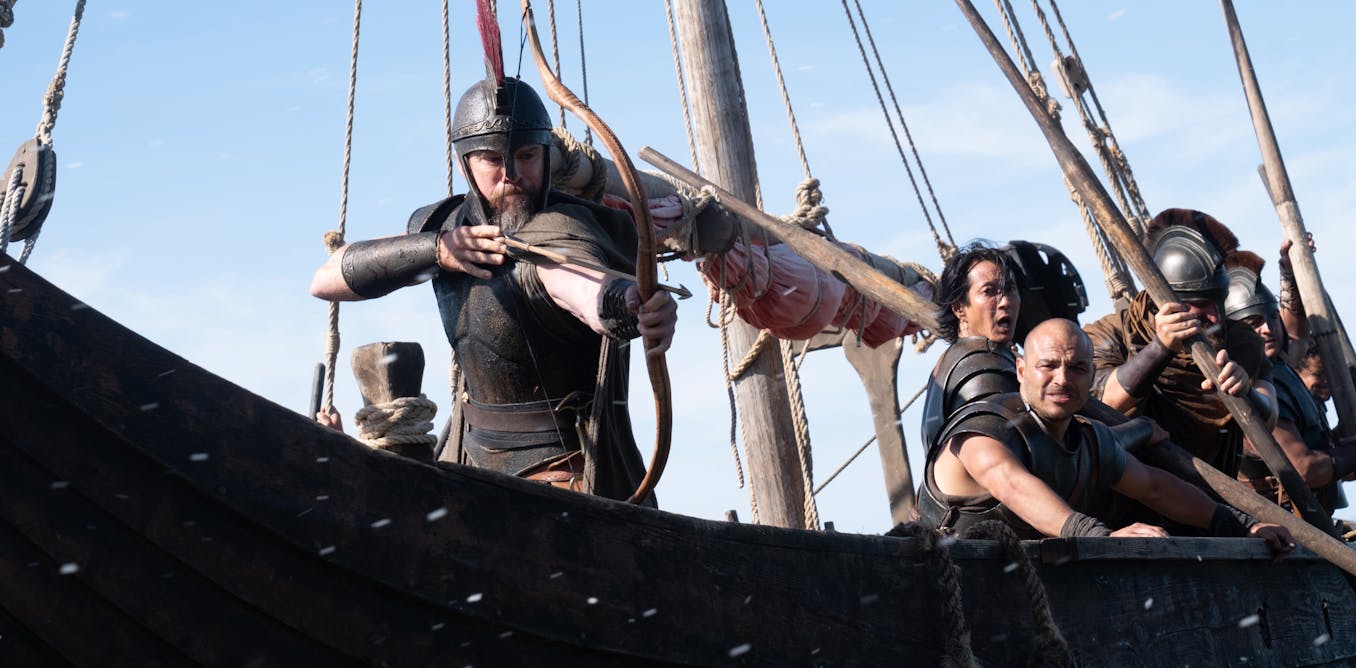
Christopher Nolan’s The Odyssey is haunted by the Sea Peoples, spectral men on the edges of a civilisation teetering on the brink.
This anxiety isn’t just cinematic fiction. The Sea Peoples feature in writing from 1200 BCE, blamed for the collapse of the interconnected world of the Bronze Age (which lasted from roughly 1500 to 1180 BCE). That world collapsed under many crises, seemingly all at once.
In Greece, the grand palaces of Mycenae and Pylos – home to the legendary kings of Homer’s Odyssey – burned down. In modern-day Turkey, the Hittite empire – overlord of Troy – fell apart. Cities from Syria to Cyprus to Canaan were destroyed within years of each other.
Historians now think a web of crises were behind this “systems collapse”: a 300-year megadrought caused famine, trade routes vital to the Bronze Age economy broke down, and people moved (sometimes peacefully, other times bringing conflict).
And throughout accounts from Egypt to Syria, “the Sea Peoples” haunt the writers of letters and grand inscriptions, much like they do Nolan’s The Odyssey.
But who were the real Sea Peoples, and what part did they play in the story of collapse?
Ancient Egypt’s view of the Sea Peoples
We first hear about the Sea Peoples in the boastful inscriptions of the Egyptian pharaohs Merneptah and Ramses III, who ruled from 1213–1203 and 1186–1155 BCE, respectively.
In Ramses’ mortuary temple near the Valley of the Kings near Luxor in Egypt, we learn:
The foreign countries made a conspiracy in their islands […] the Peleset (Philistines), Tjekker, Shekelesh (Sicilians), Danuna (Greeks), and Weshesh.
This inscription explains these peoples swept in from near Greece:
No land could stand before their arms […] they laid their hands upon the lands as far as the circuit of the earth.
In Ramses’ temple, we see depictions of the Sea Peoples as monolithic warriors, their boats sunk by Egypt’s divine pharaoh, who has kept them at bay.
At the end of the day, however, this is Pharaonic propaganda. We’ll need more clues to understand the “conspiracy” of the Sea Peoples.
The fall of the Hittite capital
One place to look is the Hittite empire, one of the most powerful empires in the ancient world, ruling over much of modern-day Turkey and Syria.
For a long time, historians followed the Egyptians’ view, alleging the Sea Peoples burned down the mighty Hittite capital, Hattusa.
But archaeology tells a messier story. The buildings burned were empty, with precious records already removed. Could this be a clue the Hittites in Hattusa were aware their society was already on the brink of collapse well before any Sea People arrived, and sought to move archives to safer places?
In fact, the Hittites were already facing multiple crises, including a megadrought which savaged the region and forced them to beg grain from vassal states. Trade routes were falling apart, too.
Some argue the final blow came not from the Sea Peoples at all, but the Kashka, an old enemy from the northern part of modern-day Turkey.
Either way, Hattusa’s end looks less like a straightforward invasion and more like the final fall of a civilisation that was already on the verge of collapse.
A complex picture
At the prosperous trading hub of Ugarit, on the Syrian coast, we get intimate accounts: letters dealing with drought, trade, and attacks from the Sea Peoples.
One, from the king of Ugarit to his allied king in Cyprus, reads like a message of an attack happening in real time:
Now the ships of the enemy have come. They have been setting fire to my cities and have done harm to the land […] Now if other ships of the enemy turn up, send me a report somehow, so that I will know.
The city met violent destruction: buildings reduced to rubble, arrowheads scattered.
Elsewhere, other cities in the Hittite orbit, such as Troy, are sacked. Some argue we have the origins of Homer’s legends here.
Yet in Ashkelon (modern-day Israel), a different picture emerges. Here, Mycenean Greek pottery, loom weights, and new crops all suggest the arrival of the “Peleset” (Philistines), one of the Sea Peoples from the Mycenean world.
Unlike at Ugarit, instead of violence there is integration. DNA analysis from recently excavated Philistine skeletons supports this: these grandchildren of the Sea Peoples had mixed southern European and local Canaanite ancestry.
These were families of farmers, not warlike people.
Greece caught in the same cluster of crises
Back in Greece, the world of Homer’s heroes was ending too.
Mycenae, King Agamemnon’s legendary palace in The Iliad and The Odyssey, burned down in 1190 BCE, soon followed by the Palace of Nestor at Pylos.
The Sea Peoples have been cast as at least partly responsible. But some think these were revolts, driven by drought, famine, collapsing trade networks, and ordinary people turning against the elite.
Equally possible is that some of the so-called Sea Peoples were in fact Mycenean Greeks, looking for a better life on other shores. They were, after all, caught up in the same cluster of crises facing many societies in the region during this period.
Not monolithic spectres
Fittingly, the Sea Peoples come from the very world Nolan’s The Odyssey portrays. Homer’s Odysseus is polytropos, “a man of many turns”: a hero, pirate, liar, but also desperate to reach safety.
Similarly, we cannot identify the Sea Peoples as one clear group, something they perhaps only ever were in their enemies’ imaginations.
They were not the monolithic spectres of Nolan’s film, but “of many turns”: in some place raiders or soldiers, in others agrarian farmers.
They remain elusive, like Odysseus himself.