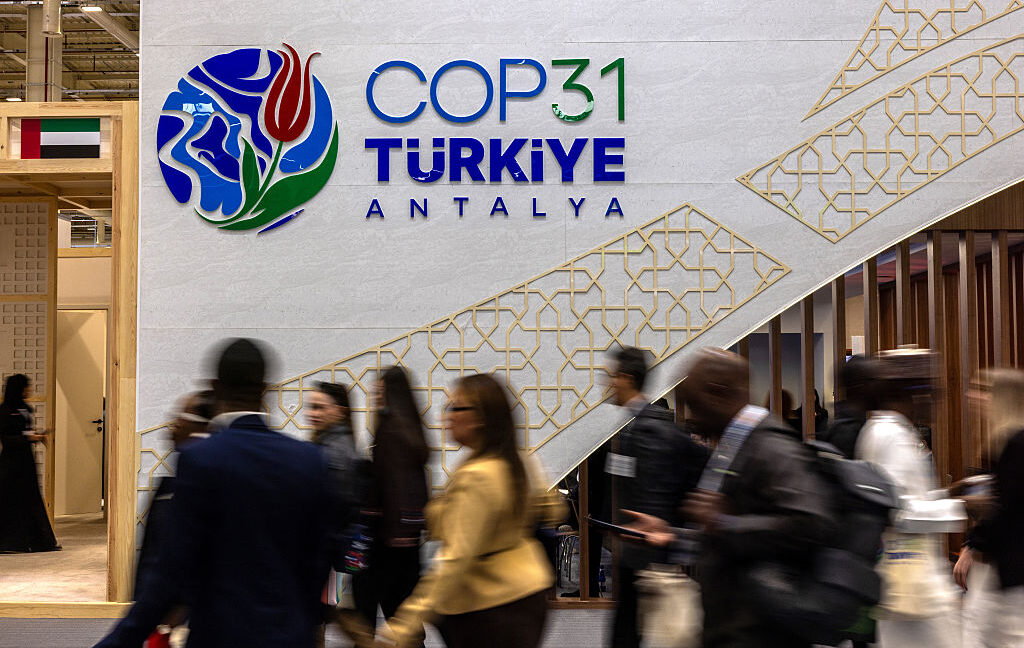
ANTALYA, Turkey — The 31st United Nations Climate Change Conference (COP31) ended without a consensus statement for the first time since 2009. As cleaning crews removed debris from the conference center, the atmosphere remained heavy with unmet expectations and growing divisions.
What Happened at COP31
More than 100,000 participants attended the conference in Antalya. By Sunday afternoon, the venue resembled a pawnshop with broken dreams — a symbolic image of the global climate effort faltering amid deepening political and economic fractures.
Murat Kurum, president of the Conference of the Parties and Turkey’s minister of environment, urbanization, and climate change, attempted to finalize a draft agreement using a multilateral ribbon of unity. However, the effort failed. The conference ended without a cover decision — the official statement that typically signals global agreement on climate action.
While the conference did produce two tangible outcomes, they were limited in scope and impact. A program was adopted to support workers and communities transitioning away from fossil fuel industries, and a plan was agreed upon to assess progress on climate adaptation efforts. These initiatives, while valuable, lack the binding, high-level commitments needed to drive transformative change.
Key Divisions in the Draft
Major disagreements centered on three critical issues:
- Whether fossil fuels should be explicitly mentioned in the agreement
- How much climate finance developed countries should provide to vulnerable nations
- Whether carbon capture and storage should be included as a viable solution
Ireland’s climate, energy, and environment minister, Darragh O’Brien, stated that the European Union formally objected to the proposed cover decision. He said the draft failed to acknowledge fossil fuels as the primary driver of climate change, and that endorsing it would amount to a form of ‘greenwashing’ — a practice that presents environmental progress while continuing to support fossil fuel infrastructure and use.
Several Latin American and Pacific Island nations also expressed opposition. Kathy Jetn̄il-Kijiner, climate envoy for the Marshall Islands Ministry of the Environment, said the final text undermines the future of her nation. She emphasized that rising seas and collapsing ecosystems are already affecting lives on the ground. ‘People are dying, seas are rising, and ecosystems are collapsing,’ she said, adding that accepting the deal would be a betrayal to the Marshallese people.
Her remarks echo a pattern seen in previous conferences. In 2023, during the Dubai COP, a final text was adopted despite a delegation of 39 small island developing states being outside the plenary session and coordinating a unified objection. In Antalya, the divide ran deeper — not only in policy, but in the fundamental understanding of climate urgency and responsibility.
Background: What COPs Are and What They Aim For
Each conference typically ends with a cover decision — a summary statement that sets the tone for global climate policy.
Since 2022, COPs have focused on accelerating the transition to clean energy and increasing climate finance for developing nations. The 2022 Egypt agreement established a loss and damage fund to help countries facing irreversible climate impacts. At the 2023 Dubai COP, delegates agreed for the first time that a ‘just and orderly’ transition away from fossil fuels is needed to slow global warming.
These agreements were seen as milestones in global climate diplomacy. However, momentum has since stalled. International collaboration on climate issues has declined amid rising geopolitical tensions, oil and gas prices, and economic insecurity. The talks in Turkey ran two days beyond the scheduled end without reaching broad agreement on potential next steps — an outcome widely viewed as a serious setback.
Why the Disagreement Matters
Climate change is accelerating. Global temperatures are rising, and extreme weather events are increasing in frequency and severity. Without clear, binding commitments, global efforts risk losing momentum.
According to Mohammad Ayoub, a climate negotiator with the Saudi Arabian energy ministry, the 22-member League of Arab States supports the proposed Antalya Pact. He said developed nations have consumed the majority of the global carbon budget — the total amount of fossil fuel emissions that can be burned without exceeding 1.5°C of warming — and now demand developing nations give up energy sources that supported their own industrial and economic growth.
He criticized the opposition to including carbon dioxide removal and carbon capture and storage in the pact, calling it unscientific. ‘Carbon capture and storage are not close to being deployed at scale,’ he said, ‘and without them, it is impossible to meet the 1.5°C target set by the Paris Agreement.’
He argued that climate solutions must be inclusive and based on all available technologies. ‘We believe that climate change requires all solutions on the table,’ he said, ‘and that countries select from these solutions depending on their national circumstances.’
Reactions from Global Leaders
UN Secretary-General António Guterres said he was ‘deeply disappointed’ by the outcome. He emphasized that fossil fuels are driving the climate crisis. ‘We can’t put out the fire while pouring fuel on it,’ he said.
While no formal agreement was reached, the conference did adopt two decisions:
- A program to support workers and communities transitioning from fossil fuel industries
- A plan to assess progress on climate adaptation efforts
These are steps, but they lack the binding, high-level commitment that would drive real change. The failure to reach consensus reflects growing political and economic divides. International climate collaboration has weakened due to rising geopolitical tensions, oil prices, and economic insecurity.
Some countries still oppose carbon capture, calling it unproven or too expensive. Others argue it is essential to meet climate targets. There is no clear path forward for how to balance energy security, economic development, and climate action. Without a unified vision, the global climate effort may continue to stall.
For now, the world moves forward without a shared global climate agreement — a setback in the long fight against climate change.
Bob Berwyn is an Austria-based reporter who has covered climate science and international climate policy for more than a decade. Previously, he reported on the environment, endangered species, and public lands for several Colorado newspapers, and also worked as editor and assistant editor at community newspapers in the Colorado Rockies.
This story originally appeared on Inside Climate News.
Comments on the original article: View comments
Sources & further reading
Featured image: Shot from COP31 Conference. Via original publisher. Image source