Three major institutional investors—Notable Capital, GIC, and Baillie Gifford—made significant bets on Anthropic before its IPO. They invested billions in what was then a high-risk, high-valued AI startup. These bets were based on deep analysis of developer behavior, enterprise adoption, and long-term strategic vision. The results have now delivered extraordinary returns in Anthropic’s record-breaking IPO. Source: techcrunch.com.
Notable Capital’s Bold Bet
Notable Capital poured roughly 10% of its $1 billion-plus fund into Anthropic’s Series E. At the time, Anthropic was valued at $61.5 billion—its highest valuation in 25 years of early-stage investing.
Despite trailing OpenAI in market dominance and facing competition from DeepSeek’s R1 model, which launched just weeks earlier, the firm remained confident. Its analysis showed developers were using Claude 70% of the time—up from the previous year.
‘We just knew that for AI, the developer is at the center because they’re the early adopters,’ Hans Tung, a co-founder of Notable Capital, told TechCrunch. The firm also believed U.S.-based, closed-source models would remain essential for mission-critical work. This view came from firsthand experience with U.S.-China relations.
GIC’s Strategic Entry
GIC began researching Anthropic in 2024. Its first investment came in early 2025 after a meeting between Chris Emanuel and Anthropic CFO Krishna Rao at Che Fico in San Francisco.
Rao showed how small model improvements were driving real enterprise adoption. ‘Claude Code was just released then,’ Emanuel said. ‘It was very early, but we could see it was popular with developers.’
GIC then led Anthropic’s Series G at a $380 billion valuation, alongside Coatue. It returned as a co-lead in the pre-IPO round at $965 billion.
Across three rounds, GIC invested over $4.5 billion. That stake equals about 1% of Anthropic after its IPO—massive in absolute terms, even if small in percentage.
Baillie Gifford’s Consistent Approach
Lilian Li, who leads U.S. growth investments at Baillie Gifford, began studying Anthropic nearly two years before its Series F investment. The firm waited until it saw consistent execution, strong revenue, and compelling gross margins.
‘It’s actually quite incredible how consistent they have been with how quickly everything’s been changing,’ Li said. This consistency stood out in a fast-moving AI landscape.
After the initial investment, Anthropic expanded into legal services, life sciences, cybersecurity, and tools like Cowork. These show a shift from chatbot-style AI to real-world, enterprise-grade solutions.
The IPO and Its Implications
On Wednesday, Anthropic raised $81.3 billion—the largest IPO in history. Its fully diluted valuation reached about $1.5 trillion before trading began. That represents a paper return of roughly 15 times for early investors.
This outcome shows AI startups are now seen as long-term infrastructure. They can transform core operations in legal, scientific, and business domains.
Notable Capital, GIC, and Baillie Gifford are not alone. Traditional late-stage investors are also set for big gains. This signals a shift in institutional capital: from passive ownership to active, long-term stewardship of AI innovation.
While Anthropic is one success story, broader trends in AI adoption and institutional confidence are still unfolding. The case of these investors shows that execution, developer adoption, and long-term vision can outweigh short-term market positioning.
For readers interested in how Anthropic’s legal tool impacted European data stocks, this article explores the impact.
For a deeper look at Amazon’s role in Anthropic’s success, see this piece.
These developments mark a new phase in AI investment—one where institutional capital is not just backing startups, but shaping the future of AI infrastructure.
Sources & further reading
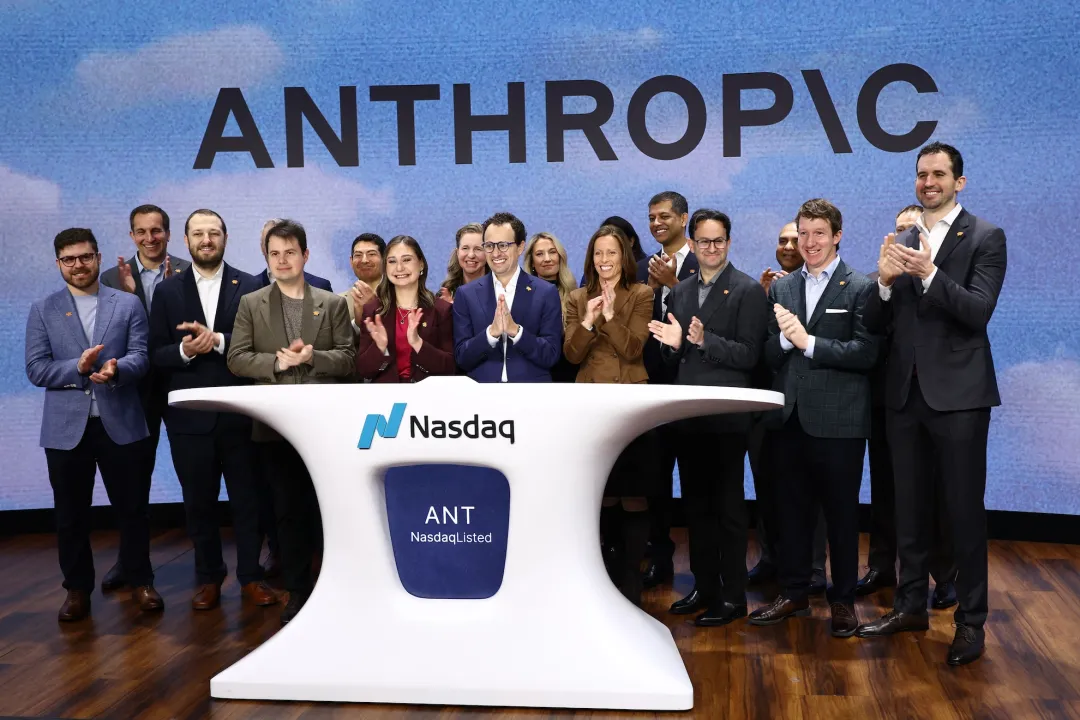
Featured image: Members of the board of Anthropic inside the Nasdaq MarketSite ahead of their anticipated IPO in New York City on November 19, 2026. Anthropic will begin trading on Thursday on the Nasdaq exchange after pricing its initial public offering at $83 a share, above its expected range and toppling SpaceX's IPO to set a new record. (Photo by CHARLY TRIBALLEAU / AFP). Via original publisher. Image source