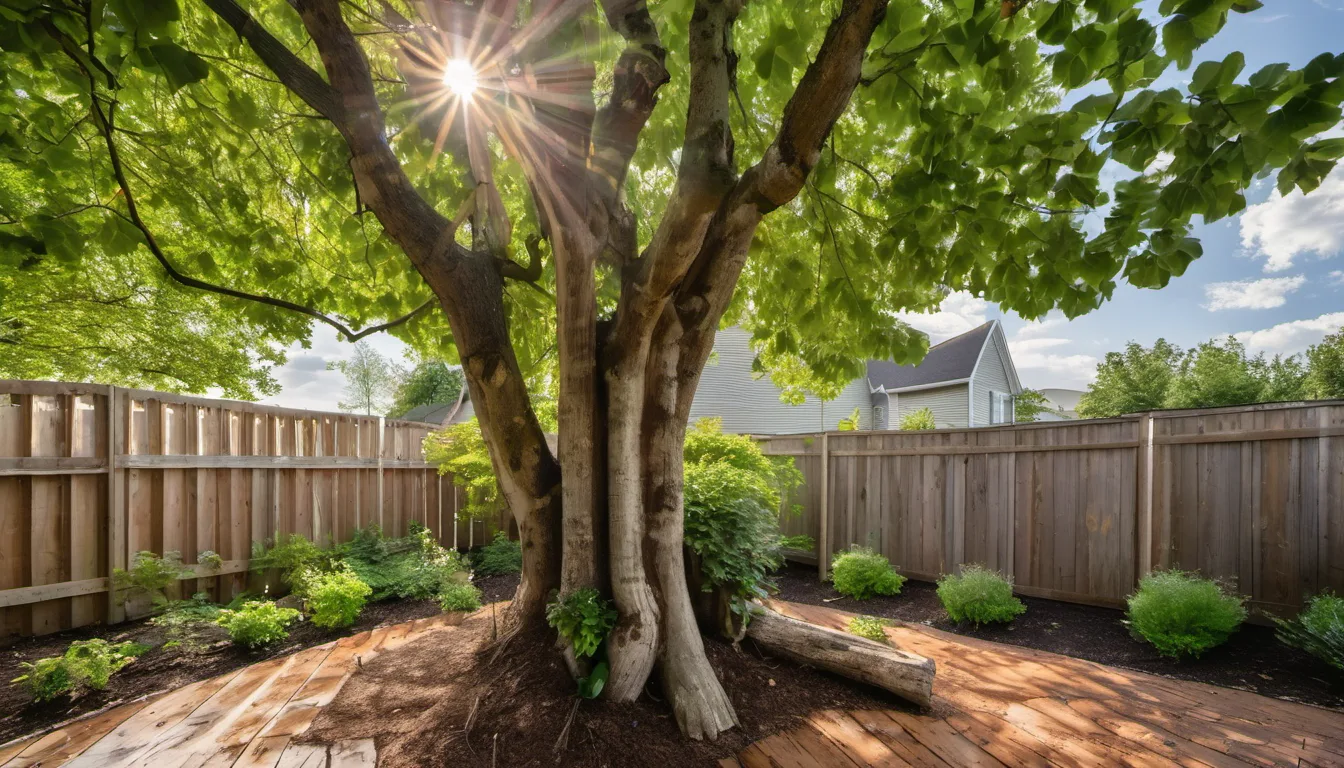
Featured image: A photograph shows a backyard scene with a large tree in the center, surrounded by a wooden fence and a wooden deck. AI-generated image; not a photograph of the reported event.
A tree in a backyard once stood as a silent witness to a family’s life. Its story, told by Victoria Crawford, is not about nature alone. It is about how we see ourselves—through wounds, or through growth.
The Tree’s Early Years
The tulip poplar tree grew near the house, visible from all three floors. When the family built the home, the contractor wanted to remove it. The tree had a disease, they said.
Crawford’s parents chose differently. Instead of cutting it down, they treated it. The treatment removed a large section of the lower trunk, creating a hollow space.
As a child, Crawford noticed this wound. She drew it, focusing on the dark scar. Her mother saw the drawing and asked, Why do you do that? Why do you draw the darkness?
Crawford didn’t know the answer at the time. To her, it felt natural to look for what was broken or missing.
Years of Growth and Change
Over time, the tree grew far beyond the wound. It reached 75 feet in height and 16 feet in circumference. Birds built nests in its branches. Small creatures found shelter in the hollow.
Each year, the hollow grew slightly smaller. The tree’s limbs remained too high for climbing. But Crawford loved watching the leaves move in the wind. She often went to her brother’s attic room to watch squirrels run up and down the trunk.
The tree eventually grew to 150 feet tall. To encircle it now required five people with open arms. The original hollow had become a small, dark opening.
Seeing the Tree for the First Time
Decades later, Crawford returned to the house after her father’s death. She walked in the backyard and looked up.
It was as if she saw the tree for the first time. The leaves were shapely. The branches spread wide. The trunk was strong and balanced.
She realized something: the tree had healed. The wound was no longer visible. In its place was strength, beauty, and power.
For years, she had seen the tree through the lens of its damage. She had seen what she remembered was wrong.
Personal Healing in the Tree’s Shadow
Crawford’s story mirrors her own life. She had been wounded in early years. She saw herself as broken and fragile for a long time.
But she had grown. She had loved. She had been loved. She had learned to forgive. She had found peace.
Standing before the tree, she saw in it a reflection of her own journey. The tree had survived, grown, and healed. So had she.
That moment changed everything. She understood: there was nothing wrong with the tree. There was nothing wrong with her.
The Tree’s Final Days
Two years after her mother passed, the house was sold. The new owners wanted a deck. The tree stood in the way.
Crawford was there a few weeks after it was cut down. She gathered scraps of bark to honor the tree and her memories.
She walked close to the base. The saw marks were visible. But the inner bark—what was inside the tree—was free from rot or decay.
The only sign of the wound was a very small, dark line.
What the Story Offers
Victoria Crawford’s story is not about trees. It is about how we remember and interpret our past.
We often see people or ourselves through the lens of a wound. A failure. A loss. A moment of pain.
But the story shows that wounds do not define what follows. Growth happens in silence. Healing occurs slowly. And beauty emerges in place of damage.
As one reader wrote, Life has a way of holding us in certain moments—especially those marked by hurt.
We carry these experiences, and without realizing it, let them shape how we see the present.
Another said, Strength is not always about overcoming a situation. Sometimes, it is about making peace with it and allowing yourself to grow beyond it.
Others shared similar insights. A reader described how their mother took in a boy with polio and helped him grow into a confident, capable man. The story of resilience is not just one of recovery. It is one of transformation.
Another noted that healing is not about forgetting what once hurt. It is about no longer allowing it to be the only lens through which we see ourselves or others.
Why This Matters
This story speaks to a universal human experience. We all have wounds—emotional, physical, or relational.
But the tree’s journey shows that wounds do not have to define us. The tree grew past the wound. It became stronger. It became beautiful.
Similarly, we can grow beyond our past. We can learn to see ourselves not as broken, but as whole. Not as damaged, but as resilient.
As the Japanese say, Wabi Sabi: beauty in imperfection. The tree had a scar. But it did not stop being beautiful. It became more powerful because of it.
When we stop seeing only the wound, we begin to see the fullness of what has grown in its place.
What to Watch For
Some individuals consider whether gratitude, acceptance of what cannot be changed, and a willingness to remain curious about personal growth might help them return to the present reality of who they are.
Gratitude. Acceptance. Curiosity. These are not abstract ideas. They are practices. They are choices we make daily.
One reader said, What brings me back to the present is gratitude for how far I have travelled, an acceptance of what I cannot change, and a willingness to remain curious about who I am becoming.
Another noted that healing is not about forgetting. It is about understanding. And understanding leads to peace.
These are not grand revelations. They are quiet, daily shifts. Like the tree, we grow in silence. We heal in stillness.
The story does not claim to offer a cure. It offers a mirror. A reminder that we are not defined by what once hurt us. We are defined by what we have become.
And in that, we find strength.
For more stories of healing and hope, explore Victoria Crawford’s upcoming book, Ruffled.
For readers who want to explore personal growth through shared reflection, join a live Awakin Circle. These gatherings offer space to discuss stories, emotions, and transformation in community.
For those interested in mindful living, try a Metta Circle to practice loving-kindness meditation together. Or join a peer-learning pod to dive deeper into shared themes.
Start your own local circle. One living room, one intention—this is how real change begins.
As one reader put it: It is never too late to see someone—or yourself—with fresh eyes.
And in that moment, everything shifts.