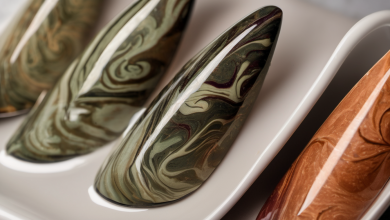
Nail enhancements have evolved significantly since the 1980s. Today, consumers face a range of options—each with distinct benefits and risks.
Soft Gel Nails
Soft gel nails, often called soft gels, are among the most popular enhancements. They were popularized by CND’s Shellac in 2010.
Soft gels rely on a chemical reaction called polymerization. This process turns a liquid into a solid under UV or LED light.
Application begins with prepping the natural nail: removing old polish, buffing, and cleaning with alcohol.
- Apply a base coat, then color coats (usually two).
- Cure each layer under a UV or LED lamp.
- Finish with a topcoat and final cure.
Removal involves buffing the surface and soaking in acetone foil wraps to break down the gel.
Soft gels last about three weeks. They are chip-resistant and protect natural nails from breakage.
They are ideal for people with weak nails or those who need a long-lasting manicure for events.
However, improper removal—such as peeling at home—can damage the nail plate.
Some users report allergies, especially if uncured gel touches skin. This risk increases with repeated exposure or DIY application.
Nail technicians often wear gloves to avoid dermatitis from residual monomers.
Hard Gel Nails
Hard gel is thicker and more rigid than soft gel. It offers greater durability and resistance to wear.
It is especially useful for people who frequently cook or get hands wet.
Hard gel is applied in a pot with a rounded brush. Each layer is cured under a UV or LED lamp.
For extensions, a form is used to build length. Once cured, the form is removed and the gel is filed to shape.
Unlike soft gels, hard gel cannot be soaked off. It requires an electric file (e-file) for removal.
Improper removal can damage the natural nail. This is why professionals are recommended for both application and removal.
Hard gel is best for those who prioritize strength and long-term wear.
Builder Gel
Builder gel is a flexible yet durable option. It is often called ‘Builder in a Bottle’ (BIAB).
It has a thicker consistency than soft gel but is thinner than hard gel.
It is applied in a thick layer that builds up the natural nail. This strengthens the nail’s apex—the stress point at the center.
It can be used for overlays or short extensions. It is not suitable for long nails.
Application includes a base coat, followed by a slip layer that is not cured. This provides a wet surface for the gel to glide onto.
A bead of gel is then applied and gently floated across the nail to self-level.
Removal can be done with an ‘infill’ process. This involves removing old color, buffing, and rebuilding the nail shape.
Up to four infills are possible before a full removal is needed.
Brittney Boyce, a nail artist in Los Angeles, says builder gel is ideal for clients with weak nails. It can fix cracks and help nails grow out.
Alice McColm from Eastbourne, England, calls it a good ‘all-rounder’ for short to medium-length nails.
Acrylic Nails
Acrylic nails were developed in the 1950s by Dr. Frederick Slack. He used dental acrylic to patch a cracked nail.
Acrylics are strong and durable. They are applied using a liquid monomer and powder polymer mixture.

The mixture forms a paste-like bead. This is applied and sculpted with a flat brush.
Three beads are typically placed—on the free edge, apex, and cuticle area.
Acrylics harden in air and do not require UV curing. This makes the process faster but more challenging to master.
Acrylics have a strong odor due to the liquid monomer. Proper ventilation is essential.
Removal requires buffing and a 15–20 minute acetone soak. An e-file is used to scrape off the material.
Salons use vacuums to collect dust, reducing inhalation risk.
Acrylics are best for people needing maximum strength or long nails. They are also used on toes for protection in tight shoes.
Concerns about safety have existed since the 070s. The FDA once investigated methyl methacrylate (MMA), a monomer used in acrylics.
Some states, like California and Florida, have restricted MMA use. Most now use ethyl methacrylate, which is less harsh.
When applied and removed correctly, acrylics are considered safe. However, allergic reactions can still occur.
Signs include redness, swelling, or burning around the nails and cuticles.
For nail technicians, proper ventilation and masks are necessary to protect health.
Soft Gel Tips
Soft gel tips are pre-shaped extensions made from cured soft gel.
They are applied using adhesive and then filed into shape. A top coat of soft gel color is added.
These tips are lighter on the natural nail than traditional extensions.
They require minimal prep, making them ideal for people with weak nails.
Brittney Boyce says Gel-X tips reduce application time and allow more focus on nail art.
Kate Williamson notes that clear tips provide a clean base for color, gems, and art effects.
Removal involves cutting the tip, buffing the nail, and soaking in acetone to remove the gel.
Polygel Nails
Polygel is an acrylic-gel hybrid. It has a thick, toothpaste-like consistency.
It was created in 2017 by Danny Haile, CEO of Gelish.
Polygel is cured under a UV lamp. It is applied inside reusable plastic molds.
The gel is placed into the mold and sculpted. Once cured, the mold is clicked off the nail.
After curing, the nail is filed and nail art is added.
It offers the strength of acrylics and the flexibility of gels.
Removal requires an e-file. A classic emery board can take up to 45 minutes.
Like builder gel, polygels can be infilled or rebalanced near the cuticle.
They are ideal for people wanting a flexible, long-lasting manicure without the rigidity of hard gel.
Many users prefer polygels for home application because the gel stays inside the mold and does not touch skin.
Because of this, the risk of allergic reactions is reduced.

Dip Powder Nails
Dip powder nails, also known as SNS, are not new. They gained popularity in the 1980s and 1990s.
They use colored acrylic powder mixed with a resin glue. No UV lamp is needed—this mixture hardens on its own.
Application involves:
- Priming the nail with a special paint.
- Dipping into colored powder.
- Tapping off excess powder.
- Applying a liquid dip powder topcoat.
Removal requires filing the top layer and soaking in acetone for 15–20 minutes.
It is recommended not to remove at home, though guides exist.
Dip powder nails are strong and chip-resistant. They are ideal for people with brittle nails or those who avoid UV lamps.
However, the result can look bulky, which may not suit all aesthetics.
Prepping and Lifting
All nail enhancements require similar prep: cuticles are trimmed, and the nail plate is buffed.
For tips, a primer is applied to bond the enhancement to the natural nail.
Lifting is a common issue. It often results from improper prep or daily exposure to water, swimming, or dishwashing.
Wearing porous extensions like soft gels increases lifting risk.
Non-porous options like hard gel or acrylics are better for frequent use.
Do Nail Enhancements Damage Natural Nails?
The product itself does not damage nails. Damage comes from improper removal.
Julie Kandalec, a celebrity manicurist and educator, says nearly every client with damaged nails has removed them incorrectly.
She advises soaking longer, removing gently with the grain of the nail, and never using nail clippers.
Many brands claim removal takes 10–15 minutes. Kandalec notes this is rarely enough time.
Nail enhancements have been unfairly blamed for damage. Proper care and professional removal are key.
LED vs. UV Lamps
Soft gels, builder gels, hard gels, and polygels require UV or LED lamps to cure.
Both emit UVA rays, which are linked to skin cancer risk.
LED lamps require less time (60 seconds vs. 2 minutes for UV) and last longer.
A 2014 study in JAMA Dermatology found that UVA exposure from gel manicures every two weeks is low.
Experts say the risk is much lower than that of tanning beds.
Consumers can reduce exposure by using sunscreen on hands or wearing UVA-protective gloves.
For those avoiding UVA exposure, non-curing options like dip powder or acrylics are available.
Meet the Experts
- Brittney Boyce: Nail artist and gel extension specialist in Los Angeles.
- Michele Class: Celebrity manicurist in London.
- Candice Idehen: Manicurist and CEO of Bed of Nails NYC salon.
- Julie Kandalec: Celebrity manicurist, educator, and co-owner of Star Touch Agency in New York City.
- Alice McColm: Nail artist and salon owner in Eastbourne, England.
- Kate Williamson: Celebrity manicurist in London.
Each expert offers insight into the practicality, safety, and application of different enhancements.
Nail enhancements are not inherently harmful. Their impact depends on how they are applied and removed.
Professional care, proper prep, and avoiding DIY removal are essential for long-term nail health.
Understanding the differences between soft gel, hard gel, builder gel, acrylics, tips, polygels, and dip powder helps consumers make informed choices.
For more on current trends, see the original source.
Sources & further reading
Featured image: original publisher image. Via original publisher. Image source