China’s Shenzhou-24 mission has carried Pakistan’s Muhammad Zeeshan Ali into space — the first foreigner to join a Chinese crewed space flight. Source: bbc.co.uk.
What Happened
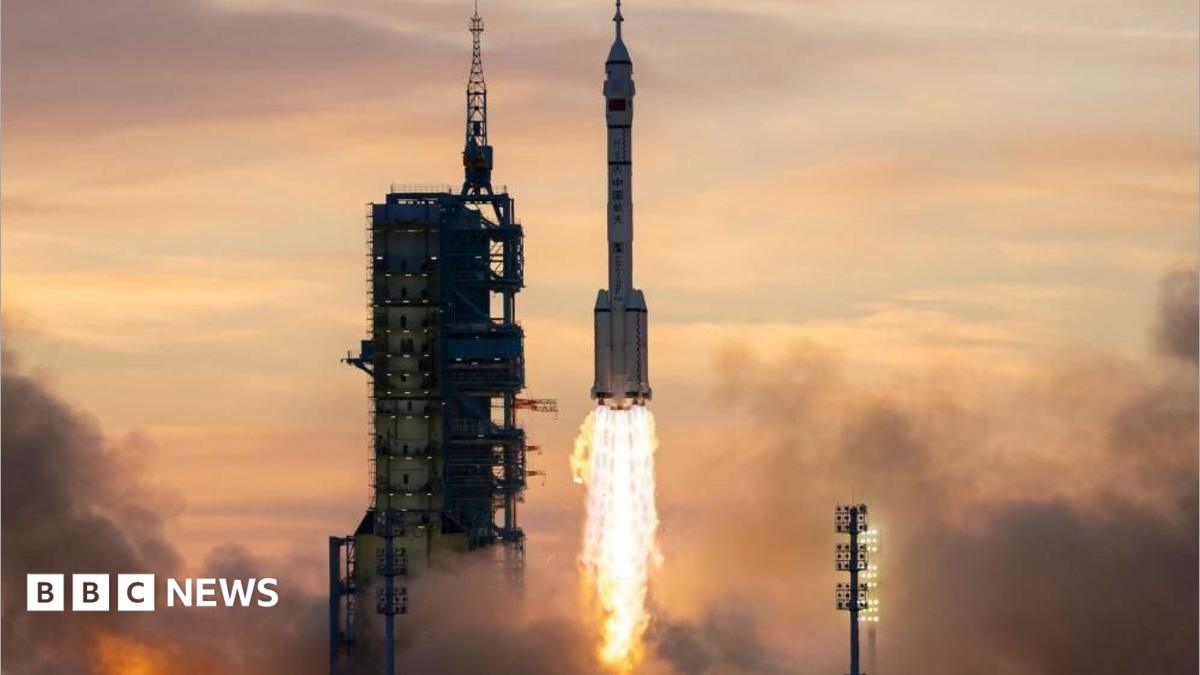
On Wednesday, China launched the Shenzhou-24 spacecraft from the Jiuquan Satellite Launch Center in the Gobi Desert.
The mission carried three astronauts: commander Tang Hongbo, flight engineer Wu Yi, and Muhammad Zeeshan Ali of Pakistan.
Key Facts
- Ali is the first foreigner to participate in a Chinese crewed space mission.
- He is a former fighter pilot with training in China and experience working under Chinese space supervision.
- Ali will conduct experiments on photosynthesis in bacteria and the effects of radiation and microgravity on seeds.
- The mission includes research on how space conditions affect aging, with a focus on vascular diseases.
- Ali will return to Earth after a short stay, while Tang and Wu remain at the Tiangong space station.
Background: How the Mission Works
The Shenzhou-24 is part of China’s ongoing operations at the Tiangong space station.
Since May, two Chinese astronauts — Zhu Yangzhu and Tang Hongbo — have been stationed at Tiangong.
Shenzhou-24 is a short-duration mission, designed to support scientific experiments and test technologies in microgravity and radiation environments.
These include studies on living organisms, aerospace medicine, and the biological effects of space on human health.
Why It Matters
For Pakistan, the mission is a significant milestone. The country lacks its own spacecraft and has no capacity to launch astronauts.
Ali’s participation marks a rare international collaboration in China’s space programme.
China has invested billions in its space efforts and now aims to position Tiangong as an international research platform — not just a national facility.
This comes amid broader efforts to challenge the US-led space dominance, with China aiming to land astronauts on the Moon by 2030.
Limitations and Open Questions
Ali’s role is limited to scientific experiments and does not involve long-term space operations.
His training in China was intensive, with mastering the Chinese language being one of his biggest challenges.
While the mission strengthens ties between China and Pakistan, it does not represent a formal partnership in space exploration.
There is no public indication of how often such international participation will occur in future missions.
What to Watch Next
Future Shenzhou missions may include more international astronauts.
China’s broader goal of making Tiangong a global research hub could lead to expanded participation from other nations.
Observers will watch whether China continues to open its space station to international scientists beyond this one instance.
For now, the mission stands as a symbolic step in international space cooperation — one that reflects both scientific ambition and diplomatic outreach.
Source: BBC News
Sources & further reading
Featured image: A rocket takes off into the sky with a fiery exhaust next to a tall tower as smoke billows around it.. Via original publisher. Image source