BepiColombo has successfully entered orbit around Mercury, marking a major milestone in planetary exploration. After an eight-year journey covering nearly six billion miles, the spacecraft is now operating in the planet’s extreme environment. Source: bbc.co.uk.
What Happened
The BepiColombo mission, a joint effort between the European Space Agency (ESA) and Japan’s JAXA, has completed its final orbital insertion. It arrived at Mercury after a complex path that included loops around Earth, Venus, and Mercury itself.
The spacecraft executed a 37-minute handbrake maneuver to slow down and be captured by Mercury’s gravity. ESA confirmed contact and received telemetry data showing the probe is now in stable orbit.
Key Facts
- BepiColombo launched in 2018 from French Guiana.
- It took six orbits around Mercury to reduce speed and enter orbit.
- The journey was extended by one year due to a propulsion system issue.
- Two spacecraft are onboard: one from ESA, one from JAXA.
- They will separate weeks after arrival to begin independent operations.
Why It Matters
Mercury is the closest planet to the Sun and has long been underexplored.
Despite its small size — only slightly larger than the Moon — Mercury holds scientific puzzles that could reshape our understanding of planetary formation.
Scientists are especially interested in two mysteries:
- Why ice exists in polar craters despite the planet’s proximity to the Sun.
- The origin of thousands of shallow, steep-sided hollows scattered across the surface.
These hollows are not impact craters. They are young — estimated at around 100,000 years old — and their formation remains unexplained.
How the Mission Works
BepiColombo carries two spacecraft. After arrival, they will separate to operate independently.
The ESA spacecraft will study the surface in detail using high-resolution cameras and spectrometers to analyze composition and mineralogy. The JAXA spacecraft will monitor Mercury from orbit, tracking its atmosphere, magnetic field, and interaction with solar wind.
Both spacecraft carry instruments to study the planet’s surface, magnetic field, and solar radiation interaction. These include radar to detect subsurface layers and magnetometers to map the weak magnetic field.
One key question is why Mercury has such a large metal core. Scientists believe it may have formed in a metal-rich region of the early Solar System or suffered a massive collision that stripped away its outer layers. Professor Emma Bunce from Leicester University, a principal investigator, said: It’s a little bit of an under-loved planet in the inner Solar System, but I think that’s one of the reasons why it is so compelling.
She explained that Mercury may have been hit by a large object early in its history, causing its mantle and crust to be stripped away. Alternatively, it could have formed naturally in a metal-rich area. This idea is supported by models of early planetary formation in the inner Solar System.
Technical Challenges
The spacecraft was built to endure extreme conditions.
For most of its journey, the two spacecraft were tightly attached. Now, after eight years, they must be carefully separated. Engineer Jessica Marshall from Airbus, who designed the spacecraft, said the release mechanism is delicate. It uses a spring-based system that twists as it releases, initiating a spin to ensure stability and avoid mechanical stress.
Marshall described the separation as ‘nerve-wracking’ — a critical step that must happen precisely and safely. The mechanism has been tested under real radiation and thermal conditions to ensure reliability in deep space.
What to Watch Next
Once in position, scientists will begin collecting data. The mission will help answer long-standing questions about Mercury’s formation, evolution, and surface features.
Mariner-10 made three flybys, capturing only brief images. Messenger spent four years in orbit, providing more detailed data. Both missions were limited by the planet’s inaccessibility and lack of sustained operations.
BepiColombo will provide the most detailed view of Mercury to date. Its instruments can detect trace elements, map surface features at high resolution, and measure the magnetic field in real time. This data will build a clearer picture of the planet’s geology and history.
The mission’s success could also inform future missions to other inner planets, especially those in extreme environments. Understanding Mercury’s evolution may offer insights into how rocky planets form and respond to solar radiation and gravity.
For more on the mission, see the original report at BBC News.
Sources & further reading
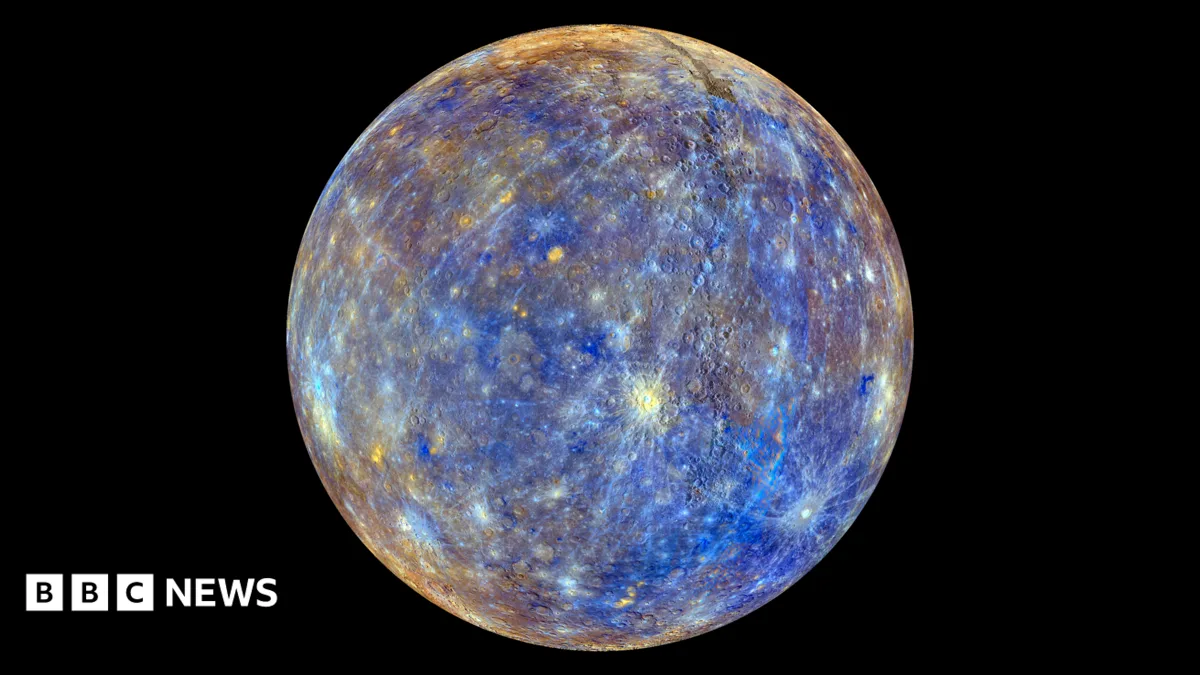
Featured image: A bright coloured circle is set against a black background. It is a mixture of dark blue and brown areas but at the top and bottom there are areas with a bronze glow. Just off the centre, and slightly down and to the right is a bright yellow circle with white broken lines coming off it. These are called crater rays. There are other bright yellow and gold spots dotted across the surface of the planet and there are many many streaks of white and yellow lines criss crossing the planet in all direct. Via original publisher. Image source