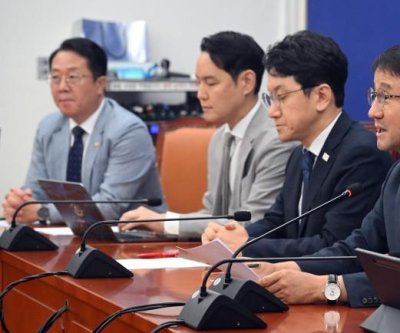
Han Byung-do, acting chair and floor leader of the Democratic Party of Korea, speaks during a policy coordination meeting Thursday at the National Assembly in Seoul. Photo by Asia Today
July 9 (Asia Today) — The People Power Party is facing a growing strategic dilemma as the ruling Democratic Party of Korea continues its legislative drive by using its majority in the National Assembly.
The Democratic Party has already elected the chairs of 11 parliamentary standing committees on its own, including the Legislation and Judiciary Committee. The opposition People Power Party has continued its boycott in protest, but party officials are weighing whether staying away makes it harder to block legislation or returning to committees would still leave them unable to overcome the ruling party’s numerical advantage.
The dilemma has deepened as the Democratic Party moves ahead with follow-up legislation on prosecution reform, including a revision to the Criminal Procedure Act that would abolish prosecutors’ supplementary investigation authority.
The People Power Party has protested the ruling party’s unilateral election of committee chairs and its handling of the committee formation process. But given the current seat distribution, it is not easy for the opposition party to prevent the Democratic Party from passing bills on its own.
People Power Party leader Jang Dong-hyeok appears to be placing more emphasis on public campaigning outside the National Assembly than on parliamentary tactics. Jang canceled a meeting Thursday with newly appointed Prime Minister Han Sung-sook and visited the Gwangju Metropolitan Police Agency in connection with the Jang Yoon-ki case.
Jang has also recently attended voting rights rallies and meetings with young people as he expands his party’s public outreach outside parliament.
Some political observers say rallying public attention outside the National Assembly may be one of the few practical options for the opposition party, rather than being drawn into a legislative process controlled by the ruling party.
But internal conflict is also becoming a political burden for Jang. As controversy continues over disciplinary proceedings by the party’s ethics committee, non-mainstream members have raised the possibility of a signature campaign to pressure the leadership.
Some inside the party say the prolonged dispute is draining energy that should be focused on confronting the ruling party.
Political observers say Jang’s public campaign will need to be paired with stronger internal leadership if it is to produce results.
“The reality is that even if we return to the standing committees, it is difficult to stop the Democratic Party as the majority party,” a People Power Party official said. “There is a need to support the party leader’s efforts to strengthen the offensive against the ruling party by going directly to the field.”
The official said internal conflict must also be brought under control for the public campaign to become a source of momentum against the ruling party.
“Only then will Jang’s leadership gain strength,” the official said.
— Reported by Asia Today; translated by UPI
© Asia Today. Unauthorized reproduction or redistribution prohibited.
Original Korean report: https://www.asiatoday.co.kr/kn/view.php?key=20260710010003702