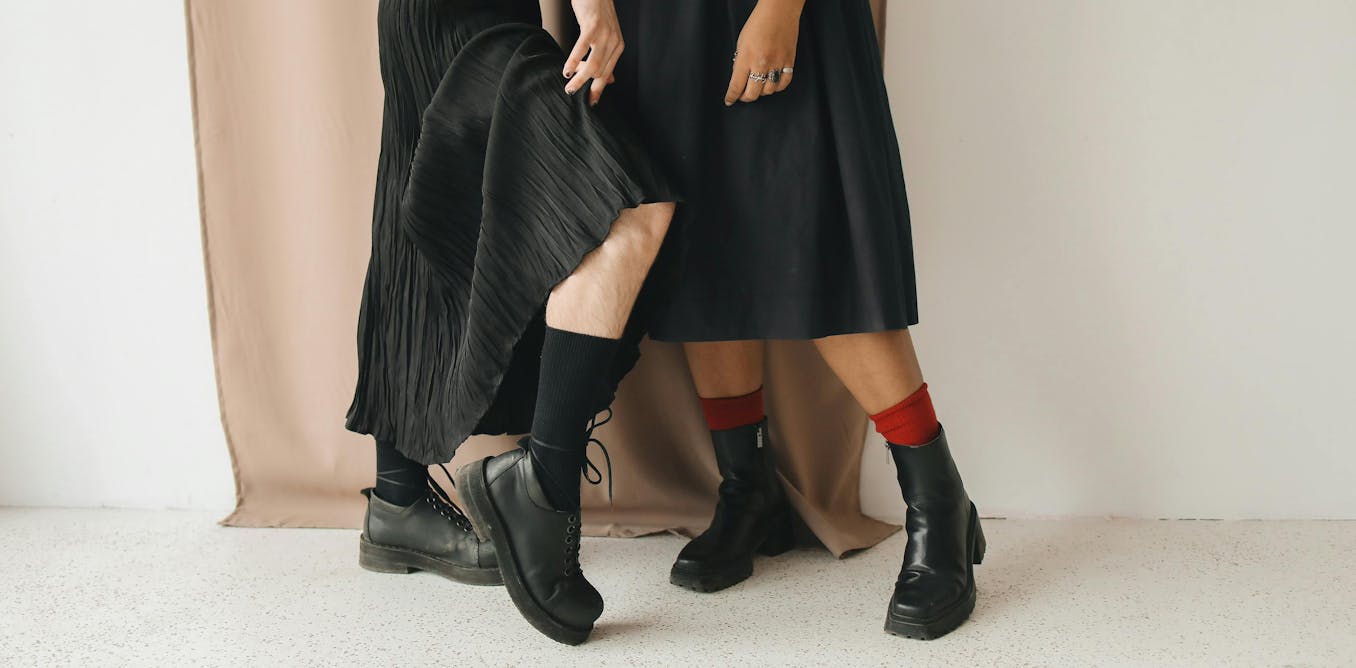
Anna Wintour, former editor in chief of Vogue, once said she would “never ever wear head-to-toe black”. It’s not a sentiment shared by most Melburnians who, while still generally considering themselves fashionable, will opt to wear black all year round – and even more (if possible) during winter.
As reflected in media coverage over the years, Melbourne has built somewhat of a reputation for its love of black clothing. Why is this?

Getty
A lot comes down to climate
When it comes to assessing the “fashion sense” of a particular city, the physical factors – particularly the local climate – matter.
Melbourne is home to a temperate oceanic climate, characterised by mild to warm summers, cool winters, and somewhat consistent rainfall during the year. Its winters are among the coldest of Australia’s capital cities.
As such, the average Melburnian’s wardrobe tends to be optimised for layering. This means having pieces that can be mixed and matched throughout the year. And of course, black on black is foolproof.
As Australian historian Hilary Davidson explained in a recent piece for the Sydney Morning Herald:
People in Melbourne can dress more, and wear more black clothing because the climate is more like London, New York, Milan or Tokyo … Sydney is ostentatiously casual or more Los Angeles glam.

Getty
Place branding and identity
Beyond the weather, the culture and norms of a city also play a role in what is considered acceptable attire.
“Place branding” is an important factor in how people dress in different parts of the world. This refers to the process of branding a city, country or region to actively shape how its residents perceive it.
Generally, place branding arises naturally through a city’s history and the major events that helped shape it. Melbourne’s place brand has developed out of its everyday culture: how residents live, what they value, and how changes in wealth and immigration have shaped the city.
The place brand of a city is reinforced through residents doubling down on established narratives – such as the idea that Melburnians love to wear black.
Melbourne as a very ‘European’ city
Melbourne has strong European undercurrents. It was the site of a large influx of European immigration following the second world war, and is home to both the largest Italian community in Australia, and one of the largest Greek communities outside of Greece.
This has helped establish the Eurocentric food and coffee cultures which remain core to the city’s branding and reputation as a great place to live.
Europeans themselves have embraced black dressing at various points in history. Colour historian Michel Pastoureau, in his book Black: The History of a Color, says this started in the medieval era, when black was adopted by European courtiers, embodying royalty and true luxury.
In the 16th and 17th century, European nobles wore black for portraits to display financial power as black dye was the most expensive and difficult to produce.

Wikimedia
Although certain cities such as Antwerp developed expertise in dyeing black fabrics, this process was only democratised in the 19th century with more widespread access to dyes.
In the early 20th century, black regained an air of European refinement, as demonstrated by French designer Gabrielle “Coco” Chanel’s little black dress concept.
The colour has retained its strong contemporary appeal through Belgian designers such as Dries Van Noten, Ann Demeulemeester and Raf Simons – as well as the Berlin techno and fashion scenes, which widely incorporate black clothing.
Melbourne as the cultural centre of Australia
Like many European cities, Melbourne is also organised around its intellectual and creative institutions. It derives its identity from its cultural appeal and heavy investment in the arts, including music, theatre, literature, fashion and design. (Although the funding that helps drives these cultures is now at risk).
Creatives, of course, are countercultural forces who are notorious for wearing black, as author and architect Cordula Rau highlights in her 2008 book Why Do Architects Wear Black?.
At the beginning of the 20th century, the “Paris end of Collins street” became home to Melbourne’s artistic community. These people brought along their stylistic inclinations with their crafts and ideas.

Getty
Since the 1950s, black has also become the preferred colour of subcultures, such as Goths and punks, who rebelled against established norms. As Japanese fashion designer Yohji Yamamoto puts it:
Black is modest and arrogant at the same time. Black is lazy and easy — but mysterious. But above all black says this: I don’t bother you – don’t bother me.
In the end, Melbourne’s adoption and fondness for black clothing might very well be a self-fulfilling prophecy, aligned with its history and culture.
It may also be a way for residents to feel part of the city’s proverbial fabric, as seeing what our peers are wearing, and emulating it, is a way to signal and find belonging.