
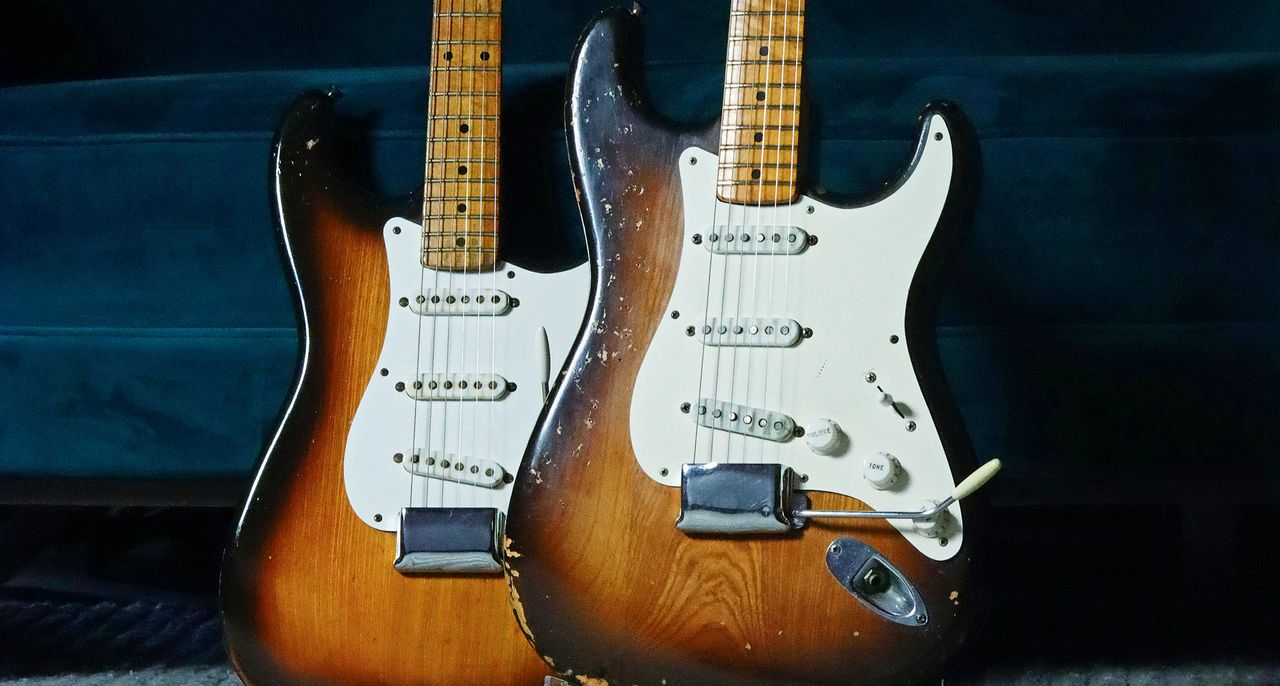
The first of these two 1954 Strats is dated March 1954 and it has serial number ‘0108’ on the spring cover. The rumour is that the Strats with trem-cover numbers were actually salesman samples.
They’re often very heavy and the bodies were usually made using multiple pieces of ash, rather than the single pieces Fender did later. The weight difference can be as much as 3lb. I’ve had a couple from January 1954 in the past, but the earliest Stratocaster I currently have pre-dates the ‘0108’ by a couple of months.
I’ve had some with slot heads for the switch or pickup-adjustment screws, but this is the only one where every screw in the guitar is a slot-head. The potentiometer date stamps on the ‘0108’ show the 42nd week of 1953 and there’s no ‘worm rout’ in the bridge pickup cavity.
Fender later figured out how to cut a wire channel in there by using a rounded router bit, but with very early Strats they just notched the wood out with a chisel. It has the more translucent polystyrene pickup covers, which gives it a much cooler look because they go a little grey as they age.
There’s also the short skirt knobs, the round spring cover holes and the football-shaped switch tip. I’ve had maybe 20 trem-cover serial number Strats in my life and they always sound darker and a little boomier, especially on the middle and neck pickups.
I wouldn’t say they’re as sonically balanced as the later ’54 guitars were. The early pickups also had softer-sounding Alnico III magnets with a shorter G-string slug. The darkness may also have something to do with the 100k potentiometers Fender used on the earliest Strats, rather than the 250k.

I definitely think it’s the extra weight, too, just like heavy ’Bursts always have a deeper roar than lighter ’Bursts. The body shapes are similar, although the belly cut is just a little deeper on very early ones.
By late ’54, you see a lot more one-piece bodies and some very pretty quarter-sawn ones. The white polystyrene covers don’t go translucent and there’s the full skirt polystyrene knobs. The neck profile was not as big by late-’54 guitars and centre-pocket tweed cases replaced the form-fit cases.

The very early trem arms have a sharper bend that was soon softened out and continued getting straighter throughout the ’50s and ’60s. We know Fender got a lot of feedback from the musicians when they lent guitars to local barn-dance guys, and I’m sure the biggest complaints about the early guitars were the weight and the neck size. That early U-shaped profile is kind of clubby, and although collectors prefer them, I don’t know many players that do.
In mid-’54, Fender started to make hardtails. People often think that option came later, but Fender planned that from the beginning and I think that was done to try to sell Stratocasters to Telecaster players.
Not everyone wanted a vibrato on their guitar, and because hardtail Strats sustain better they just prefer the overall sound. Putting in five springs and locking that bridge plate down gets you pretty close, but the hardtails always sound a bit better to me.
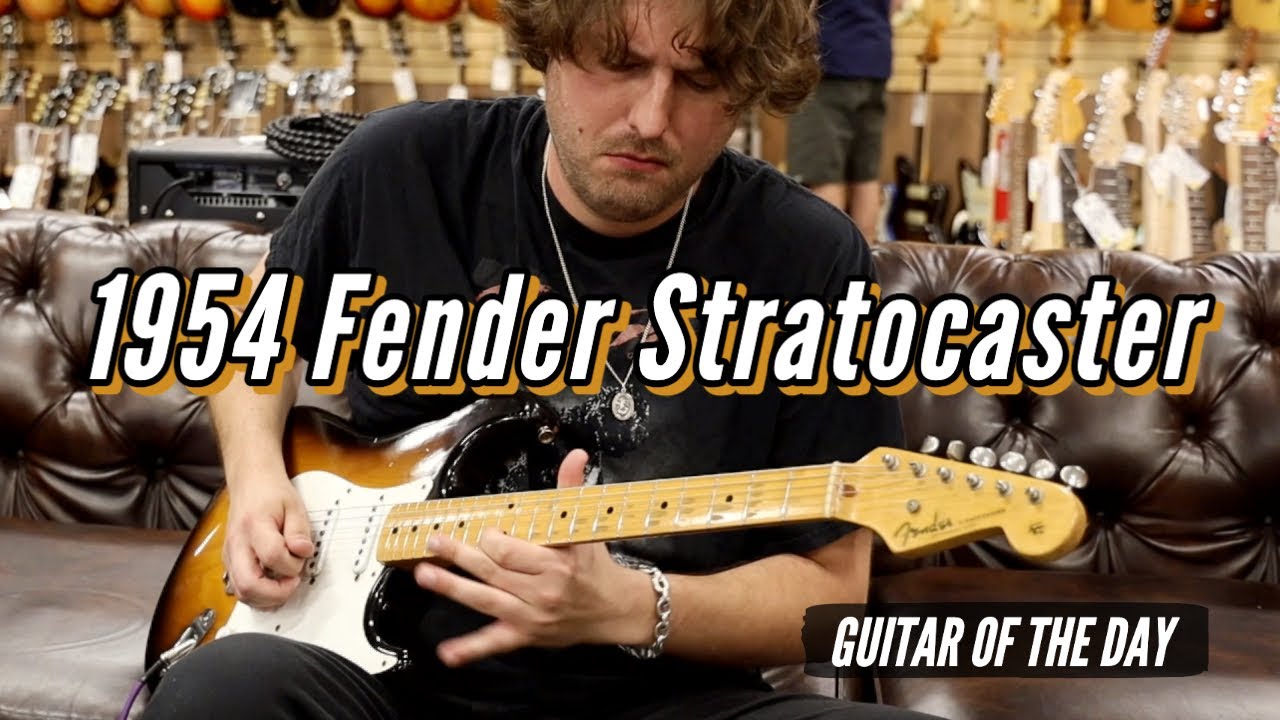
1954 Fender Stratocaster Sunburst FIRST YEAR | Guitar of the Day – YouTube
These guitars are both very original. At some point the earlier one had somebody’s name across the body and they used little brads to put the letters in.
Collectors get very excited about owning very early ’54 Strats because they’re so scarce
There are lots of tiny holes, but they just look like regular nicks and I haven’t been able to figure out the name. We’ve also had a lot of ’54s with the big elongated truss rod plug.
We used to think they were modified to match the Strat Fender used in the publicity photos, but from what I understand now, it’s because Fender often had to do some reworking in that area. They either had to make a larger plug or paint around the general area to hide evidence of work being done.
Collectors get very excited about owning very early ’54 Strats because they’re so scarce. Fender only made around 200 and the majority of them have been monkeyed with. The late ’54 we’re looking at is essentially the same as a ’55 because by around August or September of ’54 Fender had settled on the production version. My feeling is that Strats made from late 1954 onwards are the best for tone and playability.
- Vintage guitar veteran David Davidson owns Well Strung Guitars in Farmingdale, New York / 001 (516) 221-0563
- This article first appeared in Guitarist. Subscribe and save.

