This is a rush transcript. Copy may not be in its final form.
AMY GOODMAN: And before we go, I wanted to switch gears to ask you a question about Iran. You’re an Iranian-born scientist. You were one of the heads of the Department of the Environment there. The threats to the water reservoirs. On Wednesday, Iranian media reported U.S. military strikes hit drinking water reservoirs in the south of Iran, damaging at least two concrete tanks, cutting off water for tens of thousands of people. Your response to the mounting concerns over the long-term consequences of the war on human health, land and marine ecosystems and aquifers, as well as the war’s impact on global warming?
KAVEH MADANI: I think what I’m worried about is mostly the normalization of targeting civil infrastructure as a part of a war. So, you want to take out a government, your different strategies are insufficient, and at some point you start attacking infrastructure, and, you know, to paralyze your enemy. Who suffers from the consequences of this? The poor community, the vulnerable communities.
Now, we are seeing another incident in this war. This is not the first time, and we know this didn’t only happen in Iran. The rest of the countries in the region also suffered from this. But in the case of Iran, this is another case where reservoirs or where the water infrastructure in a poor community, in a rural community, gets targeted. Now 10 villages lost their water supply. Two reservoirs got impacted. One of those tanks, the bigger one, had been recently, actually, developed and established. Who suffers from this? The civilians that you claim you want to rescue from that government. So, they are the ones who have to bear the consequences. They are the ones who, even in normal times, are struggling with having access to clean water. And as a result of war, now they have to suffer further and further. This is just the short-term impacts. If you think about what happens as a result of all the emissions associated with the war, we are also, you know, going to pay the cost of that. If you think about how the economies would suffer — and when we know that the economies are in the resistance mode or in the inflation mode, they become more resources extractive, they become more polluting — then we know that the long-term consequences would be even more dire.
What I’m happy about is that Iran this year has been very lucky, and nature has been much more generous than the politicians to the Iranians. So, Iran has got a lot of rain this year, the rest of the region, as well. But, you know, that’s a temporary relief. The long-term consequences would be severe. And we have already seen that it’s not only the infrastructure that is being targeted. Think about all the pollution, all these tankers that are being targeted, the oil spills in the Persian Gulf, the petrochemical facilities, infrastructure, the refineries that are getting targeted in the coastline. All of those impacts would be there. Pollution would be there. People are going to fish, eat that, the pollution. Everything would be there for a long, long time. Even if President Donald Trump and Ayatollah Khamenei shake hands tomorrow, these consequences would be there for generations. It would not — they would not only, I think, impact the Iranians. These are transgenerational and transboundary.
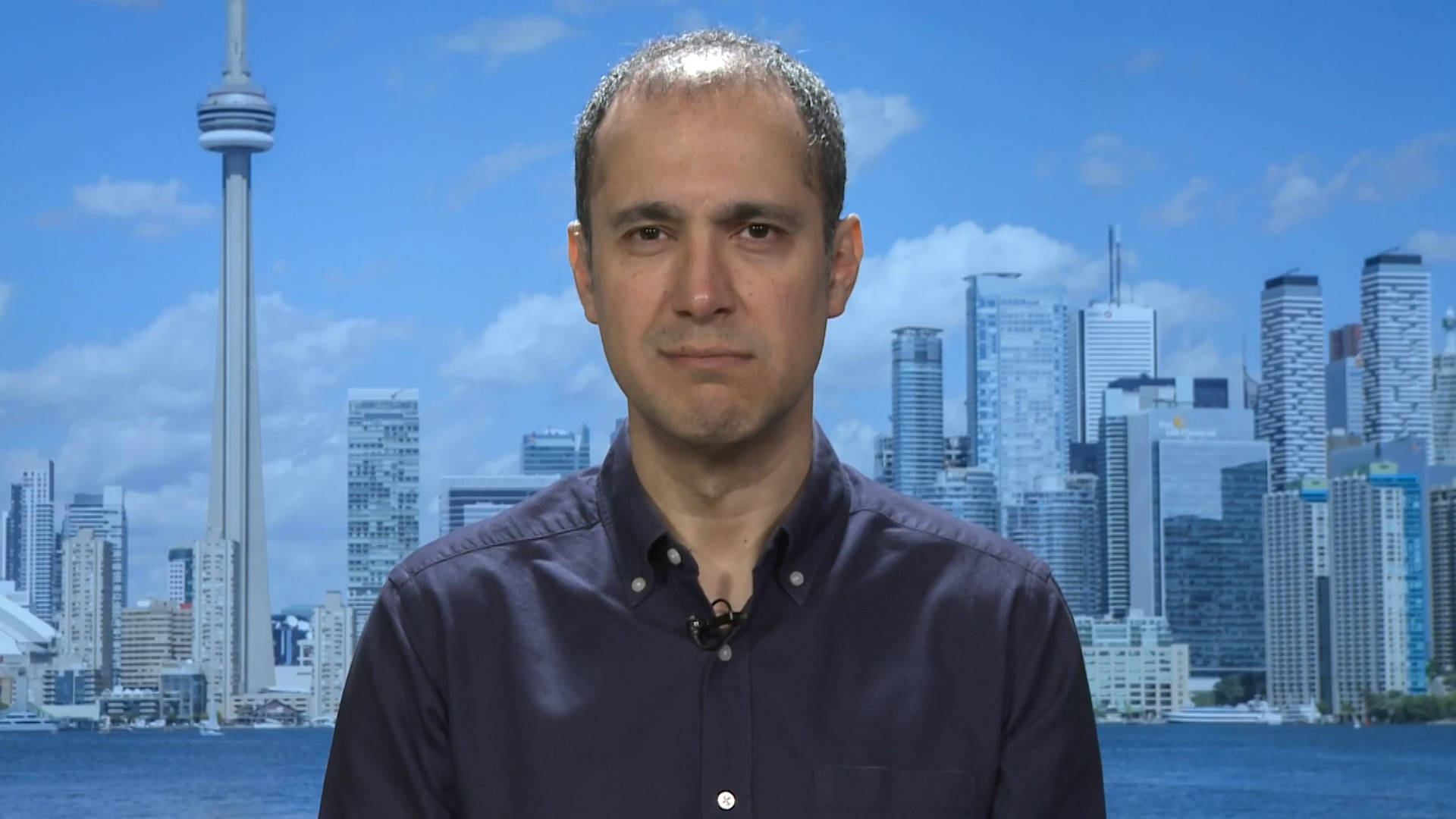
AMY GOODMAN: I want to thank you very much for being with us from Toronto, Kaveh Madani, the director of the United Nations University Institute for Water, Environment and Health, previously served as deputy head of Iran’s Department of Environment. He recently won the 2026 Stockholm Water Prize, often referred to as the Nobel of Water. Madani and his colleagues have just released a major United Nations report, which we’ll link to, called “The Environmental Cost of Artificial Intelligence: Carbon, Water, and Land Footprints.” Go to democracynow.org.
Coming up, the attack on higher education. We’ll talk about the mass layoffs at The New School and efforts to deport outspoken Palestinian Columbia University graduate student Mohsen Mahdawi. Stay with us.
AMY GOODMAN: “A Harbor for Hard Times” by David Berkeley.
The original content of this program is licensed under a Creative Commons Attribution-Noncommercial-No Derivative Works 3.0 United States License. Please attribute legal copies of this work to democracynow.org. Some of the work(s) that this program incorporates, however, may be separately licensed. For further information or additional permissions, contact us.