A new species of extinct camel, named Vampyrocamelus welshi, has been identified in fossil specimens collected decades ago and stored in museums. This discovery, based on a reanalysis of tens of thousands of camelid fossils from the American Museum of Natural History’s collection, shows how much insight can come from long-overlooked museum holdings.
What Happened
Childs Frick, a pioneering paleontologist at the American Museum of Natural History (AMNH), conducted extensive fossil digs in the early 20th century with a focus on camelids—the family that includes modern camels, llamas, and alpacas. Over decades, he collected thousands of specimens, many of which were cataloged but never deeply studied.
Recently, a team of paleontologists reanalyzed this collection using modern techniques. They identified Vampyrocamelus welshi as a new genus and species, formally described in a monograph to be published in the New Mexico Museum of Natural History and Science Bulletins.
The fossils date from 10 to 13 million years ago. They are mostly found in Texas and Oklahoma, with rare finds in Nebraska. The discovery is not about predation—but about the skull’s unique features.
Key Facts
- Vampyrocamelus welshi is a new genus and species, formally described in a monograph to be published in the New Mexico Museum of Natural History and Science Bulletins.
- The fossils were collected over a century ago and have remained largely unstudied until now.
- Only skull fragments and a few broken limb bones have been found. The rest of the skeleton is poorly preserved.
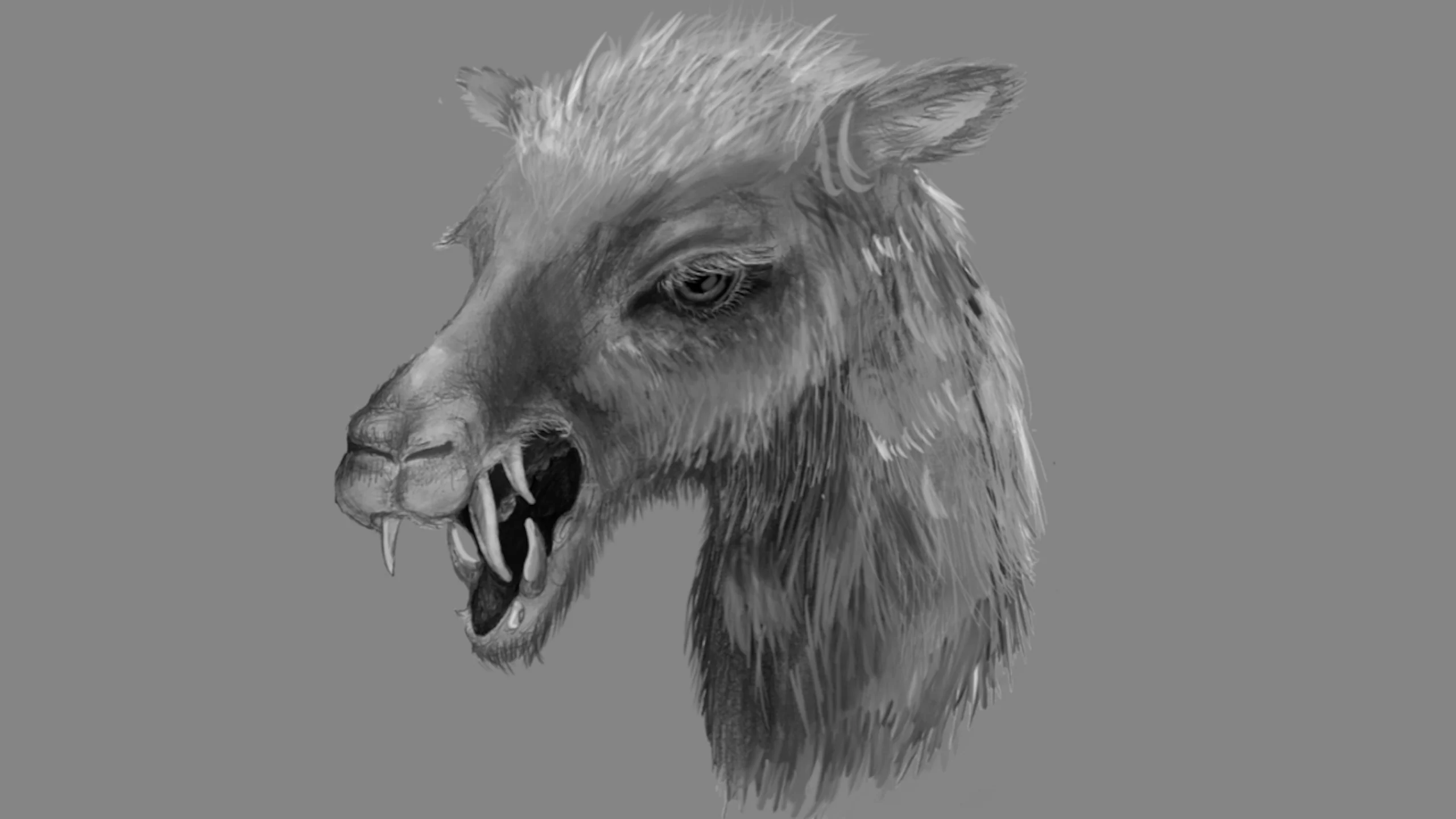
- Its skull resembles other known camelids, but the fangs are significantly larger than any previously recorded in the family.
- It may have shared a lifestyle with Aepycamelus, a genus known for its long neck and stilt-like legs.
Background: How It Works
Camelids evolved from small, tree-dwelling ancestors into large, grazing mammals adapted to open grasslands. Early forms likely spent time in trees, feeding on leaves—a behavior that may have carried into later species like Vampyrocamelus.
Based on skull and limb structure, Vampyrocamelus welshi likely stood on four slender legs with a long, giraffe-like neck. This would have let it reach high into trees to graze on leaves and branches, like modern giraffes or ancient browsers.
There’s no evidence it hunted. The large, recurved fangs suggest a different use. Canines are about 40 millimeters (1.6 inches) long, with sharp tips. When preserved, the first upper premolar is also large and sharply pointed.
Paleontologist Katherine Marriott of the AMNH says these fangs were likely used in courtship. She told Science reporter Jake Buehler: They may have been using [the fangs] to attract females, because the female animals did not have these.
Why It Matters
This discovery shows how much knowledge may already exist in museum collections—waiting for new study. Many fossils are cataloged but never deeply analyzed due to lack of time, funding, or tools.
Scientists now believe some bones once labeled as Aepycamelus may actually belong to Vampyrocamelus. The fangs are the key difference. Without close inspection, such bones could remain misclassified.
Limitations and Open Questions
Very little is known about the animal’s full body or behavior. No complete skeletons exist. Only a few limb bones have been found, and they are fragmented. This limits understanding of how it moved, ate, or lived socially.
It’s unclear if the fangs were for defense or display. No feeding or predation evidence exists. Future discoveries could clarify how Vampyrocamelus fit into the camelid family tree.
What to Watch Next
More specimens may be found in Texas and Oklahoma. Scientists are urging more systematic reviews of fossil collections to uncover hidden discoveries.
If a ‘vampire camel’ emerges from old bones, other forgotten species may be hiding in museum drawers worldwide. This case shows that the biggest breakthroughs may not come from new digs—but from reexamining what we already have.
The monograph will be published in the New Mexico Museum of Natural History and Science Bulletins.
For more, see the original report at ScienceAlert.
Sources & further reading
Featured image: Bizarre 'Vampire Camel' Discovered in Museum Fossils Collected Decades Ago. Via original publisher. Image source