
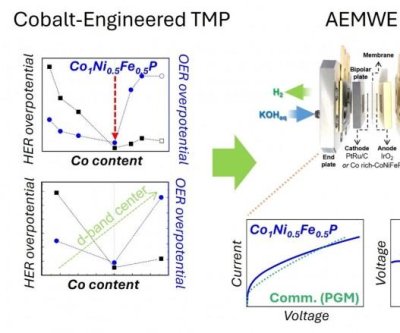
A graphic summarizes the performance of a cobalt-optimized, non-precious-metal catalyst used in an anion-exchange membrane water electrolysis system. Image courtesy of Chung-Ang University
June 15 (Asia Today) — South Korean researchers have developed a catalyst that could substantially reduce the cost of producing green hydrogen while delivering performance and durability comparable to catalysts made with expensive precious metals.
A research team led by Professor Don-Hyung Ha of Chung-Ang University developed multimetallic phosphide nanoparticles that do not require platinum, iridium or other costly precious metals, the university said Monday.
The research was conducted jointly with a team led by Professor Inho Nam of Chung-Ang University’s Department of Chemical Engineering and researchers led by Sung Jong Yoo of the Korea Institute of Science and Technology’s Center for Hydrogen and Fuel Cells.
The catalyst was used to build a high-performance anion-exchange membrane water electrolysis system, a technology considered a potential lower-cost option for producing clean hydrogen.
Water electrolysis uses electricity to split water into hydrogen and oxygen. When the electricity comes from renewable sources, the resulting fuel is commonly called green hydrogen because the production process does not directly emit carbon dioxide.
Many high-performance electrolyzers, however, rely on scarce and expensive catalysts containing platinum or iridium. Their cost and limited availability have been major obstacles to the large-scale commercialization of green hydrogen.
Anion-exchange membrane water electrolysis could reduce dependence on those metals because it can operate with less expensive materials. Existing non-precious-metal catalysts, however, often undergo changes to their surface structures during operation, resulting in lower efficiency and shorter operating lives.
The researchers sought to address the problem by designing nanoparticles made from cobalt, nickel, iron and phosphorus.
They used real-time spectroscopic analysis to examine changes in the catalyst’s oxidation state and surface structure while it was operating.
The team found that optimizing the amount of cobalt caused a stable, highly active structure to form on the catalyst’s surface during electrolysis. The researchers identified this surface reconstruction as a key factor in maintaining high catalytic activity and long-term durability.
In single-cell tests, a system using the catalyst at both the hydrogen-producing and oxygen-producing electrodes reached a current density of 5.73 amperes per square centimeter at 2 volts.
When the catalyst was used only at the oxygen-producing electrode, the system reached 11.43 amperes per square centimeter at the same voltage.
Higher current density generally indicates that an electrolyzer can produce more hydrogen from a given electrode area, although overall commercial performance also depends on factors including energy efficiency, system size, operating conditions and manufacturing cost.
The system also operated continuously for 500 hours at a commercially relevant current density of 1 ampere per square centimeter without a significant decline in performance, the researchers said.
The results indicate that non-precious-metal catalysts can deliver performance approaching that of systems using platinum-group metals.
The study combined control of the catalyst’s chemical composition, real-time analysis of its operating surface and performance testing in a complete electrolysis cell. The researchers said the integrated approach strengthens the catalyst’s potential for practical application.
“This study is academically significant because we precisely controlled the composition of a non-precious multimetallic phosphide catalyst and used real-time analysis to clarify how its surface changes during operation,” Ha said.
“It could serve as a milestone in developing low-cost water electrolysis electrodes that replace expensive precious-metal catalysts while providing both high performance and durability,” he said.
The research was supported by South Korea’s Ministry of Science and ICT through the H2GATHER program, the H2 NEXT ROUND program and a Korea Institute of Science and Technology clean hydrogen technology development program.
The study, titled “Cobalt-Engineered Multimetallic Phosphides with Switchable HER-OER Activity for Durable Anion Exchange Membrane Water Electrolysis,” was published online May 26 in Advanced Functional Materials.
— Reported by Asia Today; translated by UPI
© Asia Today. Unauthorized reproduction or redistribution prohibited.
Original Korean report: https://www.asiatoday.co.kr/kn/view.php?key=20260612001005481

