
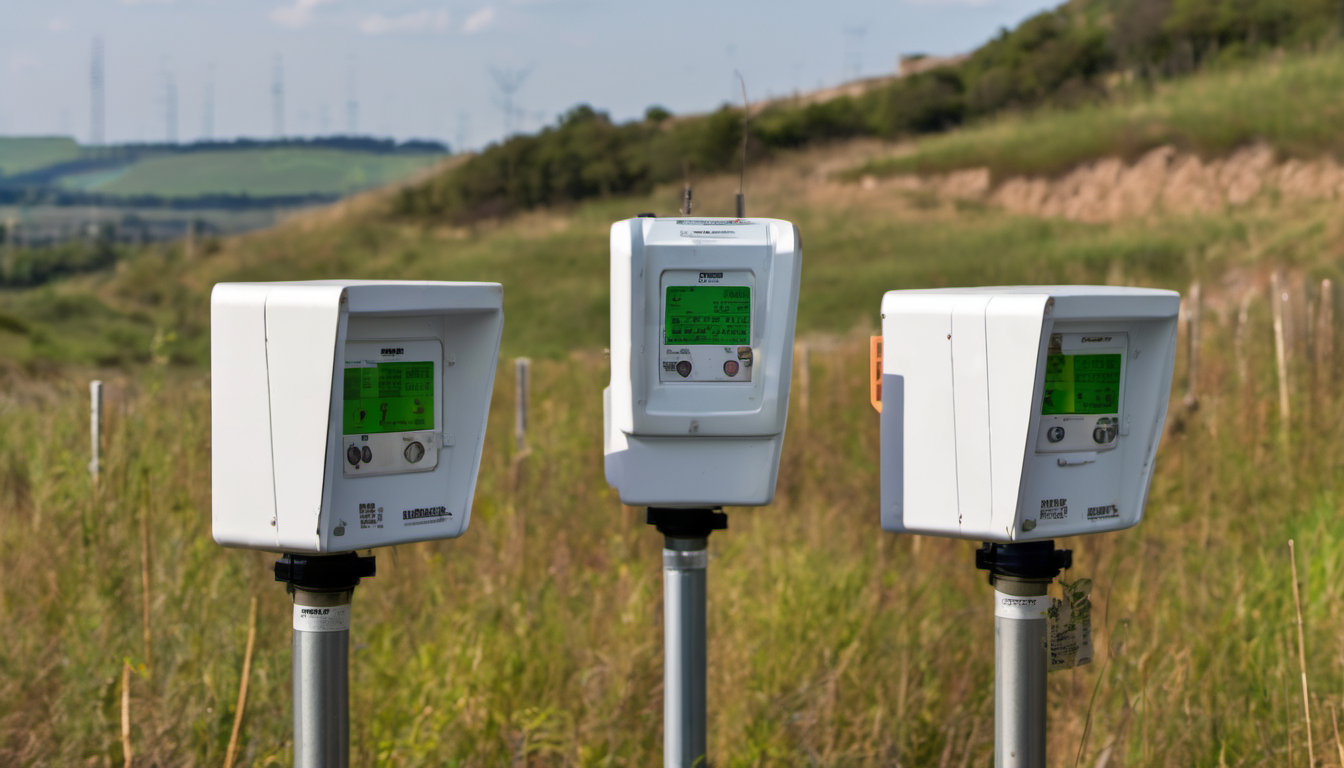
Featured image: Three white electronic devices with green displays are mounted on poles in a grassy field. AI-generated image; not a photograph of the reported event.
Smells from industrial sites are now being monitored more closely in cities around the world. Urban growth brings homes closer to waste and manufacturing facilities, increasing exposure to odours. Source: bbc.co.uk.
In Milpitas, California — a Silicon Valley hub — residents have long endured strong odours from a 342-acre landfill. The stench has lasted decades. Chia-Ling Kong, an engineer, recalls not being able to open her windows for over ten years after moving to the area.
Kong lives half a mile from the landfill. Though conditions have improved, neighbors still face about two to three hours of bad smells each day. This has led to a local citizen campaign demanding accountability and better air quality.
Technology as a Response
Local authorities have ordered the landfill to use drones and air monitors. These tools track odour-causing chemicals in real time. They detect problems early, before they spread.
The landfill must also automate gas collection. Methane and carbon dioxide are major contributors to foul smells. Automation ensures consistent, reliable data and reduces human error.
How Odours Are Monitored
Industrial odour control uses three main technologies. First, materials like activated carbon absorb airborne molecules. Second, chemical reactions convert odours into less offensive substances. Third, thermal oxidisers burn off harmful gases at high temperatures.
Experts like Carlos Diaz of Spain say these systems can remove 90% or more of odour-causing compounds when properly installed. But costs can be high — from hundreds of thousands to millions of dollars.
Limitations and Doubts
Many sites still use large-scale air fresheners. These are sprayed in massive amounts to mask odours. They often contain chemicals like citral or ethyl butyrate.
Odour consultant Michael Bull compares them to fabric conditioner. They don’t remove the source — they just cover it. This may ease the smell temporarily, but it doesn’t fix the problem.
Case Study: Des Moines, Iowa
Residents report a rotting smell known as the ‘Eastside Funk’ that drifts across parts of Des Moines. A city study found three meat processing facilities as key sources.
Real-Time Monitoring System
Des Moines now spends about $240,000 a year on air sensors arranged in a ring around the facilities. The sensors detect chemicals like hydrogen sulfide and ammonia.
Data from the sensors is combined with weather patterns. This helps pinpoint which facility is emitting the odour. Officials can now say with confidence: ‘This smell came from your site.’
Shift from Human Sniffing to Data
Before sensors, officials relied on human sniffing. Trained panels would visit sites and judge odour strength based on personal perception.
Experts like Clara Barrios Obregón say this method is unreliable. Human sensitivity varies widely. Electronic noses detect chemical compounds at very low levels — far below human detection.
Why This Matters
Urban development is pushing homes closer to industrial zones. This trend, called ‘infilling,’ increases exposure to odours. It raises concerns about public health and daily life.
Landfills are especially hard to manage. Their large surface area and diverse waste produce many odorous compounds. These reactions generate both strong smells and potentially harmful gases.
Regulatory Gaps
Many regions lack rules on odour emissions. The U.S. EPA does not regulate odours as a pollutant. Responsibility falls to states and local governments — a system with inconsistent enforcement.
Similar gaps exist in the UK, Spain, and other nations. Without national standards, local actions rely on public complaints, not science-based benchmarks.
What to Watch Next
Cities are moving from reactive complaints to proactive, data-driven responses. Some companies, like Smithfield Foods, have spent millions to upgrade their systems.
Even with upgrades, companies may deny responsibility. This shows the need for independent, transparent verification.
Smell perception is highly personal. Professor Johan Lundström notes people are more sensitive to unpleasant odours. This means low emissions may still feel foul to residents.
Technology helps track and reduce odours. But it can’t fully fix the emotional and social impact on affected communities. The issue remains a mix of science, planning, and public perception.
Source: BBC News
