Scientists have discovered a fossil of an ancient amphibian that lived its entire life in the ocean — a finding that challenges long-held assumptions about amphibian biology. Source: sciencealert.com.
What the Fossil Reveals
Two fossils found in Guanling County, China, date back to the Late Triassic period, about 237 million years ago. They belong to a species named Gerrothorax maritimus.
The site was once covered by a marine environment. Fossils of ichthyosaurs, crinoids, and turtles have been found there, indicating a rich underwater ecosystem.
Unlike modern amphibians, which typically move between land and water, Gerrothorax maritimus appears to have spent its entire life in the sea.
Body Structure and Armor
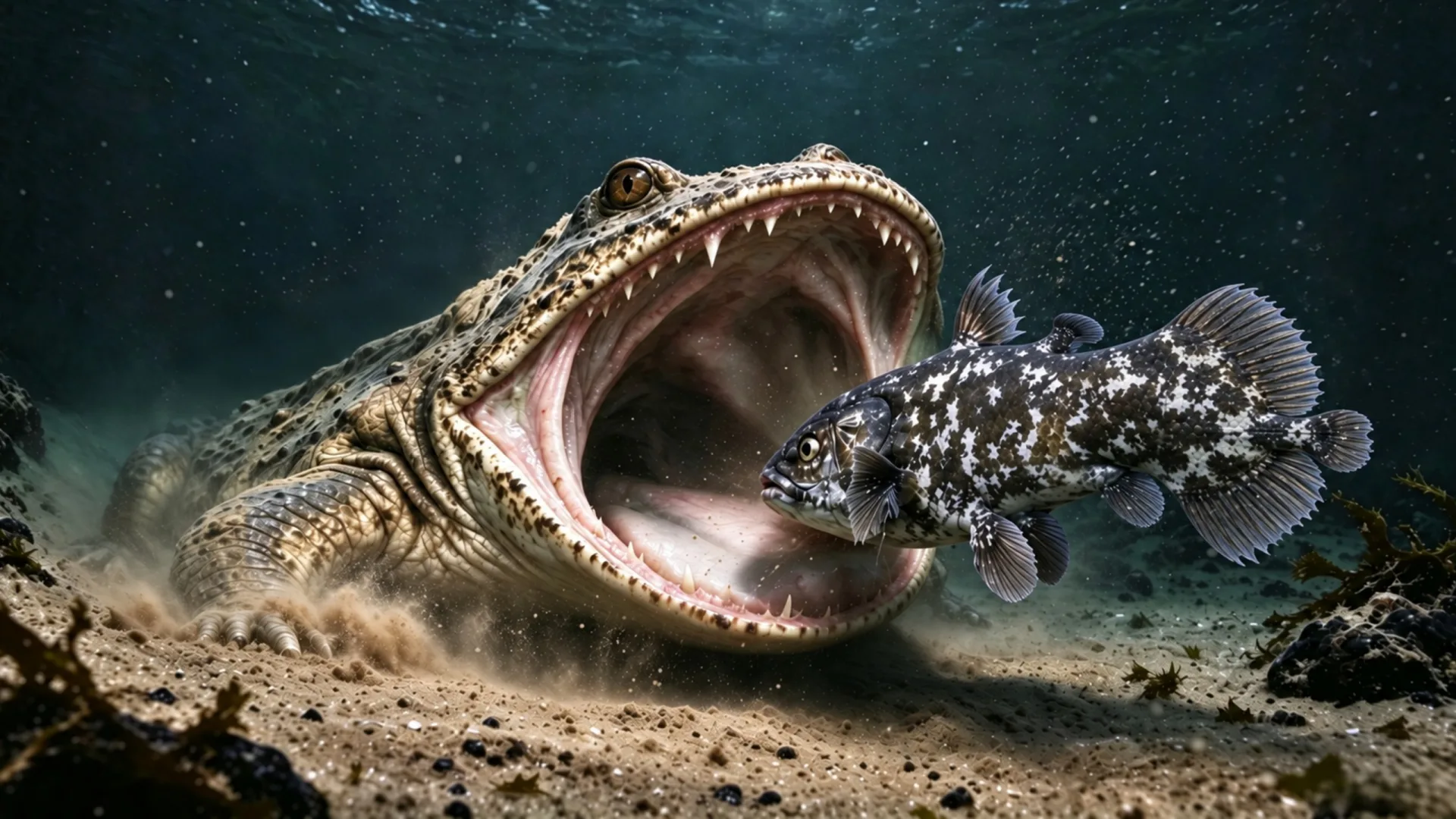
The animal had a flat, chunky body covered in hard plates of armor. These plates are well-preserved in the fossils.
Modern amphibians have porous skin that allows gas and water exchange. This trait makes them vulnerable to saltwater, which can disrupt their internal balance.
However, the armor on Gerrothorax likely prevented water from entering through its skin. This would have meant the animal had to drink seawater directly, absorbing nutrients through its digestive system — a process unlike most living amphibians.
How Scientists Know It Lived at Sea
Researchers analyzed strontium isotopes in the bones of both specimens. Strontium is a trace element that accumulates in bones and varies by location.
On land, strontium ratios differ based on the type of rock. In the ocean, the ratio is consistent across regions.
The strontium levels in the bones matched those of Triassic seawater, not the surrounding rock. This suggests the animals drank seawater throughout their lives.
Both fossils are nearly complete, with limbs preserved. If the animals had drifted far from their habitat after death, their skeletons would likely have lost limbs due to exposure and drying.
Co-author Ryosuke Motani of the University of California, Davis, says: It is very unlikely that the two individuals… were transported over 30 km and still retained nearly complete articulation down to the limb.
He adds: Carcasses at sea, unless they sink to the bottom right away, tend to dry out and lose limbs prior to sinking to the bottom.
Because the limbs are preserved, the researchers conclude the animals likely died near where they lived.
Size and Physical Characteristics
The more complete specimen measures at least 73.7 cm (about 2.4 feet) along its midline. Some tail bones are missing.
While it may weigh roughly as much as a giant salamander, its body shape is different. Giant salamanders are elongated. Gerrothorax is broad and heavy.
Its weak limbs and heavy armor suggest it would have struggled to move on land — if it ever attempted to do so.
Why This Discovery Matters
Amphibians are defined by their ability to live in both water and land. This fossil shows that an ancient amphibian species bypassed that evolutionary path entirely.
It suggests that early amphibians may have had more diverse adaptations than previously thought.
The discovery is published in the journal Nature Ecology & Evolution.
It is a significant fossil find because it shows an animal that lived entirely in the ocean — a lifestyle previously thought impossible for amphibians.
While the research is based on two specimens, the evidence from isotopes and fossil preservation is strong. The team has not ruled out the possibility that other similar species existed.
Further study may reveal more about how early amphibians evolved and adapted to different environments.
Sources & further reading
Featured image: An Armored Amphibian That Lived Its Whole Life at Sea? It's a Fossil First. Via original publisher. Image source