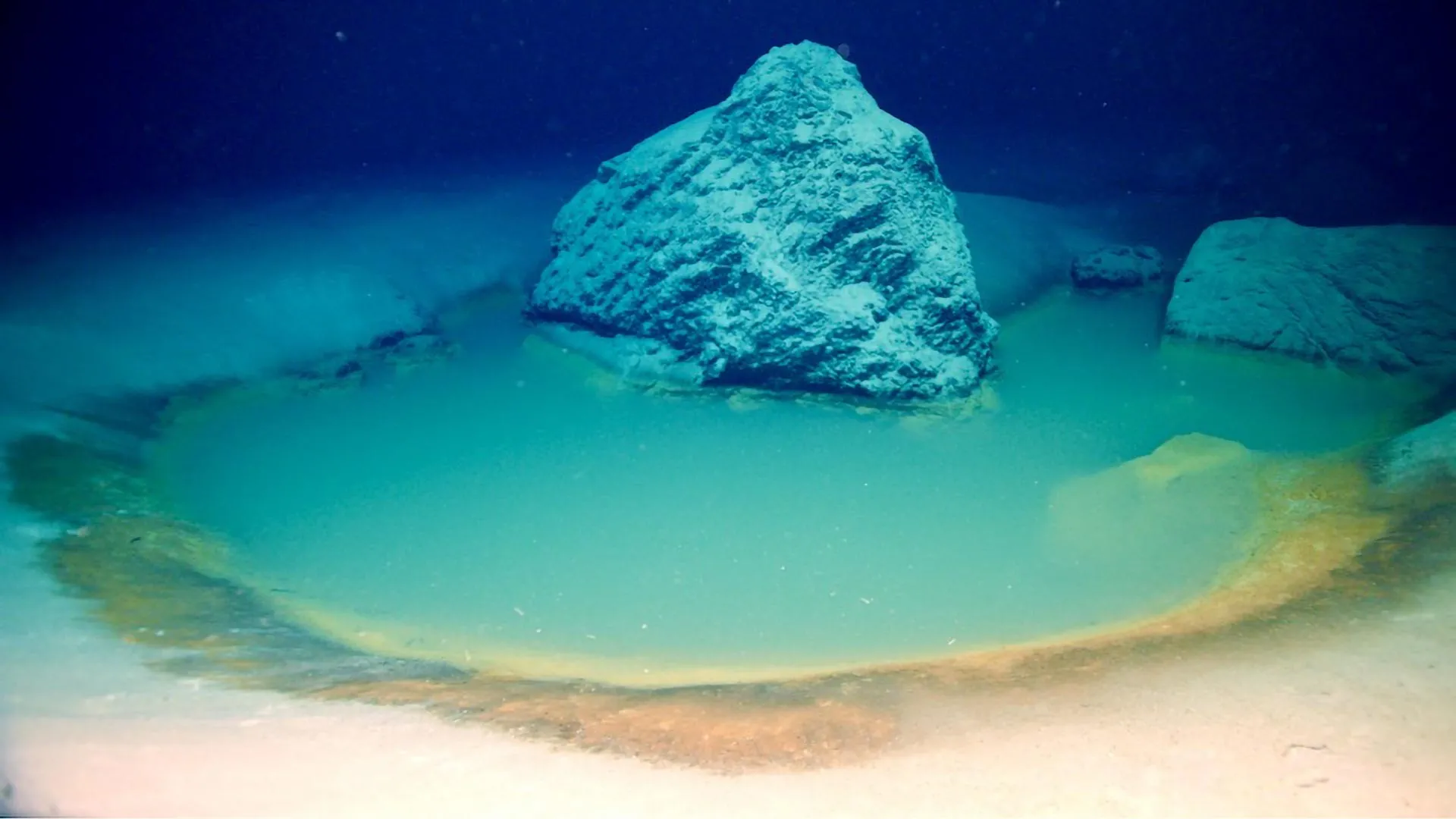
Scientists have discovered deep-sea brine pools more than a mile beneath the Red Sea. The findings, made by researchers from the University of Miami and OceanX, reveal rare underwater lakes with extreme conditions that support microbial life. These brine pools represent one of the most extreme environments on Earth, where life persists despite conditions that would otherwise be fatal to most organisms. Source: sciencedaily.com.
Discovery in the Gulf of Aqaba
The brine pools were located in the Gulf of Aqaba, a northern extension of the Red Sea, at a depth exceeding 1,770 meters—more than one mile below the ocean surface. This discovery was made by Sam Purkis, professor and chair of the UM Department of Marine Geosciences, and his colleagues in collaboration with OceanX. The researchers used a remotely operated underwater vehicle (ROV) deployed from the OceanXplorer to locate the pools at that depth.
“Until we understand the limits of life on Earth, it will be difficult to determine if alien planets can host any living beings,” said Purkis. “Our discovery of a rich community of microbes that survive in extreme environments can help trace the limits of life on Earth and can be applied to the search for life elsewhere in our solar system and beyond.”
Extreme Conditions and Microbial Life
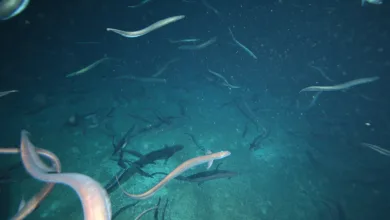
Brine pools are among the harshest environments on Earth. Their waters are extremely salty, have unusual chemistry, and lack oxygen. Despite these harsh conditions, the pools host abundant microbial life. Previous research has found biologically active molecules in these microbes with potential anticancer properties.
The study marks the first documented discovery of brine pools in the Gulf of Aqaba. The researchers nearly missed them.
“We were very lucky,” said Purkis. “The discovery came in the last five minutes of a ten-hour ROV dive.”
Geological Archives of Earth’s Past
The pools act as natural records of past geological events. Their salty, oxygen-free waters preserve evidence of tsunamis, flash floods, and earthquakes that occurred in the Gulf of Aqaba thousands of years ago. Tectonic activity has created many faults and fractures on the seabed in this region.
Earlier in 2022, Purkis and colleagues found evidence of a 500-year-old underwater landslide that likely caused a major tsunami. This history could impact coastal planning in Egypt and Saudi Arabia.
The study, titled “Discovery of the deep-sea NEOM Brine Pools in the Gulf of Aqaba, Red Sea,” was published on June 27, 2022, in Communications Earth & Environment.
Research Team and Funding
The research team included Sam J. Purkis, Hannah Shernisky, Peter K. Swart, Arash Sharifi, Amanda Oehlert, Gaëlle Duchâtellier, James Klaus, Gregor P. Eberli, Larry Peterson, and Graham Kolodziej from the UM Rosenstiel School; Fabio Marchese and Francesca Benzoni from King Abdullah University of Science and Technology’s Red Sea Research Center; Giovanni Chimienti from the University of Bari Aldo Moro in Italy; Andrew Craig and Mattie Rodrigue from OceanX; Jürgen Titschack from MARUM — Center for Marine Environmental Sciences in Germany; and Ameer Abdulla from NEOM.
NEOM, a company developing the Saudi Arabian coastline, funded the four-week research expedition aboard the OceanXplorer.
Watch the NEOM OceanX documentary about the discovery: https://youtu.be/bWNftnYDx9c.
Why This Discovery Matters
Understanding life in extreme environments helps define where life can exist on Earth and beyond. These brine pools show how life can survive in high salt and low oxygen conditions—conditions found on other planets and moons.
For example, Mars has ancient lakebeds and salt-encrusted areas. Jupiter’s moon Europa and Saturn’s moon Enceladus have subsurface oceans with high salinity and low oxygen. This discovery strengthens the case for searching for life in those places.
It also suggests life may be more resilient than we thought. This insight could shape future missions to Mars, Europa, or other celestial bodies.
Limitations and Open Questions
The study does not find any complex life. All life observed is microbial—mostly bacteria and archaea. No algae, invertebrates, or animals have been detected.
The geological record is limited to specific areas and times. A full history remains uncertain. More sampling and analysis are needed.
The discovery was nearly missed. It was found only in the final minutes of a long dive. This shows how difficult deep-sea exploration can be and highlights the need for better detection tools and real-time data processing.
Future research should explore how these microbes function, how they interact with the ocean, and how they respond to change. Scientists may also study their genetic diversity and evolutionary paths.
What to Watch Next
Future studies may examine the genetic diversity of microbes in these pools. Researchers could look for similar brine pools in other parts of the Red Sea or nearby oceans. New methods for detecting and analyzing life in extreme environments might emerge, advancing both biology and planetary science.
The research team has released a documentary. View it at https://youtu.be/bWNftnYDx9c.
Sources & further reading
Featured image: Brine pools are one of the most extreme environments on Earth, yet despite their high salinity, exotic chemistry, and complete lack of oxygen, these pools are teeming with life. Credit: NEOM. Via original publisher. Image source