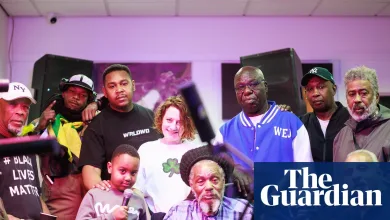
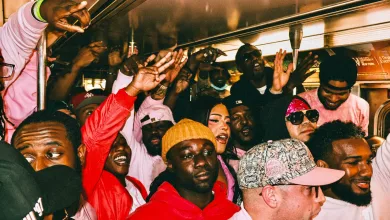
The streets were alive with sonic vibrations: music and protest in Black London – in pictures Source: theguardian.com.
From the vibrant sounds of Notting Hill Carnival to defiant marches against far-right groups, Ian Watts’s photography captures two decades of Black British cultural expression and resistance in London.
Music as a form of resistance
Watts’s images show sound systems rolling through the streets, with crowds dancing under bright lights and loud rhythms.
These events are not just celebrations. They are acts of cultural assertion. In the 1970s and 1980s, many Black communities in London used music to assert visibility and identity in a society that often marginalised them.
One image shows a sound system crew in full regalia, the bassline pulsing through the pavement. The crowd is diverse, but the energy is unified. As one participant told Watts, ‘The music wasn’t just sound — it was a statement. We were here, we were alive, and we were not going to be silenced.’
Protests against racism and exclusion
Throughout the 1970s and 1980s, Black Londoners organised marches against the National Front and other far-right groups.
Watts captured a group of marchers holding signs that read ‘Black Lives Matter’ — a phrase not yet widely used at the time, but conceptually present.
Participants wore traditional African garments and carried banners with messages of solidarity. The marchers moved through streets that had once been hostile to Black presence.
Watts noted in his notes: ‘The streets were not just empty spaces. They were alive with sonic vibrations — the beat of drums, the hum of voices, the pulse of resistance.’
Photography as historical record
Watts’s work is part of a broader tradition of street photography that documents social change. His images are not just artistic — they are historical.
Each photograph reflects a moment when Black communities in London asserted their presence, challenged exclusion, and built cultural institutions.
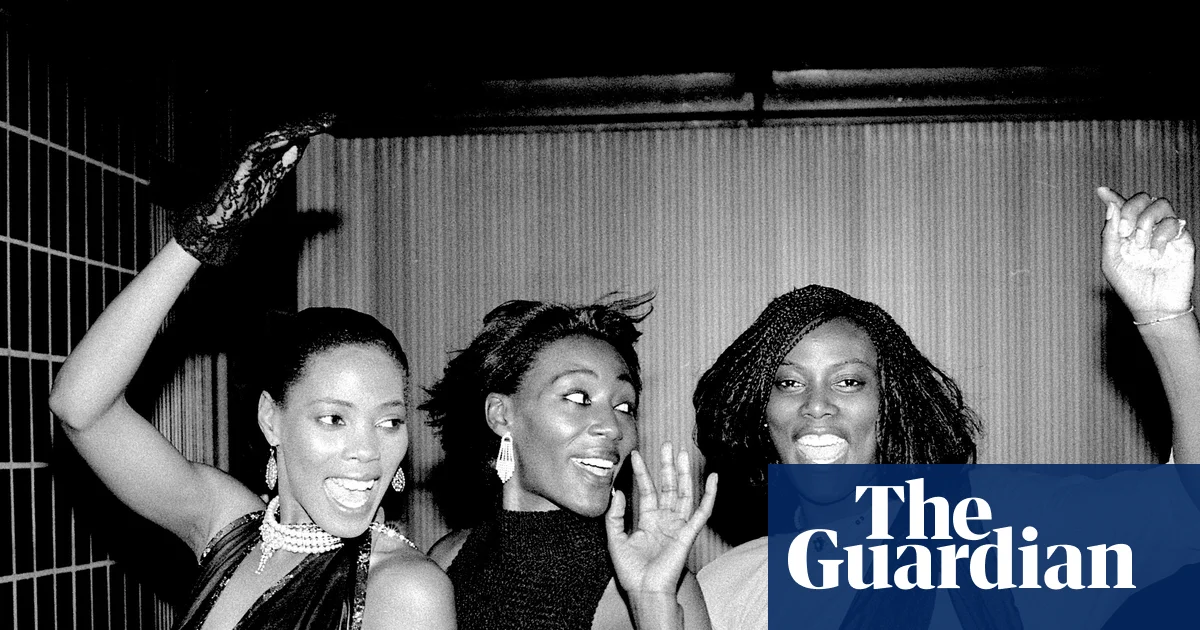
These images show how music and protest are not separate. They are intertwined — one fuels the other. The sound systems are not just entertainment. They are tools of community building and political expression.
Watts’s collection spans from the 1970s to the early 2000s. It includes candid shots of families, street performers, and protest leaders. The photos reveal a deep continuity in Black London life — one shaped by resilience and creativity.
The Guardian’s gallery presents these images in chronological order. It allows viewers to trace how cultural expression evolved in response to social pressures.
For those interested in visual history, Watts’s work is a vital resource. It shows how art and protest have shaped the identity of Black communities in the UK.
Explore more of Watts’s visual journey in Metropolis: More Than Four Decades of Street Photography – In Pictures.
What this means for cultural history
These images are not just about music or protest. They are about visibility. They show how Black communities in London have used cultural forms to resist erasure.
They also reveal how art can serve as a form of documentation — not just of events, but of lived experience.
While the political climate has changed, the core message remains: cultural expression is a form of resistance. And in London, it has been loud, visible, and enduring.
Watts’s photography does not romanticise struggle. It records it — with clarity, dignity, and depth.
It reminds us that history is not just written in books. It is also heard — in the rhythm of a drum, the hum of a crowd, the beat of a sound system rolling down a London street.
Sources & further reading
Featured image: original publisher image. Via original publisher. Image source