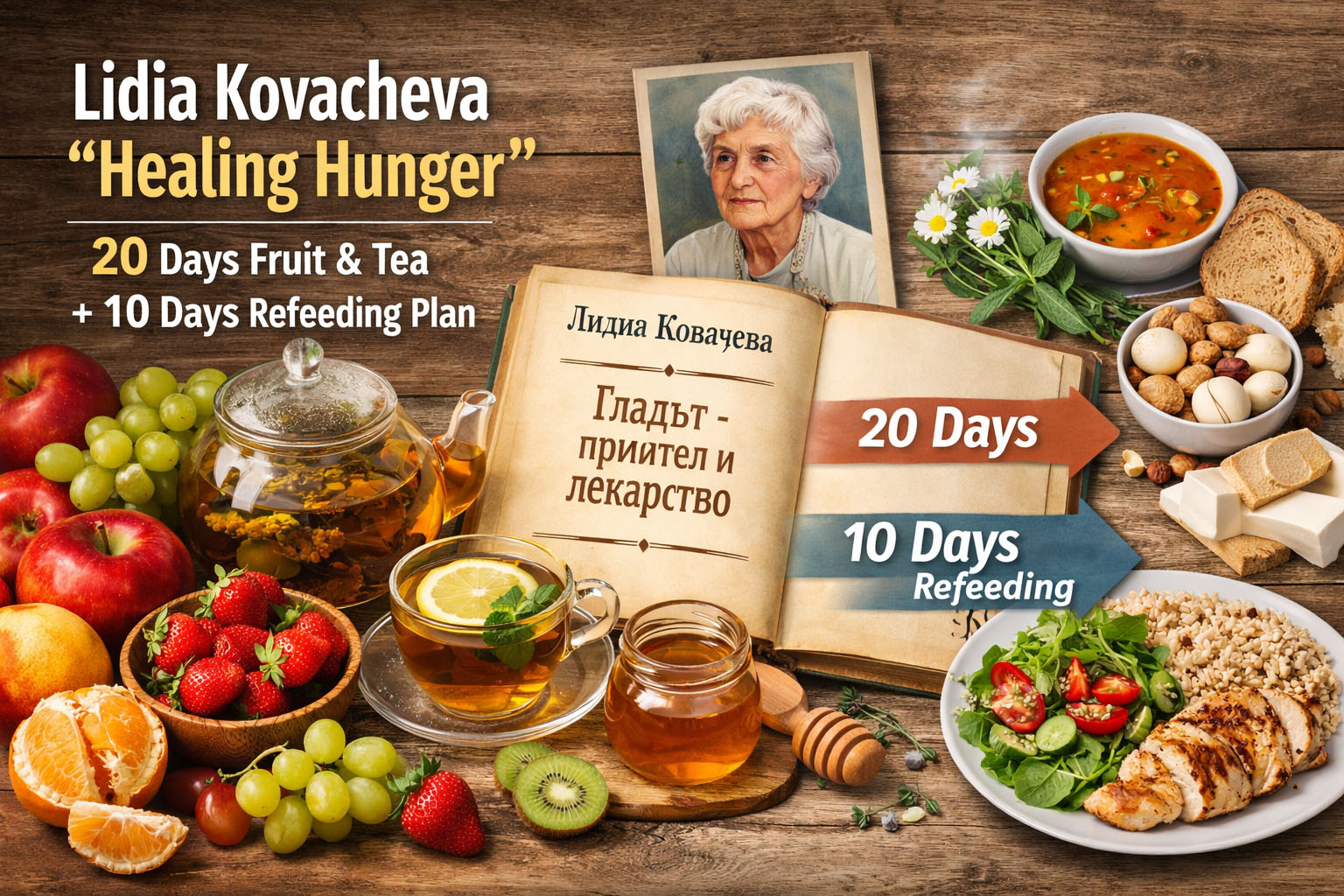
Lidia Kovacheva’s “healing hunger” is widely known in Bulgaria as the fruit-and-herbal-tea unloading regimen (плодово-чаен разтоварителен режим). In practical terms, it is a highly restrictive plan built around herbal tea (optionally with honey/lemon) and up to ~800 g fruit per day, taken separately and alternated throughout the day. Many summaries describe 20 days as the classic “full cycle,” followed by a careful refeeding period (often presented as 10 days) to return to normal eating.
Kovacheva’s approach is discussed in her book Гладът – приятел и лекарство. По стъпките на Хипократ, which frames the regimen as a Bulgarian system influenced by the principle commonly attributed to Hippocrates.
What the protocol is (as commonly described)
Core rules (the “20 days” phase)
- No regular meals during the unloading period.
- Allowed daily intake:
- Herbal tea (many sources suggest at least several cups per day), optionally with a spoon of honey and/or lemon.
- Fruit up to ~800 g total per day.
- Alternate tea and fruit, spacing them ~2 hours apart (do not take fruit and tea together). The rationale given in popular summaries is to reduce the chance of stomach “fermentation.”
A commonly shared day structure looks like:
- Morning: tea (or warm water / tea)
- Mid-morning: fruit
- Midday: tea
- Afternoon: fruit
- Early evening: tea
- Evening: fruit
- Late: tea
Note: Different communities describe the herbal tea blend differently (it may be a single herb or a rotating set). If you want to follow Kovacheva strictly, rely on the book’s guidance or a trusted practitioner familiar with her method.
How to do the 20-day phase in a realistic way
Step 1: Choose your fruit strategy (800 g/day)
Aim for seasonal, easy-to-digest fruit and keep it simple:
- Good practical options: apples, pears, grapes, peaches/nectarines, melon, berries, oranges/mandarins, bananas (portion-controlled).
- If you’re sensitive to acidity, you may prefer less acidic fruit (this is individual).
Portioning tip: 800 g/day can be split into 3–4 fruit “servings” so you don’t end up overeating in one sitting.
Step 2: Build a tea routine you can sustain
- Brew enough herbal tea for the day (thermos helps).
- If using honey/lemon, keep it consistent and moderate (many people add a small spoon of honey).
Step 3: Use an alternating schedule (example)
Here’s an easy pattern (adjust times to your day):
- 08:00 Tea / warm water
- 10:00 Fruit
- 12:00 Tea
- 14:00 Fruit
- 16:00 Tea
- 18:00 Fruit
- 20:00 Tea
The most important part: the 10-day refeeding (“zahranvane”)
Multiple sources that quote or summarize the book strongly emphasize that refeeding is inseparable from the protocol—and that mistakes after fasting are where people can get into trouble.
Below is a clear, day-by-day refeeding structure based on a published excerpt-style outline:
Day 1
- Keep fruit + tea (and honey if used)
- Add raw vegetables, replacing part of the fruit (chew very well; grate/blend tougher veg).
- No heavy dressings.
Day 2
- Keep raw vegetables at lunch/dinner
- Add one boiled potato, mashed and split into two small portions (one with lunch, one with dinner).
Day 3
- Similar structure
- Add simple vegetable additions to the potato base (a very light, oil-free, salt-free vegetable/potato soup style). Portions increase slightly if tolerated.
Day 4
- Move toward four smaller intakes
- Breakfast: tea/water; optional juicy fruit
- Lunch: salad and/or fruit, then light soup; small optional dairy spoon used by some summaries
- Afternoon: fruit/tea
- Dinner: salad + light soup.
Day 5
- Same structure as Day 4
- Increase portions slightly only if you feel comfortable (no heaviness/pain).
- Introduce a little whole-grain bread if tolerated.
Day 6
- Keep four intakes
- Add gentle starch options (examples given include oats/porridge-type foods, bulgur, pumpkin, rice in tomato soup, etc.)
- Small amount of salt may be introduced from around this point in the outline.
Day 7
- Continue four intakes, breakfasts remain light (fruit + tea)
- Add a small amount of fats (e.g., a little oil/olive oil) and small amounts of dairy are sometimes described as optional.
- Nuts may start appearing in small amounts.
Day 8
- Portions can increase if digestion is stable
- Add more nuts (walnuts/hazelnuts/almonds, etc.)
- Dairy (if you use it) may be added in small quantities (cheese/yogurt).
Day 9
- Diet becomes more complete but still moderate
- Add legumes (beans/lentils/peas) and broader vegetables/aromatics (onion/garlic/leek, etc.).
Day 10
- Transition toward 3 meals/day (some people move to 2), keeping breakfast very light
- Key message: don’t return to old overeating patterns immediately.
Common mistakes (that reduce results or increase risk)
- Skipping refeeding or “celebrating” with a big meal immediately after fasting. (Even informal guides warn of vomiting/diarrhea and worse outcomes.)
- Too much too soon: bread, dairy, legumes, oils—these are staged for a reason in the refeeding outline.
- Treating it as a miracle detox. Evidence reviews note limited clinical evidence for detox diets, and professional bodies stress the body already has detoxification systems (liver/kidneys/gut/skin).
Safety and reality-check (important)
This protocol is very low calorie and can be risky depending on your health status, medications, and nutrition needs. UK health guidance notes that very-low-calorie diets are not suitable or safe for everyone and are typically used only in specific clinical contexts.
Do not attempt without medical advice if you:
- have diabetes (especially if using insulin/sulfonylureas or other glucose-lowering meds),
- are pregnant/breastfeeding,
- have a history of eating disorders,
- have kidney/liver disease, gout, heart conditions, or are under 18,
- are frail/underweight or have recent major illness/surgery.
If your goal is general health, remember that mainstream guidance emphasizes balanced intake (for example, the World Health Organization recommends at least 400 g/day of fruits and vegetables as part of a broader healthy diet—not as a replacement for protein, essential fats, and micronutrients).
FAQ (SEO-friendly)
Is the Kovacheva healing hunger the same as water fasting?
No. Most descriptions present it as an “eased” fasting style using herbal tea and a limited amount of fruit (~800 g/day).
Why alternate fruit and tea with 2 hours between?
Popular explanations say it’s to avoid digestive fermentation when combining them closely.
Can I do fewer than 20 days?
Many summaries say people do shorter periods, but the “classic” description often mentions ~20 days plus refeeding.
What matters more: the 20 days or the refeeding?
Most protocols emphasize refeeding as critical—done wrong, it can cause significant digestive distress and undermine any perceived benefits.
Final note
If you want, tell me your age, height, current weight, typical diet, and any health conditions/medications, and I can help you turn this into a safer, food-based “reset” plan that keeps the spirit (lighter eating, structured schedule, more fruit/veg) without the extreme restriction.
Safety note: This is not medical advice. If you’re considering any fasting or very-low-calorie regimen—especially for 20 days—please speak with your GP or a qualified dietitian first (particularly if you have any medical condition or take regular medication).