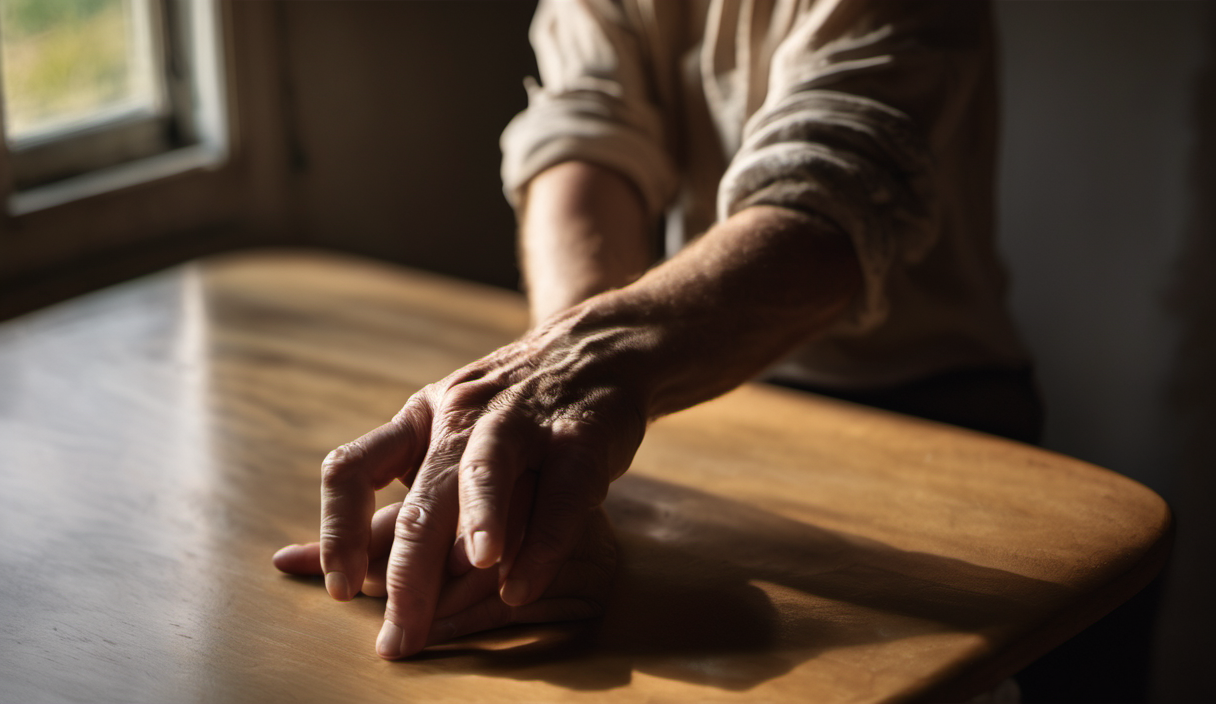
Featured image: The image shows a person's hands resting on a wooden table. AI-generated image; not a photograph of the reported event.
For centuries, scientists and philosophers have struggled to define consciousness. Is it knowing who we are? Being aware of our surroundings? Or something deeper?
Consciousness Begins in the Body
Neuroscientist Antonio Damasio says consciousness does not start in the brain alone. It emerges from a partnership between brain and body.
His research, detailed in Natural Intelligence & the Logic of Consciousness, shows that consciousness is rooted in bodily feelings.
He defines it simply: the process that allows us to know spontaneously that we exist—and that we exist in one body.
Why the Brain Alone Is Not Enough
For decades, many thinkers believed consciousness came from the brain’s highest reasoning centers. Francis Crick, a Nobel laureate, once said consciousness is the most sophisticated operation of the mind.
Damasio argues this view is flawed. He says consciousness actually begins at the body’s base—not at the top of the brain.
He notes that even simple creatures with nervous systems have a sense of their environment. Plants, he says, do not have consciousness—they don’t know they exist.
Consciousness Has a Purpose: To Keep Us Alive
Damasio claims consciousness is not abstract. It has a function: to protect the body and keep us alive.
It does this through homeostatic feelings—like hunger, thirst, pain, and body temperature.
These signals are not random. They are accurate and act as protective sentinels. When you feel pain or thirst, you act. You don’t have to think about it. The feeling happens spontaneously.
How the Body Sends Signals to the Brain
Every square millimeter of skin, muscle, and organ has nerve terminals that monitor its state.
These signals travel through the body to the brainstem and hypothalamus—key areas that regulate life-sustaining functions.
There are millions of these probes. Together, they form a network that constantly checks the body’s health.
Is Consciousness On or Off?
Yes, it can be an on-off switch. During deep sleep, consciousness fades.
Scientists believe sleep is a protective mechanism. The body needs to rest because consciousness is energy-intensive.
But dreaming shows a different kind of consciousness. In dreams, people can feel emotions and remember vivid experiences—though they are not aware of the world around them.
Can We Increase Our Consciousness?
Damasio suggests meditation can sharpen our awareness of bodily signals.
When meditating, people develop a clearer image of their body’s state. This is like focusing a camera on a part of the body—making it more vivid and present.
He sees this as a way to increase consciousness—not by adding more mental power, but by tuning into what the body already sends.
Key Brain Studies from the 1960s
Early brain research proved certain brain regions are essential for consciousness.
But it missed one key point: the deep link between body and brain. Consciousness emerges because we have a body that can die.
Without a body, there is no need for consciousness to protect us from death.
Why This Matters Today
As artificial intelligence grows, questions about what it means to be conscious grow urgent.
If consciousness depends on a body, then AI—no matter how advanced—may not have true consciousness.
This insight shifts how we think about life, awareness, and what it means to be alive.
Source: Greater Good Science Center, UC Berkeley
For more on mindfulness and body awareness, see How Long Should You Meditate?.
For a deeper look at Damasio’s work, read his book Natural Intelligence & the Logic of Consciousness.